
Health is Wealth

Cucumbers are abundant in silica, too, a trace mineral that may actually increase skin elasticity and help keep you looking young.
1 tablespoon rice wine vinegar
1 teaspoon olive oil
1/2 teaspoon toasted sesame oil
1/2 teaspoon soy sauce
Dash cayenne pepper
2 cucumbers, cut into 1/4-inch-thick slices
1/2 bunch chives, minced
1 teaspoon sesame seeds
Makes 2 servings
Calories: 100
Total fat: 4.5 g
Saturated fat: .5 g
Cholesterol: 0 mg
Sodium: 105 mg
Fiber: 3 g
Carbohydrate: 12 g
Sugar: 8 g
Protein: 4 g
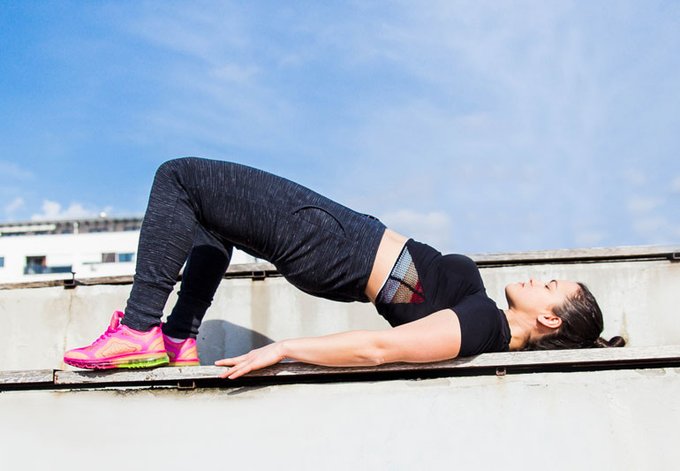
If you’re planning to start an exercise program and wondering where to begin, start with your core first, says physical therapist Brittany Smith, DPT. People often think of the core muscles as being the abdominal muscles, but the core includes the muscles in the abdomen, back and hips, all working together as a group.
“The core muscles provide stability for the entire body as it moves,” says Smith. “These muscles are activated when you stand up, turn, bend, reach, twist, stoop and move in most other ways. Everything starts with your core.”
Strong core muscles help you maintain good posture, while weak ones can lead to slouching and slumping. Poor posture can be a cause of aches and pain, especially in the back.
To get your core muscles in shape, you need to exercise.
“Our bodies were made to move, so any physical activity is really important,” says Smith.
She recommends these specific core-strengthening exercises below.
The first one engages the deep muscles in the abdomen, called the transverse abdominis. “These muscles help hold us in a better position to stabilize our core, thereby stabilizing our arms and legs,” says Smith.
“The more you work on these muscles, the more it will become second nature to hold these muscles tight when you’re lifting grocery bags, doing yard work or any other kind of physical activity,” says Smith. This will help support your body.
Other muscles that tend to be weak are the gluteus maximus in the buttocks, and the gluteus medius and gluteus minimus on the side of the hip. The bridge and clamshell exercises can help strengthen these muscles.
Smith emphasizes that getting the proper position of these exercises correct is more important than the number of repetitions you do. “It’s better to take your time, maybe do fewer reps, but with better quality,” she says. For that reason, it can be helpful to have the guidance of a physical therapist to get started.
Core exercises are the starting point of overall fitness because you need to hold those muscles engaged while you strengthen other muscles, such as the biceps in the arms or the quadriceps in the legs.
Smith suggests setting short-term goals (for about a month) and then more long-term goals. Once you have achieved short-term goals, such as getting around more easily, add other types of weight-training or resistance exercises to build muscle elsewhere.
With any exercise you do, always listen to your body, warns Smith. If you have pain other than muscle burn, take it easy. Reduce the number of repetitions, the weight or the duration of the exercises. Then build up gradually. “You don’t have to be in pain to make gains,” she says.
For each of the following, work up to one to two sets of 10 to 15 repetitions once a day.
Lie on your back with your knees bent and feet flat on the floor. Contract your abdominal muscles, and press the arch of your back down toward the floor, pulling your belly button toward your spine. Hold for 5 to 10 seconds. Make sure your lower back stays flat on the floor. Relax and repeat.

Lie on your back with your knees bent and feet flat on the floor with your arms at your sides. Squeeze your abdominal and buttocks muscles, push your heels into the floor and slowly lift your buttocks and hips off the floor. Keep your back straight. Hold for 5 to 10 seconds.

Lie on your side with knees bent in line with your hips and back, draw up the top knee while keeping contact of your feet together as shown. Don’t let your pelvis roll back during the lifting movement. Hold for 5 seconds.


8h


·
Vitamin C, also known as ascorbic acid, is a powerful micronutrient that plays a key role in keeping your body healthy. Here we’ll explore some myths and truths about this vital micronutrient. #HarvardHealth

Evidence suggests “one or fewer drinks per day” may elevate the risk for cancers.
January 6, 2025
The US Surgeon General has issued an advisory recommending updates to alcoholic beverage labels to include warnings about the risks of cancer.
The document, titled Surgeon General’s Advisory on Alcohol and Cancer Risk, addressed the “direct link” between alcohol consumption and an increased risk of cancer.
According to the advisory, alcohol is the “third leading preventable cause” of cancer in the US, following tobacco use and obesity.
It underscored that alcohol consumption contributed to cancers of the breast, colorectum, oesophagus, liver, mouth, throat, and voice box, regardless of the alcohol type.
Cancer risk increases with alcohol intake, and evidence suggests that even low levels—such as “one or fewer drinks per day” —can elevate the risk for breast, mouth, and throat cancers, according to a statement from the Surgeon General’s office.
Dr Murthy called for revising the Surgeon General’s health warning labels on alcohol-containing beverages to include information about cancer risks.
This advisory also emphasised the need to reevaluate recommended limits for alcohol consumption based on the latest research to account for cancer risks.
Dr Murthy said: “Alcohol is a well-established, preventable cause of cancer responsible for about 100,000 cases of cancer and 20,000 cancer deaths annually in the US – greater than the 13,500 alcohol-associated traffic crash fatalities per year in the US – yet the majority of Americans are unaware of this risk.
“This advisory lays out steps we can all take to increase awareness of alcohol’s cancer risk and minimise harm.”
The release also urged public health professionals and community groups to emphasise alcohol consumption “as a leading modifiable cancer risk factor” and improve education efforts to raise public awareness.
The surgeon general advised people to consider the link between alcohol consumption and increased cancer risk “when deciding whether to drink or how much to have”.
The action comes in response to a 2020 letter addressed to Dr Murthy by the Center for Science in the Public Interest, American Institute for Cancer Research, Consumer Federation of America, and US Alcohol Policy Alliance, urging an update to alcoholic beverage labels to include cancer warnings.
A 2024 World Health Organization (WHO) report noted that around 2.6 million annual deaths are due to alcohol consumption.
In May 2023, Ireland became the “first” country in the European Union to mandate health labelling on alcoholic drinks with the law anticipated to take effect from 22 May 2026.
The Canadian Centre on Substance Use and Addiction (CCSA) issued new guidance in 2023, warning that no level of alcohol consumption is risk-free and recommended a maximum of two drinks per week.