
Warms you up indoor and out #cyclamen 💝💖


Health is Wealth


11/6/2025 by Tamara Soerense
n
Inflammation is a natural process initiated by the immune system in response to illness, trauma, toxins, physical stress and chronic disease. While acute inflammation is protective and allows our bodies to heal, it can become harmful if it persists, leading to chronic inflammation. Chronic inflammation, in turn, can lead to conditions such as arthritis, heart disease, and diabetes.
Several foods can contribute to inflammation. These include highly processed foods, refined carbohydrates, or foods high in added sugars. Conversely, other foods can help calm the immune system, decreasing inflammation.
Let’s explore which foods help lower inflammation and how they can be incorporated into an anti-inflammatory diet.
What change can you make today to shift your body into a less inflamed state?
Consider adding one colorful fruit or vegetable to your diet each day. Suggestions include tomatoes, oranges, yellow bell peppers, arugula, blueberries, pumpkin and broccoli.
Tamara Soerensen completed her bachelor’s degree in biology at the University of California, Santa Barbara and her master’s in nutrition at Bastyr University. She is currently a dietetic intern at Mayo Clinic in Rochester, Minnesota. Special interests include digestive health and the utilization of diet for disease prevention.
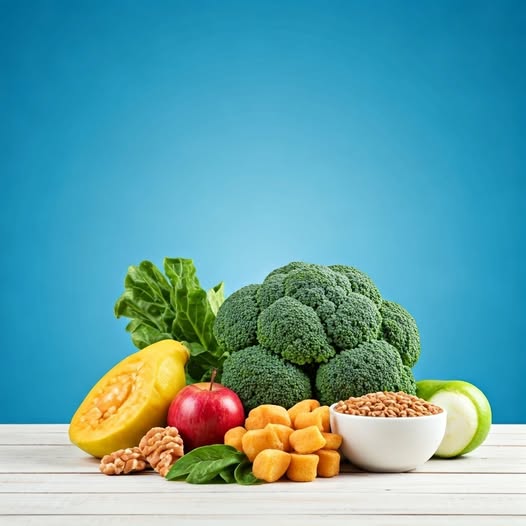
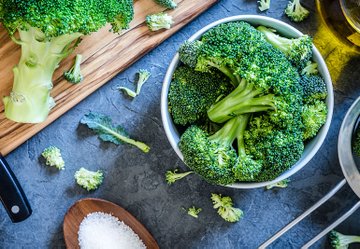
“Eat your broccoli,” may be a familiar refrain from your childhood. Maybe you didn’t love broccoli as a kid, but your parents were onto something. The “little trees” are full of fiber, folate, vitamins and more.
Broccoli is a member of the Brassica genus of plants, also known as the cabbage family. Broccoli’s relatives include Brussels sprouts, cabbage, cauliflower, chard and watercress. Many Brassicas have strong flavors and mix well with meats and other vegetables.
“A pile of steamed broccoli doesn’t appeal to everyone,” recognizes registered dietitian Beth Czerwony, RD, LD. “But broccoli is incredibly versatile and can be used in so many different dishes. Toss it in with your stir fry, chop it fresh in a salad or roast it with your baby potatoes. And with an abundance of nutrients, there are many benefits of eating broccoli.”
A cup of chopped raw broccoli has approximately:
In addition, a cup of raw broccoli offers:
Source: U.S. Department of Agriculture
It’s worth finding ways to add broccoli to your diet because it’s a health-boosting dynamo. Here’s some motivation for you to get your green on: Some of the beneficial substances in broccoli are somewhat unique to the Brassica family of vegetables. Broccoli provides nutrients that may:
As a superfood status, broccoli can improve your health with these five components:
“Broccoli offers some powerful molecules that protect your cells from damage,” says Czerwony. “Some of them even destroy cancer cells.”
Cancer-fighting molecules in broccoli include DIM, indole-3-carbinol and sulforaphane. According to studies, they may help:
These anticancer molecules are in several of broccoli’s cruciferous veggie relatives, too. These nutrients don’t survive cooking or freezing. So, to get the benefits, raw broccoli is best.
“Some of these compounds are even more concentrated in broccoli sprouts,” notes Czerwony. “You can find broccoli sprouts in health food stores and many grocery stores. Sprouts are also easy to grow at home using a sprouting kit.”
Both human and lab studies suggest compounds in broccoli may help lower blood sugar in people with Type 2 diabetes. This effect may be due to the antioxidants in broccoli, like vitamin C.
Research shows that fiber can also help with blood sugar management. At 2.5 grams of fiber per cup, broccoli is a good source of this nutrient.
In a nonhuman study, researchers found that broccoli can help protect the lining of your small intestine. Compounds found in broccoli, called aryl hydrocarbon receptor ligands, help keep small intestine cells working well.
Why do those cells matter so much? When your small intestine lining is healthy, it only allows water and nutrients to pass through it into your bloodstream.
But when the cells of the lining are damaged, undigested food particles, bacteria and other disease-causing particles may pass through. A damaged small intestine lining can lead to infections and inflammation. It can also prevent you from absorbing the nutrients you need.
Vitamin C is well-studied as an immune-boosting nutrient. When you don’t have enough vitamin C, you’re more likely to get infections.
The antioxidant effects of vitamin C also help your body keep free radicals under control. “Free radical damage is linked to all kinds of problems, including Alzheimer’s disease, autoimmune diseases, cancer, heart disease and Parkinson’s disease,” says Czerwony. When you don’t have enough antioxidants to neutralize free radicals, they damage your cells.
Surprising but true: Broccoli has more vitamin C than oranges. In 1 cup of the green cruciferous veggie, you get a whopping 81 milligrams of vitamin C. That’s 90% of the daily U.S. recommended dietary allowance (RDA) for adults. (An orange has about 70 milligrams.)
Research suggests certain bioactive compounds in broccoli may boost your heart health in a variety of ways. It may:
“If you want those anticancer compounds like sulforaphane, choose fresh broccoli,” advises Czerwony. Freezing inactivates sulforaphane.
“Frozen broccoli also loses a bit of its vitamin content. But overall, frozen broccoli is still very healthy. It’s better than not eating any broccoli because you still get a lot of the health benefits,” she continues.
Need some broccoli-inspired meals? Try these easy recipes:


Want to tone your midsection? You can start by standing up to do ab exercises.
Surprised? That’s understandable. After all, most of us think of a few classic on-the-floor exercises when it comes to strengthening our abdominals. Crunches and sit-ups, for instance. Planks, too.
But it turns out, you can get a deeper and more thorough core workout while on your feet, says exercise physiologist Katie Lawton, MEd. Here’s how.
The pursuit of “six-pack abs” explains the devotion to crunches and similar floor exercises. “You completely isolate the rectus abdominis muscles when you lie down and do that motion,” says Lawton. “It’s very targeted.”
That’s great for creating washboard abs. But it doesn’t do much to enhance other muscles in your middle that play an important role in day-to-day movements.
Standing ab exercises, on the other hand, engage a network of muscles within your core that you use all the time, whether it’s picking laundry up off the floor or putting cans on the top shelf in the pantry.
“Think of your core as a chain of muscles that needs to work together to get the job done,” illustrates Lawton. “When you do an ab workout from a standing position, you’re working more of the muscles in that system.”
Strengthening your core can help you:
Incorporate these exercises in a standing abs workout to see those benefits.
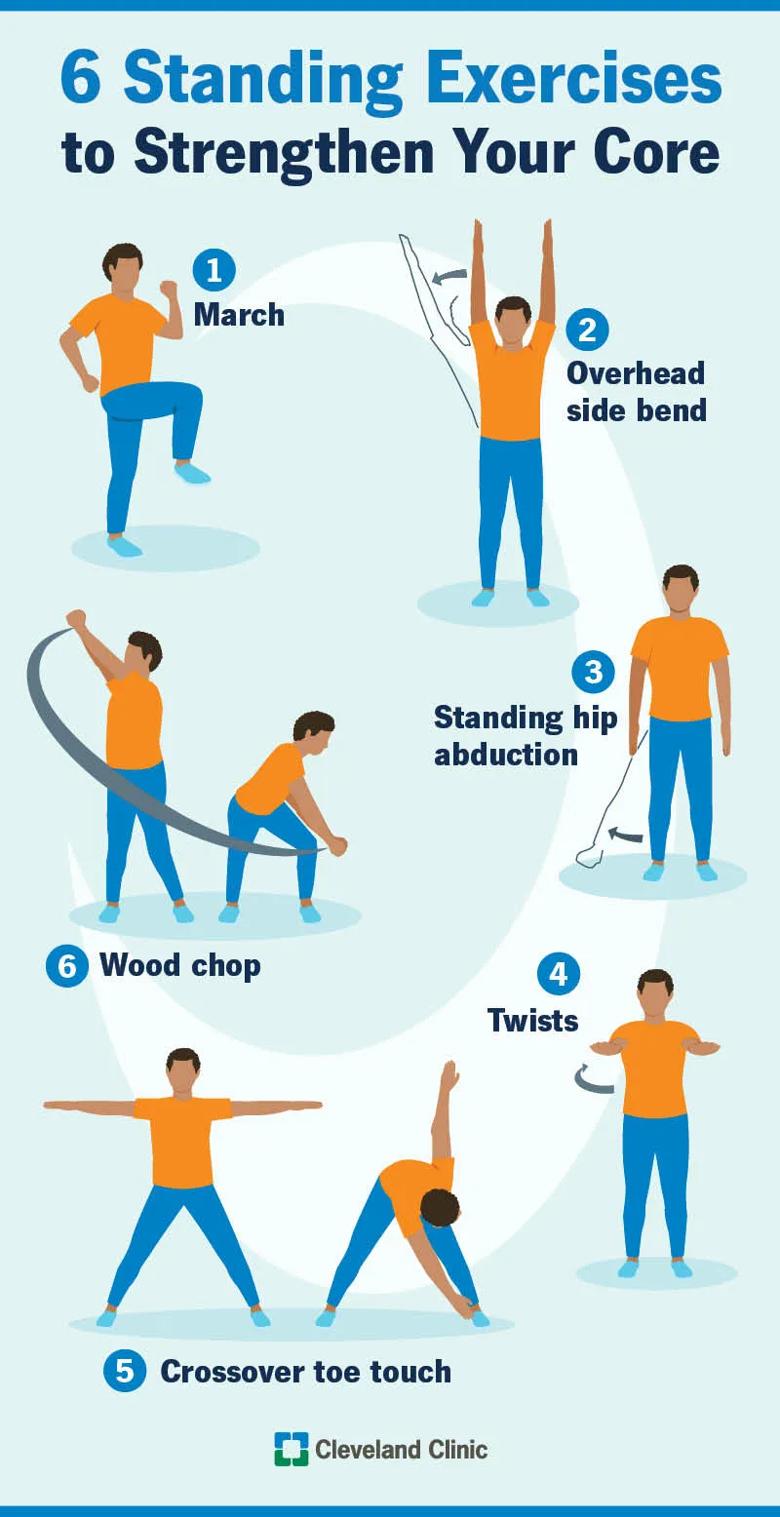
Muscles targeted: Rectus abdominis, transverse abdominis, erector spinae and hip flexors
Pro tip: Want to make the march more challenging? Then add a “twist” to your motion by moving your right knee toward your left side when you raise it. (Your left knee would go toward your right side.)
Muscles targeted: External and internal obliques, quadratus lumborum, deltoids and erector spinae
Pro tip: “As you bend to each side, focus on engaging your core muscles to work them properly,” advises Lawton. “You’re just going to the side, too. Your torso shouldn’t lean forward at all.”
Muscles targeted: Rectus abdominis, transverse abdominis, erector spinae, glutes and hamstrings
Pro tip: Use a chair to steady yourself if balance is an issue. “You always want to make sure these exercises are done in the safest way possible,” emphasizes Lawton.
Muscles targeted: Internal and external obliques, rectus abdominis, transverse abdominis and erector spinae
Pro tip: Twists should be done in a slow and controlled manner. “You don’t want to be whipping back and forth,” cautions Lawton.
Muscles targeted: Internal and external obliques, rectus abdominis, transverse abdominis, erector spinae, hamstrings and glutes
Pro tip: Skip this exercise if you sometimes get lightheaded when raising your head and up and down.
Muscles targeted: Internal and external obliques, rectus abdominis, transverse abdominis, erector spinae, deltoids and latissimus dorsi
Pro tip: Tailor these exercises to your range of motion. “Move the best you can within the parameters you have,” advises Lawton. “When you start to feel that tension in your muscles, stop there. If it hurts, you’ve gone too far.”
The simplicity of standing ab exercises just … well, stands out. That’s because the exercises build on natural movements that we do all the time. “That’s a big reason why they’re so effective,” says Lawton.
It’s important to safely progress these exercises as they become easier. Resistance bands, cable machines, medicine balls or free weights are all tools that can help you increase the intensity of the movements.
Dedicating a few minutes a day to these exercises can help you build core strength that supports everything you do, from walking the dog to lifting groceries.
“Standing ab exercises really don’t take a lot of time,” emphasizes Lawton.
Plus, you won’t need to find your floor mat to do them.
Learn more about our editorial process.


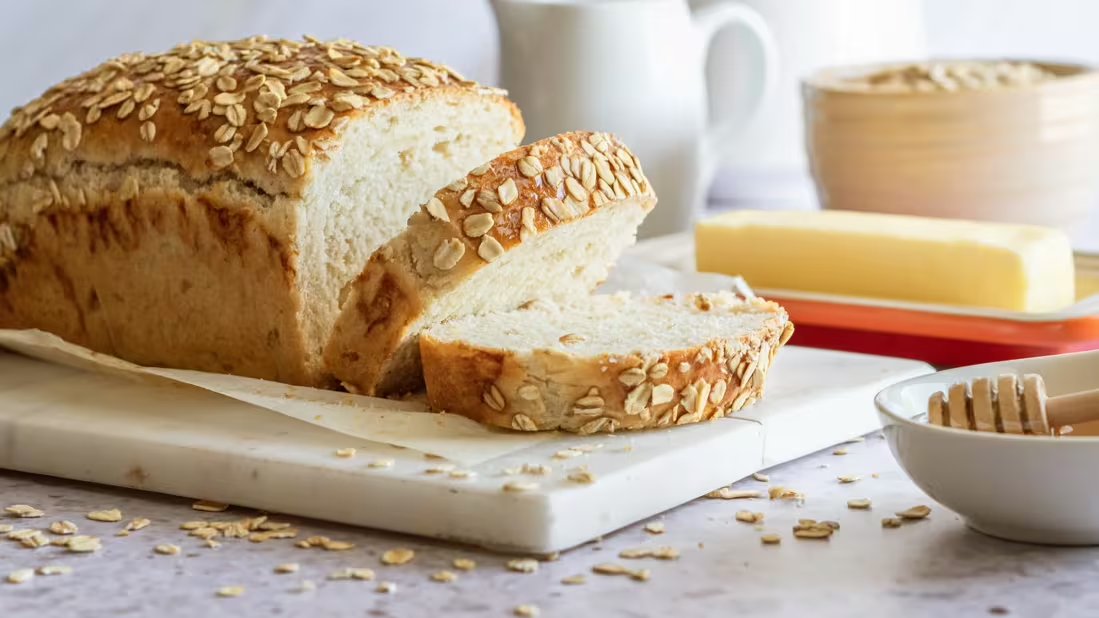
A homemade loaf that’s sure to impress and please
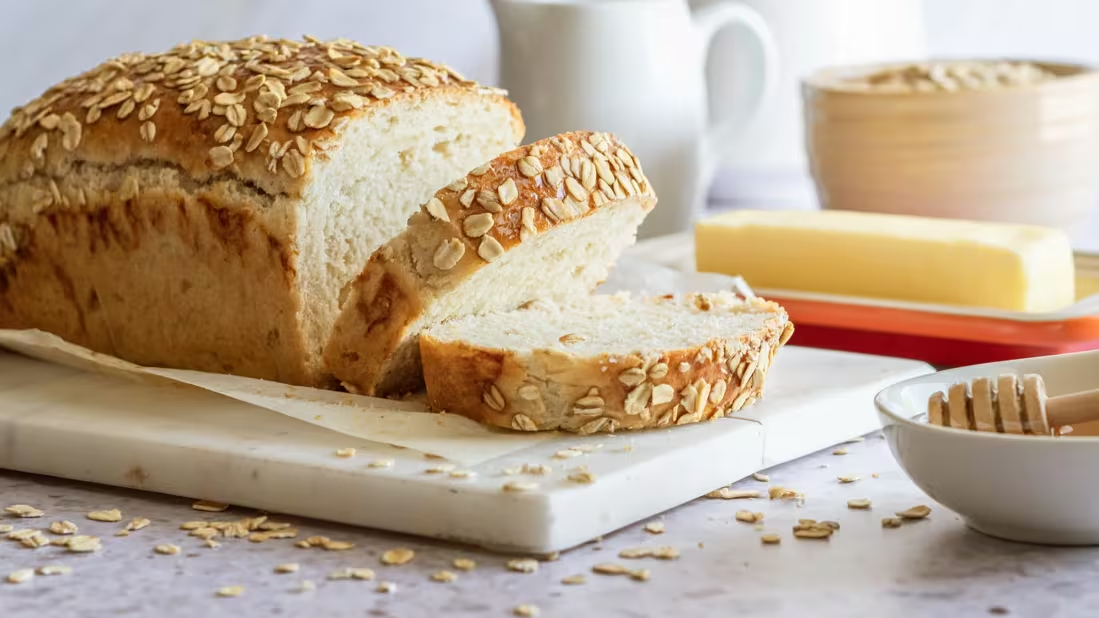
Whether you prefer to knead and bake it in the oven or use your bread machine, this recipe will be a family favorite. Oats and honey add flavor to traditional bread, giving it an extra kick your family will love. The quick oats are healthy and add texture, and the slight honey-sweet taste is sure to please!
Serving = 2 slices
Each loaf makes about 16 slices
Calories: 100
Protein: 2.2 g
Carbohydrates: 16 g
Fat: 2.2 g (0.7 g saturated fat)
Calcium: 6 mg
Want to tone your midsection? You can start by standing up to do ab exercises.
Surprised? That’s understandable. After all, most of us think of a few classic on-the-floor exercises when it comes to strengthening our abdominals. Crunches and sit-ups, for instance. Planks, too.
But it turns out, you can get a deeper and more thorough core workout while on your feet, says exercise physiologist Katie Lawton, MEd. Here’s how.
The pursuit of “six-pack abs” explains the devotion to crunches and similar floor exercises. “You completely isolate the rectus abdominis muscles when you lie down and do that motion,” says Lawton. “It’s very targeted.”
That’s great for creating washboard abs. But it doesn’t do much to enhance other muscles in your middle that play an important role in day-to-day movements.
Standing ab exercises, on the other hand, engage a network of muscles within your core that you use all the time, whether it’s picking laundry up off the floor or putting cans on the top shelf in the pantry.
“Think of your core as a chain of muscles that needs to work together to get the job done,” illustrates Lawton. “When you do an ab workout from a standing position, you’re working more of the muscles in that system.”
Strengthening your core can help you:
Incorporate these exercises in a standing abs workout to see those benefits.
Muscles targeted: Rectus abdominis, transverse abdominis, erector spinae and hip flexors
Pro tip: Want to make the march more challenging? Then add a “twist” to your motion by moving your right knee toward your left side when you raise it. (Your left knee would go toward your right side.)
Muscles targeted: External and internal obliques, quadratus lumborum, deltoids and erector spinae
Pro tip: “As you bend to each side, focus on engaging your core muscles to work them properly,” advises Lawton. “You’re just going to the side, too. Your torso shouldn’t lean forward at all.”
Muscles targeted: Rectus abdominis, transverse abdominis, erector spinae, glutes and hamstrings
Pro tip: Use a chair to steady yourself if balance is an issue. “You always want to make sure these exercises are done in the safest way possible,” emphasizes Lawton.
Muscles targeted: Internal and external obliques, rectus abdominis, transverse abdominis and erector spinae
Pro tip: Twists should be done in a slow and controlled manner. “You don’t want to be whipping back and forth,” cautions Lawton.
Muscles targeted: Internal and external obliques, rectus abdominis, transverse abdominis, erector spinae, hamstrings and glutes
Pro tip: Skip this exercise if you sometimes get lightheaded when raising your head and up and down.
Muscles targeted: Internal and external obliques, rectus abdominis, transverse abdominis, erector spinae, deltoids and latissimus dorsi
Pro tip: Tailor these exercises to your range of motion. “Move the best you can within the parameters you have,” advises Lawton. “When you start to feel that tension in your muscles, stop there. If it hurts, you’ve gone too far.”
The simplicity of standing ab exercises just … well, stands out. That’s because the exercises build on natural movements that we do all the time. “That’s a big reason why they’re so effective,” says Lawton.
It’s important to safely progress these exercises as they become easier. Resistance bands, cable machines, medicine balls or free weights are all tools that can help you increase the intensity of the movements.
Dedicating a few minutes a day to these exercises can help you build core strength that supports everything you do, from walking the dog to lifting groceries.
“Standing ab exercises really don’t take a lot of time,” emphasizes Lawton.
Plus, you won’t need to find your floor mat to do them.
Learn more about our editorial process.

By Audrey Noble
January 13, 2026
Cabbage often—and unfairly—gets overlooked, with flashier veggies and protein-dense superfoods getting all the attention. But as far as nutritional food options go, the leafy green is pretty hard to beat. A staple in different cuisines (American coleslaw! Middle Eastern malfouf! Chinese suan la bai cai!), cabbage has been a longtime favorite amongst global chefs.
“Much of this stems from its versatility,” Woldy Reyes, chef and author of the cookbook In the Kusina: My Seasonal Filipino Cooking, tells Vogue. “We are seeing a growing trend of chefs utilizing it as a centerpiece, such as cabbage steaks, rather than as a side dish. The culinary appeal has never been stronger.”
“Its popularity stems from its ability to transform,” adds Tatiana Mora, chef of plant-based Michelin star restaurant Mita. “It can be eaten raw, fermented, steamed, roasted, or sautéed, consistently providing flavor, texture, and nutrition. I love it because it is a noble vegetable that grows easily, keeps well, and can be used almost entirely, making it perfect for a conscious and respectful approach to cooking.”
It’s accessible, easy to cook, and delicious. Here are all the reasons cabbage deserves a seat at your table (get it?) in 2026.
Cabbage is a leafy green that is part of the brassica plant family (which also includes broccoli, cauliflower, brussels sprouts, and kale), says Amy Shapiro, RD, registered dietitian and founder of Real Nutrition. It comes in several varieties, but the most common ones you’ll see are green, red (or purple), and savoy. What makes cabbage different from other leafy greens is its density and durability. “It’s heartier, stores longer, and holds up well to cooking, fermenting, and shredding,” Shapiro says. “Nutritionally, it shares many benefits with other cruciferous vegetables, but it’s often milder in flavor and more versatile across cuisines.”
Besides its versatility, one of the main benefits of cabbage is its many nutrients. Shapiro lists other main benefits of the leafy green:
Supports Gut Health
Shapiro says that, because cabbage contains fiber and other compounds that support digestion, eating this leafy green can benefit the gut bacteria and boost gut health.
Anti-Inflammatory Properties
Cabbage is also rich in antioxidants and phytonutrients that studies have shown can reduce inflammation, she says.
Boosts Heart Health
Along with fiber, cabbage has potassium, which supports healthy cholesterol levels and blood pressure. Cabbage also has vitamin K, which is essential for blood clotting (and bone health). Shapiro points to red cabbage in particular, which she says contains antioxidants called anthocyanins that studies have shown can improve brain and heart health.
Regulates Blood Sugar
Cabbage is low in calories and carbs while being high in fiber, which can help stabilize glucose levels in the body.
Boosts Immune System
Shapiro says that cabbage is rich in sulfur-containing compounds to help strengthen your immune system’s defences—and vitamin C, which studies have shown can provide antioxidant protection and support immune health.

 Healthaware