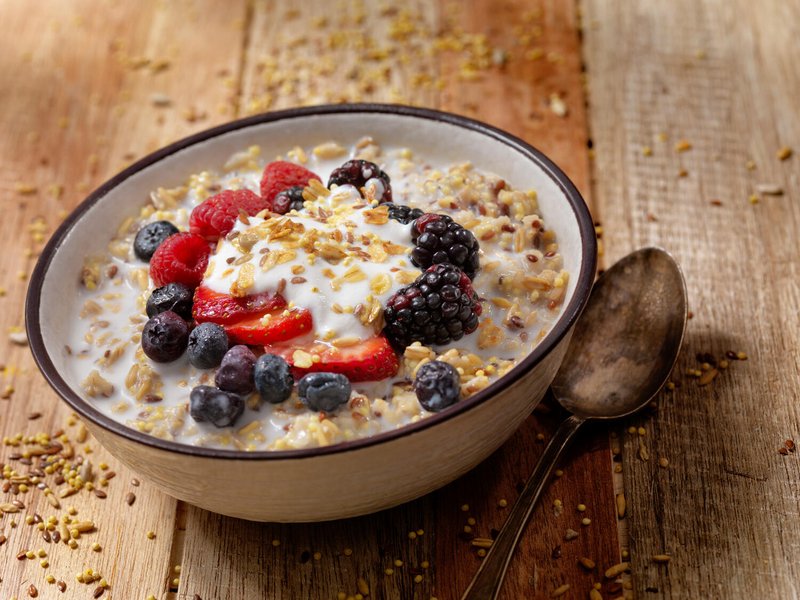
Start your day with a hearty and nutritious 6-grain hot cereal that will keep you energized and satisfied. Prepare a big batch over the weekend and enjoy a warm, comforting breakfast all week long. Top it with your favorite fruits or a dollop of yogurt for added natural sweetness.
Servings: 14 Serving Size: ½ cup
Nutritional Information Per Serving
114 calories
1 g total fat
0 g saturated fat
0 g transfat
0 g monounsaturated fat
0 mg cholesterol
74 mg sodium
21 g total carbohydrate
3 g dietary fiber
0 g total sugars
4 g protein
Ingredients
½ cup uncooked pearl barley
½ cup uncooked red wheat berries
½ cup uncooked brown rice
¼ cup uncooked steel cut oats
3 tablespoons uncooked quinoa
2 tablespoons of flaxseed
½ teaspoon kosher salt
1 ½ quarts water
Directions
In a large saucepan, combine the barley, wheat berries, rice, oats, quinoa, flaxseed and salt.
Pour water over ingredients, stir and bring to a boil over medium heat.
Reduce heat to low and simmer for 45 minutes, stirring occasionally.
Dietitian’s tip:
Make a big batch of this cereal on the weekend and reheat all week. Top with fruit or yogurt to add natural sweetness.
How Long To Breastfeed: What the Guidelines Say and What To Consider
Recommendations encourage breast milk exclusively for baby’s first six months and continuing to provide human milk until age 2 and beyond
How and what you feed your baby is probably one of the most basic — and yet deeply personal — decisions you’ll face when you become a parent.
You’ll hear things like “breast is best.” As in, breastfeeding (chestfeeding) is the absolute best way to nourish your baby.
And then you’ll hear the retort, “fed is best.” Meaning breast milk (human milk) and formula are both fine. As long as your baby is getting nutrients in their belly, all is well.
Then come the opinions on how long you should breastfeed. (You’re still breastfeeding? You gave up on nursing already? You fed your baby formula?)
It can feel like there’s no right way to do it. And there’s some truth to that.
Because what works for one family may not be feasible for another. But that’s OK.
Breast milk can provide certain benefits that formula can’t mimic. But breastfeeding, especially for long periods of time, might not work for everyone. Or you may have been given the impression that you’ve continued providing human milk long after others think you “should.”
No one should feel guilt, shame or otherwise crummy about how they feed their baby. Let’s face it, mom guilt is tough enough as it is.
So, we talked with board-certified breastfeeding medicine physician Heidi Szugye, DO, about breastfeeding recommendations.
How long to breastfeed
Science shows that if you can give your baby human milk (either your own or a donor’s), it has its benefits. And the longer, the better, experts recommend.
12 months to 24 months (and beyond): Mostly solid foods with some human milk, as mutually desired by parent and child.
Previous recommendations called for providing breast milk until age 1. But these newer guidelines (implemented in 2022) are based on the understanding that human milk has benefits that continue long after baby’s first birthday. And they help to remove stigmas associated with people who choose to extend breastfeeding into toddlerhood.
“These recommendations are a call to action for everyone, and that includes hospitals, pediatricians and all physicians that are taking care of families,” Dr. Szugye states. “We want to make sure our practices and policies are set up to support people who choose to breastfeed beyond the first year of their child’s life.”
Think of the guidelines as the best-case scenario. If it works for you, your family, your child, your body and your life to breastfeed for two years or longer, you’re doing a great thing. And there’s no reason to stop until you and your child are ready.
If it doesn’t work for you, that’s OK, too. Your worth as a parent and your love for your child can’t be measured in ounces of milk.
Benefits of extended breastfeeding
The recommendations are based on research showing that human milk has some big benefits. And those perks continue for as long as you continue to supply it.
“Breastfeeding offers tremendous benefits — from custom-made nutrition and increased immunity to protecting you against some forms of cancer. And those benefits don’t go away as your baby ages,” Dr. Szugye shares. “We have more and more data supporting that there are benefits to breastfeeding for more than one year when possible.”
Breastfeeding can offer both you and your baby some big benefits:
Benefits for lactating parents
Benefits for baby
Lower risk of developing conditions like Type 2 diabetes, high blood pressure, cardiovascular disease, breast cancer and ovarian cancer.
Decreased risk for ear infections, respiratory infections, gastrointestinal illnesses, SIDS, leukemia, diabetes, obesity, asthma and eczema.
“There are a lot of immunologic factors and components to human milk,” Dr. Szugye says. “One big advantage to human milk is that you pass antibodies to the baby. So, if you’re exposed to a respiratory illness or GI illness, those antibodies are passed on to the baby and then that makes them less likely to get sick. And if they do get sick, it’s less severe. It’s almost like a built-in immunity.”
Keeping up milk supply for the long haul
Some people can make enough milk to breastfeed for as long as they and their babies choose. But some don’t. At least not without taking some steps to keep it up.
If you suspect your supply is dwindling as your child gets older, there are ways to help promote more milk production if you want.
“Many people notice their supply drop and mistakenly assume it won’t return,” Dr. Szugye notes. “But if you want to continue to breastfeed, there are options that could help.”
If a supply boost is in order, you can try:
Nursing more often — Add sessions as long as your child will nurse. If you’re away from them during the day, try early evenings, mornings or weekends.
Pumping strategies — An extra session or several short “power pumping” sessions (think five to 10 minutes throughout the day) for several days in a row can trigger your body to make more milk.
Breast massage and compression — Easy-to-learn techniques can improve drainage when nursing or pumping.
Take care of yourself — Reduce stress, rest when possible, hydrate and eat a balanced diet with an extra 500 calories a day to support breastfeeding.
Not an ‘all-or-nothing’
If two or more years of breastfeeding seems daunting, remember that you have options.
For starters, giving your child human milk doesn’t always mean latching them to your breast and nursing. That’s just one way to do it. Pumping milk and putting it in a bottle, cup or spoon are also options.
And you may find that a donor bank could be a route to explore if you don’t lactate or if you have concerns about a low milk supply. Donor milk is pasteurized, screened for drugs, medications and infections, and tested for bacterial contamination before it’s stored and made available for purchase.
“Reach out to your pediatrician or women’s healthcare provider if you’re interested in obtaining donor milk. You may need a prescription from a healthcare provider,” Dr. Szugye suggests.
Remember, too, that any amount of human milk can be a benefit. If keeping up with your baby’s breastfeeding demands becomes too high a burden, there are alternatives.
Some parents may find that supplementing with formula (or other foods and milk after baby turns 1) can help give your child some human milk, while keeping up with their nutritional needs — and not burning yourself out in the process.
“It’s not an all-or-nothing thing,” Dr. Szugye reassures. “Any amount of human milk you can give is a benefit. If it doesn’t work for you to constantly supply human milk, that’s OK. We’re all just doing our best.”
If breastfeeding is going well for both you and your child, there’s no reason to give it up until you’re both ready to.
Feeding a baby is tough work, no matter how you do it. And chances are, you’re doing a fantastic job.
Yoga has a lot going for it. It can help you tune in to your breath, relieve stress, and improve your balance and flexibility. It can also help tone your muscles — including your core.
“Understanding how to activate your core and utilize your core muscles is central to the physical practice of yoga,” says yoga instructor Valerie Williams, E-RYT 500.
Williams shares ways that yoga can help strengthen your core muscles and guides us through five poses that target your midsection.
Yoga poses to strengthen your core
Just about any yoga pose that challenges you can help strengthen your core. But some can be particularly helpful for targeting those muscles.
Start by holding each of the following poses for about two to three breaths at first. As they become easier, challenge yourself by holding them longer.
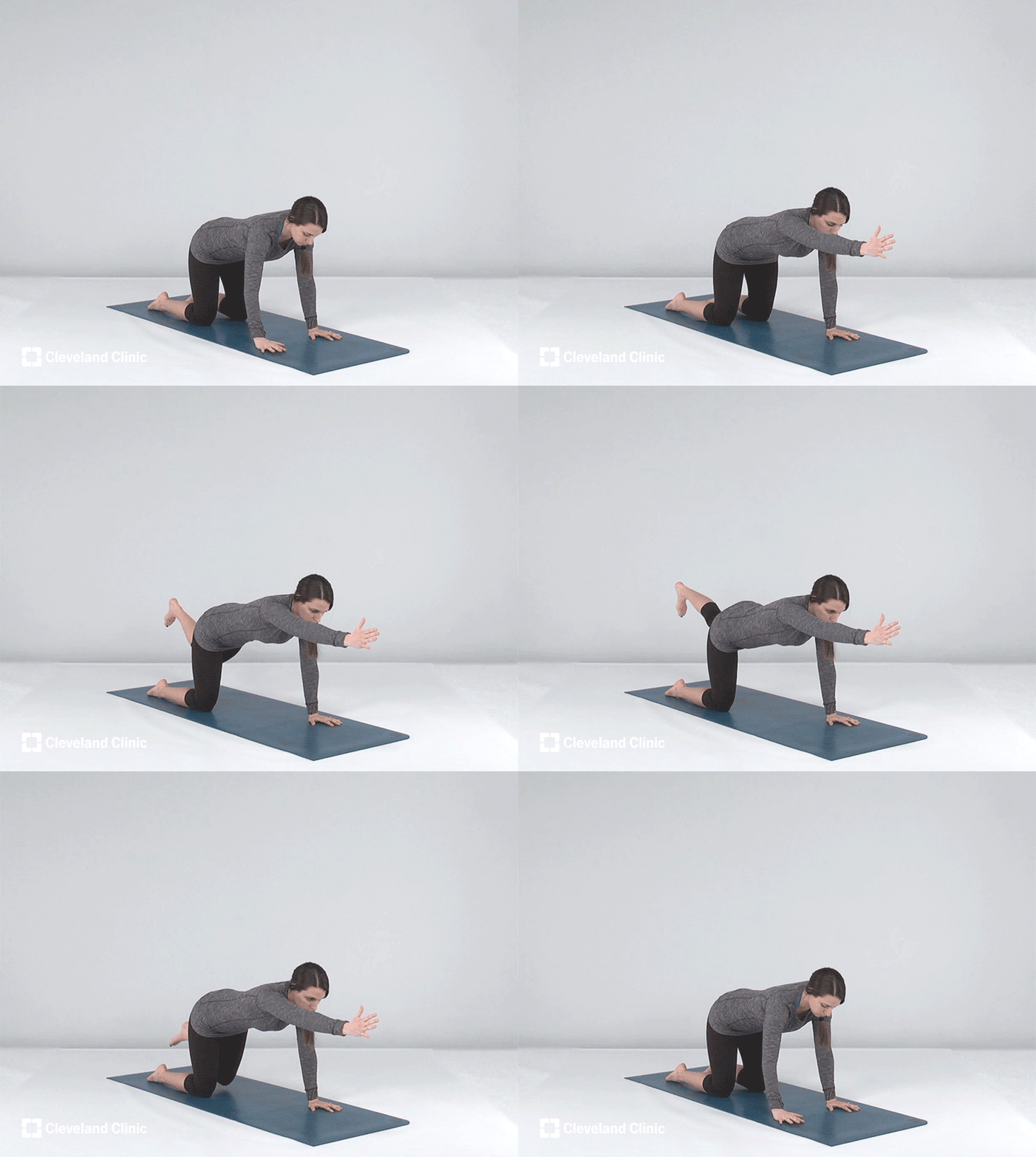
1. Tabletop balance
This pose can help strengthen your core and lengthen your spine, but it may not be right for you if you have chronic knee problems or difficulty with mobility in your arms or shoulders.
Start on your hands and knees.
Engage your core by pulling your belly muscles inward and keeping your lower back flat.
Reach forward with your right arm. Keep your chin tucked.
Lift your left knee and straighten it behind you. Keep your hips level and toes pointed downward.
Return your hand and knee to the floor.
Repeat on the other side.
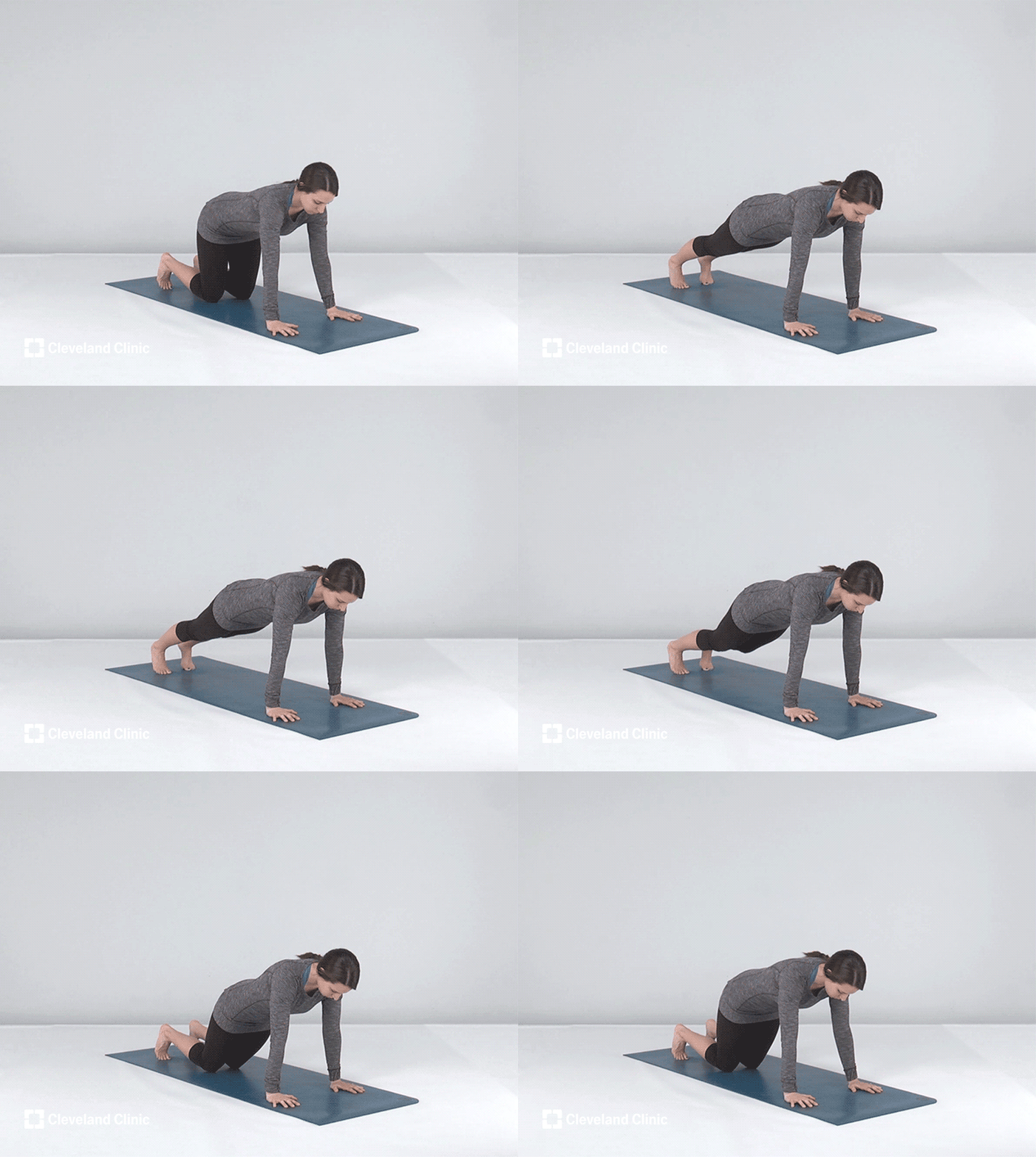
2. Plank
This simple pose can help develop strength in your upper body, forearms, wrists and front abdominal muscles.
Start on your hands and knees.
Lift your hips and straighten your legs out behind you, like you’re about to do a push-up.
Engage your core by pulling your belly button upward.
Pull your shoulder blades together and squeeze your front thigh muscles.
Keep your body in a straight line from the crown of your head through your heels.
Variation: Drop to your knees to lighten the load.
3. Side plank
Side planks can help improve your balance and work your core without putting too much pressure on your back.
Start in a plank position.
Plant your left hand on the floor as you turn your body and raise your right arm above you.
Balance on the outside of your left foot, with your right foot on top.
Make a straight line from your left palm, through your shoulders and all the way to the tips of the fingers on your right hand. Keep your hips stacked on top of each other with your bottom hip lifted away from the mat.
Repeat on the other side.
Variation: To make this pose easier, bring your bottom knee to the floor.
4. Boat pose
This pose can be challenging at first. But it can give your core a good workout.
Start in a seated position, with your knees bent.
Lean back about 45 degrees and place your hands, palms down, on the mat behind you, bending your arms slightly.
Lift your feet off the floor and hold your shins parallel to the mat. Balance on your sit bones (butt).
Pull your belly muscles inward. Keep your chest lifted and your back straight. Point your toes up.
Variation: For an added challenge, extend your arms in front of you, parallel to the mat, or straighten both knees. At its most challenging, your body will take the shape of the letter ‘V.’
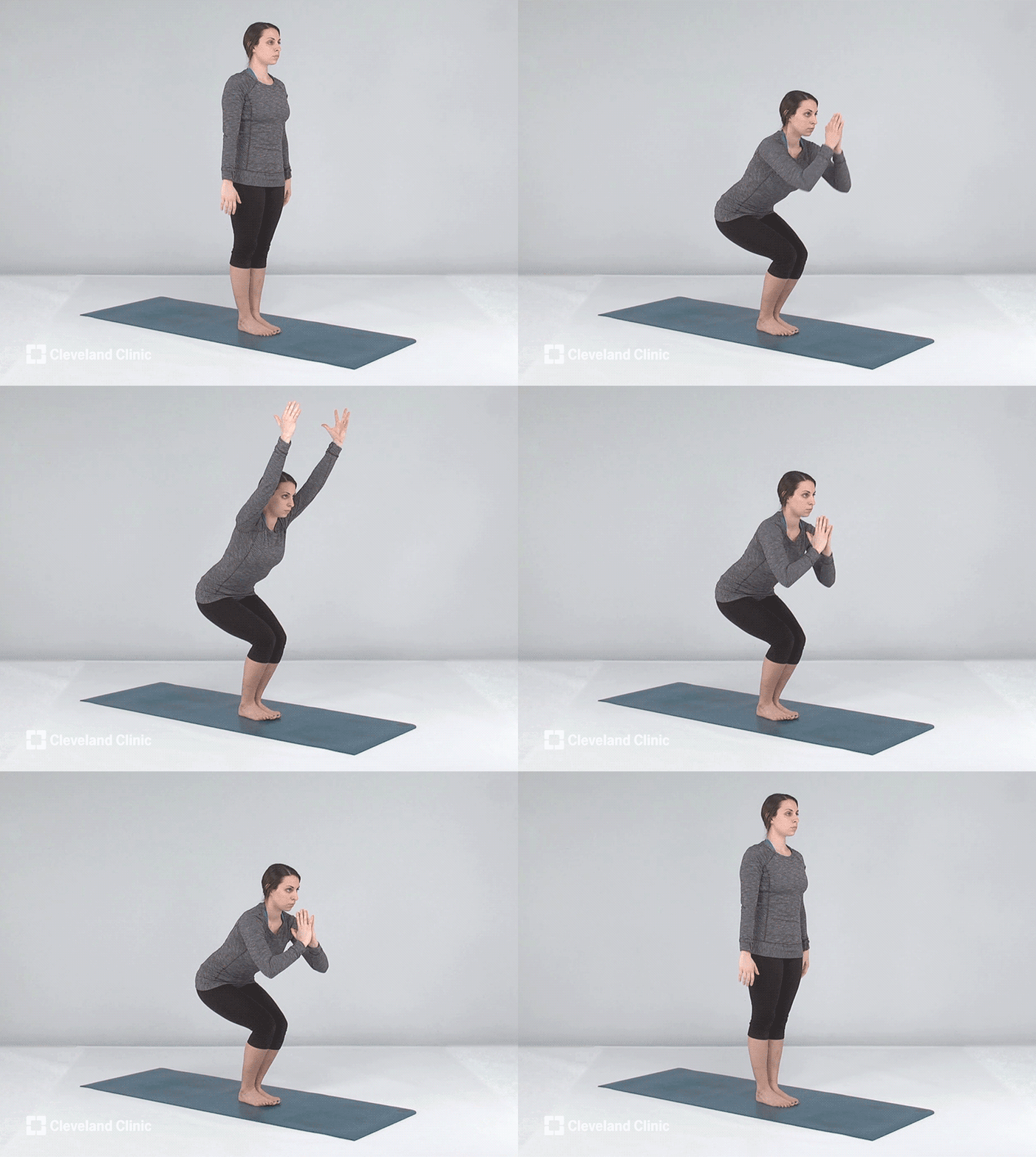
5. Chair pose
This standing pose puts a lot of focus on your thighs and ankles, demanding more from your core muscles.
Stand up straight with your feet together.
Bend your knees slightly and press your inner thighs together as you shift your weight to your heels.
Drop your tailbone toward the ground, like you’re sitting in an invisible chair.
Bring your palms together and raise your arms above your head.
Variation: To make this pose easier, bring your palms together in front of your chest. For an added challenge, sink your butt deeper into your “seat.”
Tips for your safety
Before you jump in, consider these guidelines to build your core strength with yoga safely:
Focus on your breath. Throughout your practice, keep your breath slow and deliberate. Breathe in through your nose and out through your mouth.
Move with care. Transition in and out of poses slowly to protect your muscles and joints.
Be gentle. Don’t try to force poses that aren’t working for your body. You should feel a stretch, but never pain.
Seek advice. If you are in pain, are recovering from injury or are concerned about whether yoga is safe for you, talk with a qualified health care provider, like a physical therapist, before starting any exercise program.
And, above all, enjoy the many benefits.
“Yoga is highly adaptable to your skill level and your goals,” Williams says. “And while it can certainly help strengthen your core and promote stronger muscles, it can also help you to live more mindfully and get in tune with your body.”
It’s hard to feel sad or stressed with all this cuteness. We have science to prove it! Pets help raise their owners’ fitness levels, improve blood pressure, cholesterol and blood sugar levels, and boost overall happiness and well-being. pic.twitter.com/onB8EEGK5W
— American Heart Association (@American_Heart) June 27, 2025
Did you know that fruit can be just as sweet as candy? But don’t stress, these natural sugars come with essential vitamins, fiber and nutrients that support your health. Aim for about 2 cups of fruit daily for a delicious and nutritious boost. pic.twitter.com/Z0ORULkhEF
Blackrock Health Womens Health Centre is officially open at 2-5 Warrington Place, Dublin 2!
From gynaecology to menopause, cardiology to pelvic health – we offer a wide range of services for every stage of your health journey.
Don’t delay your well-being and book your appointment today.
You can access our clinic directly through our website, or with a referral from your GP. Learn more about our patient-centred approach and book an appointment here: https://ow.ly/jGy850XsMvR
It’s no secret that alcohol can harm your health. But in a pop quiz, many of us would link alcohol with liver damage — not connect the dots between drinking and developing heart problems, like atrial fibrillation (AFib). We might even think that alcohol in moderation is good for the heart, thanks to the longstanding myth about red wine.
So, let’s set the record straight: Alcohol consumption, in any amount, isn’t doing your heart any favors. In fact, it may even harm your heart. One of the major reasons? It creates just the right conditions for abnormal rhythms, especially AFib, to develop or get worse.
Raising your risk: Regularly drinking alcohol — even at moderate levels — increases your risk of developing atrial fibrillation at some point during your lifetime. Even if your heart rhythm is normal now, drinking alcohol could change that down the road.
Making existing atrial fibrillation worse: If you already have a diagnosis, alcohol becomes even more dangerous. “AFib is a progressive disease, meaning it gets worse over time,” Dr. Kanj explains. “That progression will be faster if you continue drinking alcohol.”
Making treatments less effective: Nowadays, plenty of AFib treatments are available, but they work best without alcohol in the mix. “When you drink alcohol, every therapy available to us becomes less effective,” Dr. Kanj emphasizes. “This means your symptoms may persist, get worse or require other treatments.”
In all these scenarios, no amount of alcohol is truly safe (more on that in a moment).
How alcohol impacts heart rhythm
Alcohol damages your heart in ways that invite atrial fibrillation to develop. That’s true even if you’re a casual drinker — for example, you routinely have a glass of wine with dinner or throw back a couple of beers at the ballgame. Most of us would consider drinking in moderation to be pretty low risk. But that’s simply not the case when it comes to AFib.
“Drinking a little bit of alcohol every day can slowly cause changes that lead to atrial fibrillation,” Dr. Kanj warns.
These changes include:
Cell death: “Alcohol is a toxin at any dose,” Dr. Kanj points out. “But the more you take in, the more it acts.” He adds that it can actually kill your heart muscle cells — including the cluster of cells, called the sinoatrial (SA) node, that sets the pace for your heartbeat. “That node starts dying at a faster rate the more you drink.”
High blood pressure: Drinking raises your blood pressure over time. When your blood pressure goes up, your heart gets bigger. This type of structural change raises your risk of developing atrial fibrillation.
Poor sleep: Alcohol disrupts your sleep cycle, which translates to low-quality sleep and a host of related health issues, including high blood pressure. “Sleep disruptions also put your heart into what we call a heightened state, where arrhythmias are more likely,” Dr. Kanj says.
Binge drinking, or having four or five drinks within two hours, is especially risky. Dr. Kanj shares that having too much alcohol too fast can lead to a short-term arrhythmia called holiday heart syndrome. While your heart rhythm may return to normal in a couple days, continued heavy drinking can lead to heart damage and repeated AFib episodes.
He also cautions that when you have AFib, drinking alcohol increases your risk of:
Thromboembolism (a blood clot that breaks free from where it started, travels through your blood and blocks a blood vessel)
If you’ve been diagnosed with AFib, taking a zero-alcohol approach can help you:
Have fewer AFib episodes
Feel better from day to day
See more effective results from treatments
“The success rate for an ablation, a common heart procedure, is better for those who cut down on alcohol compared to those who continue their usual drinking,” he adds. “But the success rate is highest for those who don’t drink at all.”
If you opt for an occasional drink, Dr. Kanj offers some advice:
Learn what counts as a drink. You might think you’re having “just one” when, in fact, your friend (or that friendly bartender) was feeling extra generous. A standard drink is typically 12 ounces of beer, 8 ounces of malt liquor, 5 ounces of wine or 1 to 1.5 ounces of spirits.
Know the limit. “Current guidelines suggest no more than two drinks a day for men, and no more than one drink a day for women — but no more than three in a week,” Dr. Kanj shares. “Still, your doctor may advise even fewer. Ask them to weigh in.”
Keep track. Many of us think we drink rarely when, in fact, it may happen more often than we realize. The best way to know for sure? Keep a log for a few months. Track the date, time, and the type and amount of alcohol. The results might surprise you.
Seek support. Drinking less isn’t always a matter of willpower. Other factors can come into play, including your genes or mental health conditions. If you think you may have alcohol use disorder — which is common and treatable — talk to a healthcare provider.
Final thoughts
Cutting back on alcohol is one of the best ways to prevent atrial fibrillation or manage it once you’re diagnosed. That means it may be time to make some changes to your daily routine.
Dr. Kanj points out that for many people, avoiding alcohol can feel like a tall order because drinking and socializing often go hand in hand. You meet colleagues for happy hour. You celebrate birthdays at the bar. It can become second nature.
But he offers a challenge: “The next time you’re at a bar or restaurant, ask to see the list of nonalcoholic drinks. It’ll likely be longer than your arm. Choose one and try it in place of your usual drink. You might find it easier than you thought to go out and have fun in ways that aren’t so hard on your heart.”
How Long To Breastfeed: What the Guidelines Say and What To Consider
Recommendations encourage breast milk exclusively for baby’s first six months and continuing to provide human milk until age 2 and beyond
How and what you feed your baby is probably one of the most basic — and yet deeply personal — decisions you’ll face when you become a parent.
You’ll hear things like “breast is best.” As in, breastfeeding (chestfeeding) is the absolute best way to nourish your baby.
And then you’ll hear the retort, “fed is best.” Meaning breast milk (human milk) and formula are both fine. As long as your baby is getting nutrients in their belly, all is well.
Then come the opinions on how long you should breastfeed. (You’re still breastfeeding? You gave up on nursing already? You fed your baby formula?)
It can feel like there’s no right way to do it. And there’s some truth to that.
Because what works for one family may not be feasible for another. But that’s OK.
Breast milk can provide certain benefits that formula can’t mimic. But breastfeeding, especially for long periods of time, might not work for everyone. Or you may have been given the impression that you’ve continued providing human milk long after others think you “should.”
No one should feel guilt, shame or otherwise crummy about how they feed their baby. Let’s face it, mom guilt is tough enough as it is.
So, we talked with board-certified breastfeeding medicine physician Heidi Szugye, DO, about breastfeeding recommendations.
How long to breastfeed
Science shows that if you can give your baby human milk (either your own or a donor’s), it has its benefits. And the longer, the better, experts recommend.
12 months to 24 months (and beyond): Mostly solid foods with some human milk, as mutually desired by parent and child.
Previous recommendations called for providing breast milk until age 1. But these newer guidelines (implemented in 2022) are based on the understanding that human milk has benefits that continue long after baby’s first birthday. And they help to remove stigmas associated with people who choose to extend breastfeeding into toddlerhood.
“These recommendations are a call to action for everyone, and that includes hospitals, pediatricians and all physicians that are taking care of families,” Dr. Szugye states. “We want to make sure our practices and policies are set up to support people who choose to breastfeed beyond the first year of their child’s life.”
Think of the guidelines as the best-case scenario. If it works for you, your family, your child, your body and your life to breastfeed for two years or longer, you’re doing a great thing. And there’s no reason to stop until you and your child are ready.
If it doesn’t work for you, that’s OK, too. Your worth as a parent and your love for your child can’t be measured in ounces of milk.
Benefits of extended breastfeeding
The recommendations are based on research showing that human milk has some big benefits. And those perks continue for as long as you continue to supply it.
“Breastfeeding offers tremendous benefits — from custom-made nutrition and increased immunity to protecting you against some forms of cancer. And those benefits don’t go away as your baby ages,” Dr. Szugye shares. “We have more and more data supporting that there are benefits to breastfeeding for more than one year when possible.”
Breastfeeding can offer both you and your baby some big benefits:
Benefits for lactating parents
Benefits for baby
Lower risk of developing conditions like Type 2 diabetes, high blood pressure, cardiovascular disease, breast cancer and ovarian cancer.
Decreased risk for ear infections, respiratory infections, gastrointestinal illnesses, SIDS, leukemia, diabetes, obesity, asthma and eczema.
“There are a lot of immunologic factors and components to human milk,” Dr. Szugye says. “One big advantage to human milk is that you pass antibodies to the baby. So, if you’re exposed to a respiratory illness or GI illness, those antibodies are passed on to the baby and then that makes them less likely to get sick. And if they do get sick, it’s less severe. It’s almost like a built-in immunity.”
Keeping up milk supply for the long haul
Some people can make enough milk to breastfeed for as long as they and their babies choose. But some don’t. At least not without taking some steps to keep it up.
If you suspect your supply is dwindling as your child gets older, there are ways to help promote more milk production if you want.
“Many people notice their supply drop and mistakenly assume it won’t return,” Dr. Szugye notes. “But if you want to continue to breastfeed, there are options that could help.”
If a supply boost is in order, you can try:
Nursing more often — Add sessions as long as your child will nurse. If you’re away from them during the day, try early evenings, mornings or weekends.
Pumping strategies — An extra session or several short “power pumping” sessions (think five to 10 minutes throughout the day) for several days in a row can trigger your body to make more milk.
Breast massage and compression — Easy-to-learn techniques can improve drainage when nursing or pumping.
Take care of yourself — Reduce stress, rest when possible, hydrate and eat a balanced diet with an extra 500 calories a day to support breastfeeding.
Not an ‘all-or-nothing’
If two or more years of breastfeeding seems daunting, remember that you have options.
For starters, giving your child human milk doesn’t always mean latching them to your breast and nursing. That’s just one way to do it. Pumping milk and putting it in a bottle, cup or spoon are also options.
And you may find that a donor bank could be a route to explore if you don’t lactate or if you have concerns about a low milk supply. Donor milk is pasteurized, screened for drugs, medications and infections, and tested for bacterial contamination before it’s stored and made available for purchase.
“Reach out to your pediatrician or women’s healthcare provider if you’re interested in obtaining donor milk. You may need a prescription from a healthcare provider,” Dr. Szugye suggests.
Remember, too, that any amount of human milk can be a benefit. If keeping up with your baby’s breastfeeding demands becomes too high a burden, there are alternatives.
Some parents may find that supplementing with formula (or other foods and milk after baby turns 1) can help give your child some human milk, while keeping up with their nutritional needs — and not burning yourself out in the process.
“It’s not an all-or-nothing thing,” Dr. Szugye reassures. “Any amount of human milk you can give is a benefit. If it doesn’t work for you to constantly supply human milk, that’s OK. We’re all just doing our best.”
If breastfeeding is going well for both you and your child, there’s no reason to give it up until you’re both ready to.
Feeding a baby is tough work, no matter how you do it. And chances are, you’re doing a fantastic job.