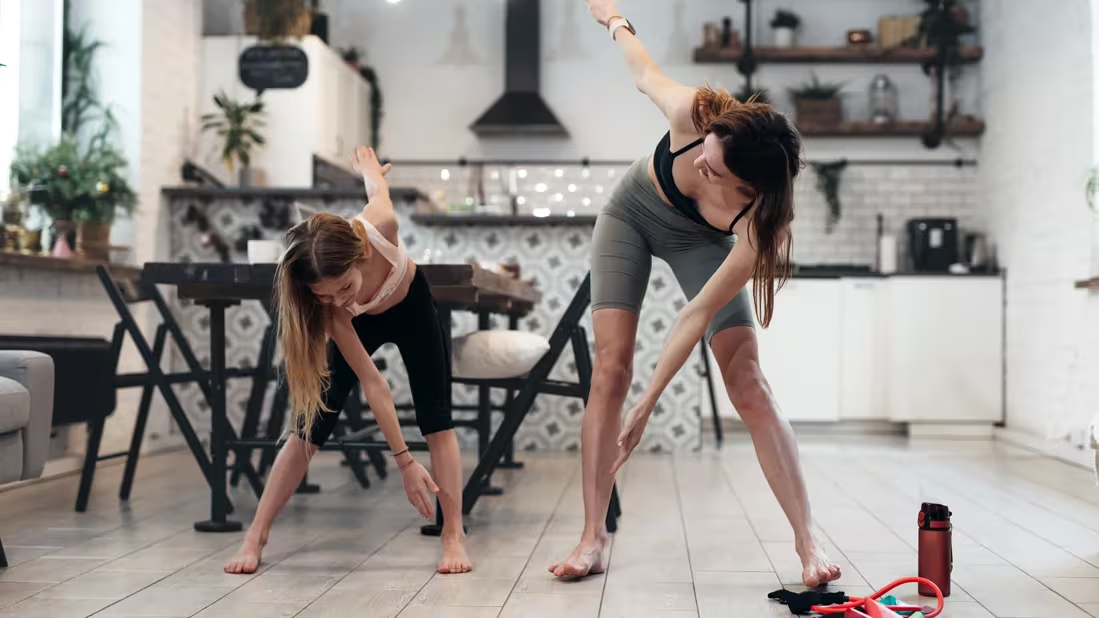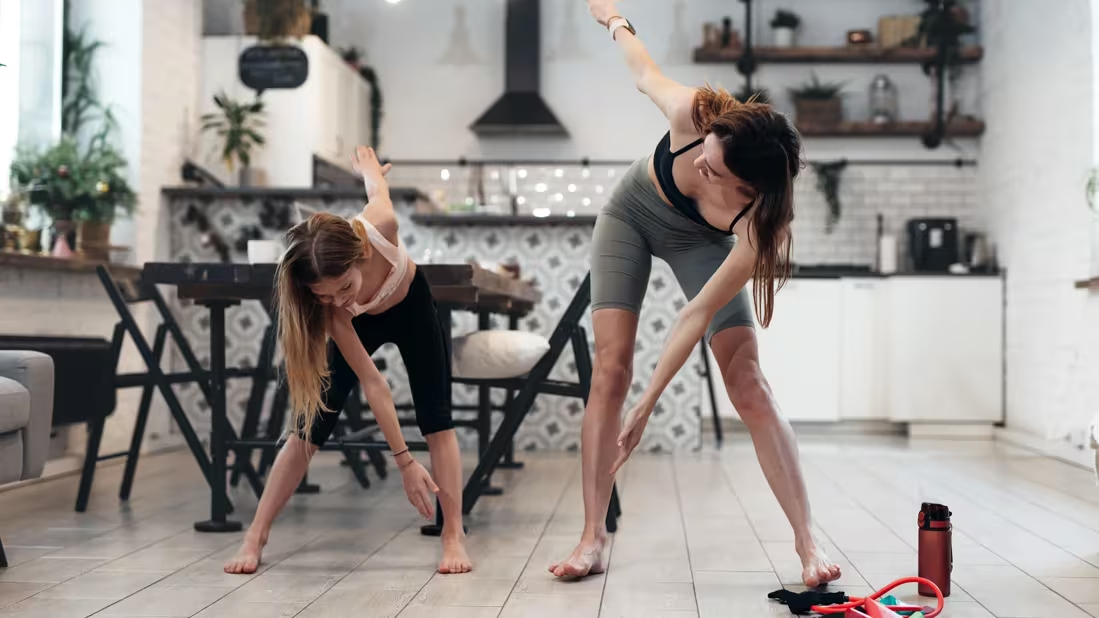
Are your kids interested in sports or just want to feel stronger? @MayoClinic #physicalactivity

Are your kids interested in sports or just want to feel stronger? Strength training can be safe and beneficial for children when it is done the right way. Light weights, proper form and age appropriate guidance matter. Curious about when kids can start and how to keep it safe?

Image

Strength training: OK for kids?

Strength training offers kids many benefits, but there are important warnings to keep in mind. Here’s what you need to know about youth strength training.By Mayo Clinic Staff

Strength training for kids? Great idea! Done right, it offers many benefits to young athletes. Strength training is good even for kids who just want to look and feel better. In fact, strength training might put your child on a lifetime path to better health and fitness.

Strength training, not weightlifting

Don’t confuse strength training with weightlifting, bodybuilding or powerlifting. Trying to build big muscles can put too much strain on young muscles, tendons and areas of cartilage that haven’t yet turned to bone, called growth plates. Also, being more focused on lifting large amounts of weight than on form can make strength training riskier.

For kids, light weights and controlled movements are best. Using good form and being safe are most important.

Children can do many strength training exercises using their own body weight or resistance tubing. Free weights, machine weights and medicine balls are other options. But keep in mind that some equipment designed for adults might be too large for many children.

What can kids get out of strength training?

Done right, strength training can:

  • Increase children’s muscle strength.
  • Help protect children’s muscles and joints from sports injuries.
  • Help children do better in nearly any sport.
  • Teach children proper form.

Keep in mind that strength training isn’t only for athletes. Even for children who don’t want to play sports, strength training can:

  • Strengthen bones.
  • Help promote healthy blood pressure and cholesterol levels.
  • Help maintain a healthy weight.
  • Help kids feel good about themselves.
  • Increase physical activity overall.

When can a child begin strength training?

During childhood, being active improves kids’ body awareness and control and their balance. Strength training can become a part of a fitness plan as early as age 7 or 8.

Younger children who start sports activities such as baseball or soccer also might benefit from strength training. To strength train, children should be able to follow directions and practice proper form.

The Department of Health and Human Services says that school-age children should get 60 minutes or more of daily activity. As part of this activity, muscle- and bone-strengthening exercises are suggested at least three days a week.

For children who have an interest in strength training, remind them that strength training is meant to increase muscle strength and endurance. Increasing muscle size, also called bulking up, is something else.

You might also check with your child’s healthcare professional for the OK to begin a strength training program. Be sure to check with your child’s healthcare professional if your child has a known or suspected health problem, such as a heart condition, high blood pressure or seizures.

What’s the best way to start a strength training program for kids?

A child’s strength training program isn’t just a scaled-down version of an adult program. Here are some things you can do to help your child train safely:

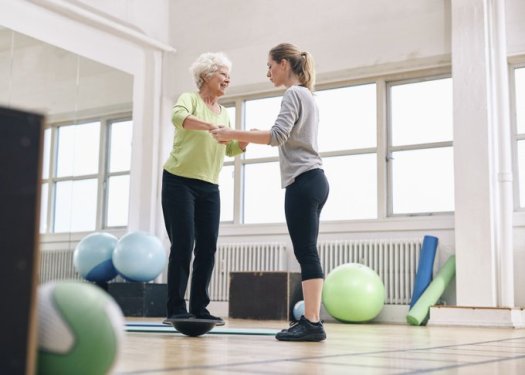
  • Talk with a professional. Start with a coach or personal trainer who has worked with youth to strength train. The coach or trainer can create a safe strength training program that works based on your child’s age, size, skills and sports interests. Or enroll your child in a strength training class for kids.
  • Keep watch. Don’t let your child strength train alone. It’s important to have an adult who knows how to strength train oversee your child’s program.
  • Keep it fun. Help your child vary the routine to prevent boredom.

Urge your child to:

  • Warm up and cool down. Your child should begin each strength training session with 5 to 10 minutes of light aerobic activity. This could be walking, jogging in place or jumping rope. This warms the muscles and prepares them for harder activity. Each strength training session should be followed with 10 to 15 minutes of light aerobic activity and gentle stretching. This helps keep blood flowing to the muscles during recovery.
  • Keep it light. Kids can safely lift light adult-size weights. Children can try to do one or two sets of 8 to 12 repetitions with good form. If they can’t do 10 repetitions, the weight might be too heavy.
  • Focus on good form. Form and technique are more important than the amount of weight your child lifts. Children can increase the resistance or number of repetitions little by little as they build strength.
  • Rest between workouts. Make sure your child rests at least one full day between exercising each major muscle group. Major muscle groups are the legs, hips, back, abdomen, chest, shoulders and arms.

Results won’t come overnight. But in time, your child will have more muscle strength and be able to work the muscles harder

Are your kids interested in sports or just want to feel stronger? @MayoClinic #physicalactivity

Are your kids interested in sports or just want to feel stronger? Strength training can be safe and beneficial for children when it is done the right way. Light weights, proper form and age appropriate guidance matter. Curious about when kids can start and how to keep it safe?

Image

Strength training: OK for kids?

Strength training offers kids many benefits, but there are important warnings to keep in mind. Here’s what you need to know about youth strength training.By Mayo Clinic Staff

Strength training for kids? Great idea! Done right, it offers many benefits to young athletes. Strength training is good even for kids who just want to look and feel better. In fact, strength training might put your child on a lifetime path to better health and fitness.

Strength training, not weightlifting

Don’t confuse strength training with weightlifting, bodybuilding or powerlifting. Trying to build big muscles can put too much strain on young muscles, tendons and areas of cartilage that haven’t yet turned to bone, called growth plates. Also, being more focused on lifting large amounts of weight than on form can make strength training riskier.

For kids, light weights and controlled movements are best. Using good form and being safe are most important.

Children can do many strength training exercises using their own body weight or resistance tubing. Free weights, machine weights and medicine balls are other options. But keep in mind that some equipment designed for adults might be too large for many children.

What can kids get out of strength training?

Done right, strength training can:

  • Increase children’s muscle strength.
  • Help protect children’s muscles and joints from sports injuries.
  • Help children do better in nearly any sport.
  • Teach children proper form.

Keep in mind that strength training isn’t only for athletes. Even for children who don’t want to play sports, strength training can:

  • Strengthen bones.
  • Help promote healthy blood pressure and cholesterol levels.
  • Help maintain a healthy weight.
  • Help kids feel good about themselves.
  • Increase physical activity overall.

When can a child begin strength training?

During childhood, being active improves kids’ body awareness and control and their balance. Strength training can become a part of a fitness plan as early as age 7 or 8.

Younger children who start sports activities such as baseball or soccer also might benefit from strength training. To strength train, children should be able to follow directions and practice proper form.

The Department of Health and Human Services says that school-age children should get 60 minutes or more of daily activity. As part of this activity, muscle- and bone-strengthening exercises are suggested at least three days a week.

For children who have an interest in strength training, remind them that strength training is meant to increase muscle strength and endurance. Increasing muscle size, also called bulking up, is something else.

You might also check with your child’s healthcare professional for the OK to begin a strength training program. Be sure to check with your child’s healthcare professional if your child has a known or suspected health problem, such as a heart condition, high blood pressure or seizures.

What’s the best way to start a strength training program for kids?

A child’s strength training program isn’t just a scaled-down version of an adult program. Here are some things you can do to help your child train safely:

  • Talk with a professional. Start with a coach or personal trainer who has worked with youth to strength train. The coach or trainer can create a safe strength training program that works based on your child’s age, size, skills and sports interests. Or enroll your child in a strength training class for kids.
  • Keep watch. Don’t let your child strength train alone. It’s important to have an adult who knows how to strength train oversee your child’s program.
  • Keep it fun. Help your child vary the routine to prevent boredom.

Urge your child to:

  • Warm up and cool down. Your child should begin each strength training session with 5 to 10 minutes of light aerobic activity. This could be walking, jogging in place or jumping rope. This warms the muscles and prepares them for harder activity. Each strength training session should be followed with 10 to 15 minutes of light aerobic activity and gentle stretching. This helps keep blood flowing to the muscles during recovery.
  • Keep it light. Kids can safely lift light adult-size weights. Children can try to do one or two sets of 8 to 12 repetitions with good form. If they can’t do 10 repetitions, the weight might be too heavy.
  • Focus on good form. Form and technique are more important than the amount of weight your child lifts. Children can increase the resistance or number of repetitions little by little as they build strength.
  • Rest between workouts. Make sure your child rests at least one full day between exercising each major muscle group. Major muscle groups are the legs, hips, back, abdomen, chest, shoulders and arms.

Results won’t come overnight. But in time, your child will have more muscle strength and be able to work the muscles harder

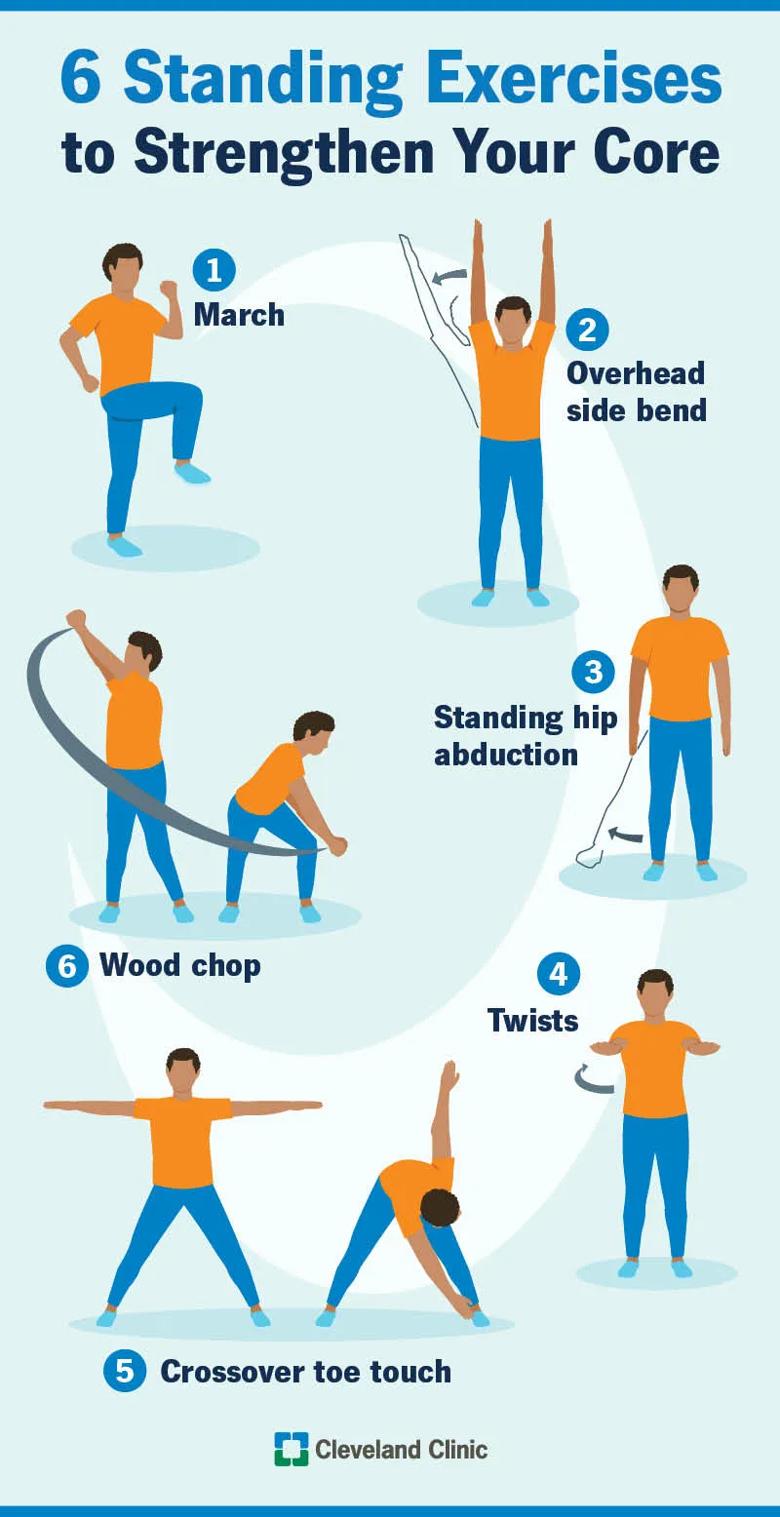
Why a strong core is important + exercises to try. @ClevelandClinic

cleveland evrything starts wit your core

If you’re planning to start an exercise program and wondering where to begin, start with your core first, says physical therapist Brittany Smith, DPT. People often think of the core muscles as being the abdominal muscles, but the core includes the muscles in the abdomen, back and hips, all working together as a group.

“The core muscles provide stability for the entire body as it moves,” says Smith. “These muscles are activated when you stand up, turn, bend, reach, twist, stoop and move in most other ways. Everything starts with your core.”

Strong core muscles help you maintain good posture, while weak ones can lead to slouching and slumping. Poor posture can be a cause of aches and pain, especially in the back.

Getting started with your core

To get your core muscles in shape, you need to exercise.

“Our bodies were made to move, so any physical activity is really important,” says Smith.

She recommends these specific core-strengthening exercises below.

The first one engages the deep muscles in the abdomen, called the transverse abdominis. “These muscles help hold us in a better position to stabilize our core, thereby stabilizing our arms and legs,” says Smith.

“The more you work on these muscles, the more it will become second nature to hold these muscles tight when you’re lifting grocery bags, doing yard work or any other kind of physical activity,” says Smith. This will help support your body.

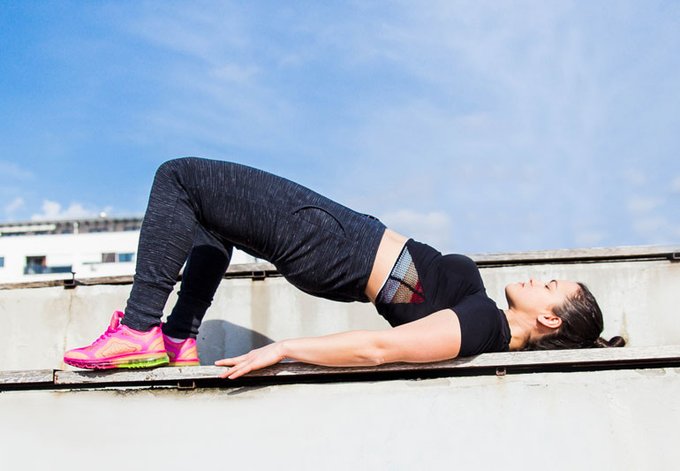
Other muscles that tend to be weak are the gluteus maximus in the buttocks, and the gluteus medius and gluteus minimus on the side of the hip. The bridge and clamshell exercises can help strengthen these muscles.

Smith emphasizes that getting the proper position of these exercises correct is more important than the number of repetitions you do. “It’s better to take your time, maybe do fewer reps, but with better quality,” she says. For that reason, it can be helpful to have the guidance of a physical therapist to get started.

Move on from the core

Core exercises are the starting point of overall fitness because you need to hold those muscles engaged while you strengthen other muscles, such as the biceps in the arms or the quadriceps in the legs.

Smith suggests setting short-term goals (for about a month) and then more long-term goals. Once you have achieved short-term goals, such as getting around more easily, add other types of weight-training or resistance exercises to build muscle elsewhere.

With any exercise you do, always listen to your body, warns Smith. If you have pain other than muscle burn, take it easy. Reduce the number of repetitions, the weight or the duration of the exercises. Then build up gradually. “You don’t have to be in pain to make gains,” she says.

Beginner exercises for core strength

For each of the following, work up to one to two sets of 10 to 15 repetitions once a day.

Abdominal bracing

Lie on your back with your knees bent and feet flat on the floor. Contract your abdominal muscles, and press the arch of your back down toward the floor, pulling your belly button toward your spine. Hold for 5 to 10 seconds. Make sure your lower back stays flat on the floor. Relax and repeat.

Bridge

Lie on your back with your knees bent and feet flat on the floor with your arms at your sides. Squeeze your abdominal and buttocks muscles, push your heels into the floor and slowly lift your buttocks and hips off the floor. Keep your back straight. Hold for 5 to 10 seconds.

Clamshell

Lie on your side with knees bent in line with your hips and back, draw up the top knee while keeping contact of your feet together as shown. Don’t let your pelvis roll back during the lifting movement. Hold for 5 seconds.

https://health.clevelandclinic.org/planning-to-start-exercising-start-with-your-core-first/?utm_medium=social&utm_source=twitter&utm_campaign=cc+tweets

Why a strong core is important + exercises to try. @ClevelandClinic

cleveland evrything starts wit your core

If you’re planning to start an exercise program and wondering where to begin, start with your core first, says physical therapist Brittany Smith, DPT. People often think of the core muscles as being the abdominal muscles, but the core includes the muscles in the abdomen, back and hips, all working together as a group.

“The core muscles provide stability for the entire body as it moves,” says Smith. “These muscles are activated when you stand up, turn, bend, reach, twist, stoop and move in most other ways. Everything starts with your core.”

Strong core muscles help you maintain good posture, while weak ones can lead to slouching and slumping. Poor posture can be a cause of aches and pain, especially in the back.

Getting started with your core

To get your core muscles in shape, you need to exercise.

“Our bodies were made to move, so any physical activity is really important,” says Smith.

She recommends these specific core-strengthening exercises below.

The first one engages the deep muscles in the abdomen, called the transverse abdominis. “These muscles help hold us in a better position to stabilize our core, thereby stabilizing our arms and legs,” says Smith.

“The more you work on these muscles, the more it will become second nature to hold these muscles tight when you’re lifting grocery bags, doing yard work or any other kind of physical activity,” says Smith. This will help support your body.

Other muscles that tend to be weak are the gluteus maximus in the buttocks, and the gluteus medius and gluteus minimus on the side of the hip. The bridge and clamshell exercises can help strengthen these muscles.

Smith emphasizes that getting the proper position of these exercises correct is more important than the number of repetitions you do. “It’s better to take your time, maybe do fewer reps, but with better quality,” she says. For that reason, it can be helpful to have the guidance of a physical therapist to get started.

Move on from the core

Core exercises are the starting point of overall fitness because you need to hold those muscles engaged while you strengthen other muscles, such as the biceps in the arms or the quadriceps in the legs.

Smith suggests setting short-term goals (for about a month) and then more long-term goals. Once you have achieved short-term goals, such as getting around more easily, add other types of weight-training or resistance exercises to build muscle elsewhere.

With any exercise you do, always listen to your body, warns Smith. If you have pain other than muscle burn, take it easy. Reduce the number of repetitions, the weight or the duration of the exercises. Then build up gradually. “You don’t have to be in pain to make gains,” she says.

Beginner exercises for core strength

For each of the following, work up to one to two sets of 10 to 15 repetitions once a day.

Abdominal bracing

Lie on your back with your knees bent and feet flat on the floor. Contract your abdominal muscles, and press the arch of your back down toward the floor, pulling your belly button toward your spine. Hold for 5 to 10 seconds. Make sure your lower back stays flat on the floor. Relax and repeat.

Bridge

Lie on your back with your knees bent and feet flat on the floor with your arms at your sides. Squeeze your abdominal and buttocks muscles, push your heels into the floor and slowly lift your buttocks and hips off the floor. Keep your back straight. Hold for 5 to 10 seconds.

Clamshell

Lie on your side with knees bent in line with your hips and back, draw up the top knee while keeping contact of your feet together as shown. Don’t let your pelvis roll back during the lifting movement. Hold for 5 seconds.

https://health.clevelandclinic.org/planning-to-start-exercising-start-with-your-core-first/?utm_medium=social&utm_source=twitter&utm_campaign=cc+tweets

Why a strong core is important + exercises to try. @ClevelandClinic

cleveland evrything starts wit your core

If you’re planning to start an exercise program and wondering where to begin, start with your core first, says physical therapist Brittany Smith, DPT. People often think of the core muscles as being the abdominal muscles, but the core includes the muscles in the abdomen, back and hips, all working together as a group.

“The core muscles provide stability for the entire body as it moves,” says Smith. “These muscles are activated when you stand up, turn, bend, reach, twist, stoop and move in most other ways. Everything starts with your core.”

Strong core muscles help you maintain good posture, while weak ones can lead to slouching and slumping. Poor posture can be a cause of aches and pain, especially in the back.

Getting started with your core

To get your core muscles in shape, you need to exercise.

“Our bodies were made to move, so any physical activity is really important,” says Smith.

She recommends these specific core-strengthening exercises below.

The first one engages the deep muscles in the abdomen, called the transverse abdominis. “These muscles help hold us in a better position to stabilize our core, thereby stabilizing our arms and legs,” says Smith.

“The more you work on these muscles, the more it will become second nature to hold these muscles tight when you’re lifting grocery bags, doing yard work or any other kind of physical activity,” says Smith. This will help support your body.

Other muscles that tend to be weak are the gluteus maximus in the buttocks, and the gluteus medius and gluteus minimus on the side of the hip. The bridge and clamshell exercises can help strengthen these muscles.

Smith emphasizes that getting the proper position of these exercises correct is more important than the number of repetitions you do. “It’s better to take your time, maybe do fewer reps, but with better quality,” she says. For that reason, it can be helpful to have the guidance of a physical therapist to get started.

Move on from the core

Core exercises are the starting point of overall fitness because you need to hold those muscles engaged while you strengthen other muscles, such as the biceps in the arms or the quadriceps in the legs.

Smith suggests setting short-term goals (for about a month) and then more long-term goals. Once you have achieved short-term goals, such as getting around more easily, add other types of weight-training or resistance exercises to build muscle elsewhere.

With any exercise you do, always listen to your body, warns Smith. If you have pain other than muscle burn, take it easy. Reduce the number of repetitions, the weight or the duration of the exercises. Then build up gradually. “You don’t have to be in pain to make gains,” she says.

Beginner exercises for core strength

For each of the following, work up to one to two sets of 10 to 15 repetitions once a day.

Abdominal bracing

Lie on your back with your knees bent and feet flat on the floor. Contract your abdominal muscles, and press the arch of your back down toward the floor, pulling your belly button toward your spine. Hold for 5 to 10 seconds. Make sure your lower back stays flat on the floor. Relax and repeat.

Bridge

Lie on your back with your knees bent and feet flat on the floor with your arms at your sides. Squeeze your abdominal and buttocks muscles, push your heels into the floor and slowly lift your buttocks and hips off the floor. Keep your back straight. Hold for 5 to 10 seconds.

Clamshell

Lie on your side with knees bent in line with your hips and back, draw up the top knee while keeping contact of your feet together as shown. Don’t let your pelvis roll back during the lifting movement. Hold for 5 seconds.

https://health.clevelandclinic.org/planning-to-start-exercising-start-with-your-core-first/?utm_medium=social&utm_source=twitter&utm_campaign=cc+tweets

Why a strong core is important + exercises to try. @ClevelandClinic

cleveland evrything starts wit your core

If you’re planning to start an exercise program and wondering where to begin, start with your core first, says physical therapist Brittany Smith, DPT. People often think of the core muscles as being the abdominal muscles, but the core includes the muscles in the abdomen, back and hips, all working together as a group.

“The core muscles provide stability for the entire body as it moves,” says Smith. “These muscles are activated when you stand up, turn, bend, reach, twist, stoop and move in most other ways. Everything starts with your core.”

Strong core muscles help you maintain good posture, while weak ones can lead to slouching and slumping. Poor posture can be a cause of aches and pain, especially in the back.

Getting started with your core

To get your core muscles in shape, you need to exercise.

“Our bodies were made to move, so any physical activity is really important,” says Smith.

She recommends these specific core-strengthening exercises below.

The first one engages the deep muscles in the abdomen, called the transverse abdominis. “These muscles help hold us in a better position to stabilize our core, thereby stabilizing our arms and legs,” says Smith.

“The more you work on these muscles, the more it will become second nature to hold these muscles tight when you’re lifting grocery bags, doing yard work or any other kind of physical activity,” says Smith. This will help support your body.

Other muscles that tend to be weak are the gluteus maximus in the buttocks, and the gluteus medius and gluteus minimus on the side of the hip. The bridge and clamshell exercises can help strengthen these muscles.

Smith emphasizes that getting the proper position of these exercises correct is more important than the number of repetitions you do. “It’s better to take your time, maybe do fewer reps, but with better quality,” she says. For that reason, it can be helpful to have the guidance of a physical therapist to get started.

Move on from the core

Core exercises are the starting point of overall fitness because you need to hold those muscles engaged while you strengthen other muscles, such as the biceps in the arms or the quadriceps in the legs.

Smith suggests setting short-term goals (for about a month) and then more long-term goals. Once you have achieved short-term goals, such as getting around more easily, add other types of weight-training or resistance exercises to build muscle elsewhere.

With any exercise you do, always listen to your body, warns Smith. If you have pain other than muscle burn, take it easy. Reduce the number of repetitions, the weight or the duration of the exercises. Then build up gradually. “You don’t have to be in pain to make gains,” she says.

Beginner exercises for core strength

For each of the following, work up to one to two sets of 10 to 15 repetitions once a day.

Abdominal bracing

Lie on your back with your knees bent and feet flat on the floor. Contract your abdominal muscles, and press the arch of your back down toward the floor, pulling your belly button toward your spine. Hold for 5 to 10 seconds. Make sure your lower back stays flat on the floor. Relax and repeat.

Bridge

Lie on your back with your knees bent and feet flat on the floor with your arms at your sides. Squeeze your abdominal and buttocks muscles, push your heels into the floor and slowly lift your buttocks and hips off the floor. Keep your back straight. Hold for 5 to 10 seconds.

Clamshell

Lie on your side with knees bent in line with your hips and back, draw up the top knee while keeping contact of your feet together as shown. Don’t let your pelvis roll back during the lifting movement. Hold for 5 seconds.

https://health.clevelandclinic.org/planning-to-start-exercising-start-with-your-core-first/?utm_medium=social&utm_source=twitter&utm_campaign=cc+tweets

Starting a Workout Routine – Tips to start moving and grooving @ClevelandClinic #physicalactivity


Exercise
 is a vital part of a healthy lifestyle. But if you’ve gotten out of the habit of being active — or have never found an exercise routine that works — it might feel like an impossible task to get started.
Luckily, it’s never too late to figure out a workout routine. Here’s how to start exercising — and tips to stay motivated when all you want to do is hang out on the couch instead.
What should I include in my exercise program?
Every exercise session should include a warm-up, a conditioning phase and a cool-down phase.
The warm-up
In a nutshell, a warm-up helps your body adjust slowly from rest to exercise. Making this part of your routine reduces the stress on your heart and muscles, and slowly increases your breathing, circulation (heart rate) and body temperature. A warm-up can also help improve your flexibility and reduce muscle soreness.
The best warm-up includes stretching, range of motion activities and beginning the activity at a low-intensity level.
Conditioning phase
The conditioning phase follows the warm-up and is the time when you’re burning calories and moving and grooving.
During the conditioning phase, you should monitor the intensity of your activity. The intensity is how hard you’re exercising, which can be measured by checking your heart rate.
Over time, you can work on increasing the duration of the activity. The duration is how long you exercise during one session.
Cool-down phase
The cool-down phase is the last phase of your exercise session. It allows your body to gradually recover from the conditioning phase. Your heart rate and blood pressure will return to near-resting values.
However, a cool down does not mean to sit down. In fact, for safety reasons, don’t sit, stand still or lie down right after exercise. This might cause you to feel dizzy, lightheaded or have heart palpitations (fluttering in your chest).
The best cool down is to slowly decrease the intensity of your activity. You might also do some of the same stretching activities you did in the warm up.
General exercise guidelines
In general, experts recommend doing a five-minute warm up, including stretching exercises, before any aerobic activity, and include a five- to 10-minute cool down after the activity. Stretching can be done while standing or sitting.
Here are some other things to keep in mind when starting a workout routine:
Determine the best exercise routine for your lifestyle
Not everybody likes to hop out of bed in the morning and go for a run. Figuring out a routine that fits your lifestyle can help you be more successful.
Here are some questions you can think about before choosing a routine:
What physical activities do I enjoy?
Do I prefer group or individual activities?
What programs best fit my schedule?
Do I have physical conditions that limit my choice of exercise?
What goals do I have in mind?
(These might include losing weight, strengthening muscles or improving flexibility, for example.)
Don’t try and exercise too much too fast
Gradually increase your activity level, especially if you haven’t been exercising regularly. Guidelines around how often to exercise also differ depending on your age, any health conditions you have and your fitness history.
Set big and small goals — and be specific
If you’re looking to reach a particular goal, exercise specialist Ben Kuharik suggests setting mini goals to achieve along the way. This ensures your motivation stays strong over the long haul.
Setting a specific goal is also important. “For example, if you want to lose some weight, it’s hard to be motivated or stick to a plan,” he says. “That’s because you don’t have the excitement in knowing you are getting closer to achieving it.”
Having smaller goals or milestones to reach in between the big ones keeps you on track. “If you want to lose 8 pounds in two months — and you set a mini goal of losing 1 pound a week in the process — you get the sense of accomplishment that reaffirms your efforts,” Kuharik says. “And this can snowball into achieving even greater goals.”
This also applies if you fall short of your goal. “If you only lose 7 pounds in two months, you’re still 7 pounds down than when you started,” Kuharik affirms. “You’ll feel great about the progress you’ve already made.”
Schedule exercise into your daily routine
Plan to exercise at the same time every day, such as in the mornings when you have more energy or right after work. Add a variety of exercises so you don’t get bored.
Where exercise is concerned, something is also always better than nothing. “Not every day will go as planned,” Kuharik notes. “If you unexpectedly have a tight schedule or are even just having an off day, doing half of your planned workout that day is much more rewarding and beneficial than skipping it altogether.”
Exercise at a steady pace
Keep a pace that allows you to still talk during the activity. Be sure not to overdo it! You can measure the intensity of your exercise using the Rated Perceived Exertion (RPE) scale. The RPE scale runs from 0 to 10 and rates how easy or difficult you find an activity.
For example, 0 (nothing at all) would be how you feel when sitting in a chair; 10 (very, very heavy) is how you feel at the end of an exercise stress test or after a very difficult activity. In most cases, you should exercise at a level that feels 3 (moderate) to 4 (somewhat heavy).
Keep an exercise record
Keep a record of how much and when you exercise. This can help you look at goal-setting, as well as get a sense of how much activity you’re doing in a given week.
Time your eating and drinking properly
Wait at least one and a half hours after eating a meal before exercising. When drinking liquids during exercise, remember to follow any fluid restriction guidelines you might have.
Only buy what you need
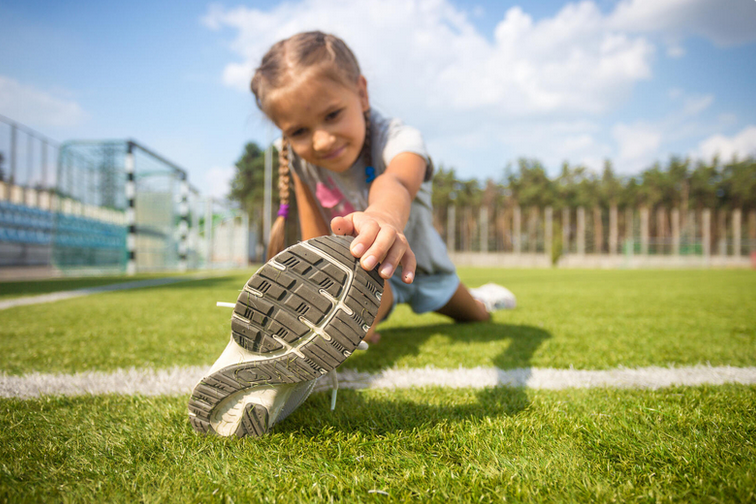
Exercise doesn’t have to put a strain on your wallet. Avoid buying expensive equipment or health club memberships unless you’re sure you’ll use them regularly. But you’ll want to dress for the weather (if working out outside) and wear protective footwear. Sneakers are the one thing you should prioritize, as you want to make sure your feet are protected.
Stick with it
If you exercise regularly, it’ll soon become part of your lifestyle. Make exercise a lifetime commitment. Finding an exercise “buddy” can also help you stay motivated.
Don’t forget to have fun
Exercising should be fun and not feel like a chore. “Consistency is key — but to do something consistently, it’s important to find a way to enjoy it,” Kuharik says.
So, above all, choose an activity you enjoy! You’ll be more likely to stick with an exercise program if you don’t dread working out.
“Try to look at exercise as an opportunity to get away from stress, clear your mind and leave nagging thoughts at the door,” Kuharik encourages. “With this in mind, over time, you will look forward to giving your mind a break and feeling good after a great workout session!”
Exercise: Where To Start
You should always talk to your doctor before starting an exercise routine. Together, you can figure out a plan to ease into regular physical activity.
And walking and climbing stairs are two easy ways to start an exercise program.
Walking guidelines
Start with a short walk. See how far you can go before you become breathless. Stop and rest whenever you’re short of breath.
Count the number of steps you take while you inhale. Then exhale for twice as many steps. For example, if you inhale while taking two steps, exhale through pursed lips while taking the next four steps. Learn to walk so breathing in and exhaling out become a habit once you find a comfortable breathing rate.
Try to increase your walking distance. When setting specific goals, you might find you can go farther every day. Many people find that an increase of 10 feet a day is a good goal.
Set reasonable goals. Don’t walk so far that you can’t get back to your starting point without difficulty breathing. Remember, if you’re short of breath after limited walking, stop and rest.
Never overdo it. Always stop and rest for two or three minutes when you start to become short of breath.
Stair climbing
Hold the handrail lightly to keep your balance and help yourself climb.
Take your time.
Step up while exhaling or breathing out with pursed lips. Place your whole foot flat on each step. Go up two steps with each exhalation.
Inhale or breathe in while taking a rest before the next step.
Going downstairs is much easier. Hold the handrail and place each foot flat on the step. Count the number of steps you take while inhaling, and take twice as many steps while exhaling.
Whichever activity you choose, remember, even a little exercise is better than none!

FACEBOOK
TWITTER
LINKEDIN
PINTEREST

Email
aerobic exercise exercise exercise and heart health exercise plan moderate exercise