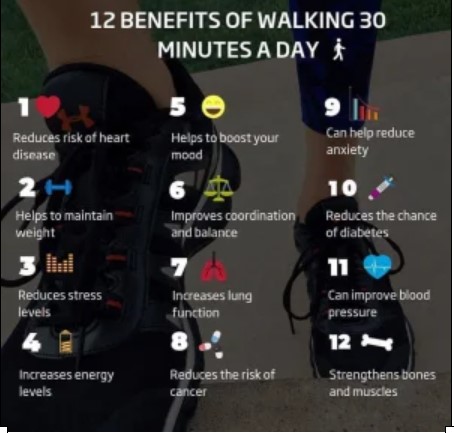
- physiorehabgroup_giaquaticsThe benefits of simply walking 🚶🏻♂️
.
.
.
.
.
.
#physicaltherapy #physiotherapy #physio #walking #gym #rehab #health #life #fitness #recovery #physiotips #potd #walkingbenefits

Health is Wealth
Here’s a fact that may surprise you: By the year 2020, depression is projected to be a leading social and economic burden worldwide — second only to coronary artery disease! Psychotherapy and antidepressants are effective but aren’t for everyone.
But there’s another treatment for depression that’s free and available to everyone: exercise. It will also lower your blood pressure, improve your cholesterol profile, help control blood sugar, and reduce your risk of heart disease, diabetes and common cancers. And, of course, help you achieve or maintain a healthy weight.
https://health.clevelandclinic.org/2016/03/get-happy-exercise-can-lift-mood-infographic/?
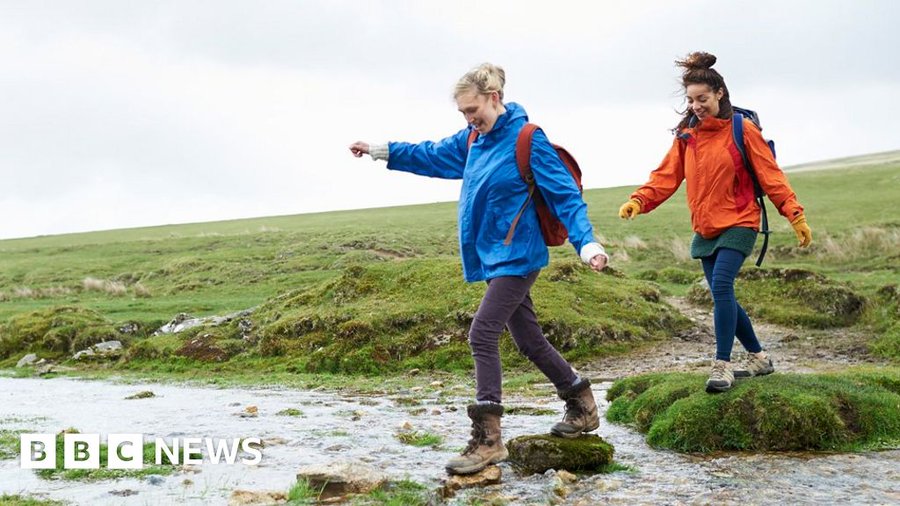
Walking is key to reducing the risk of death, according to a new study
By Annabel Rackham
BBC News
It has long been touted that 10,000 steps a day is the magic number you need to stay fit and healthy – but a new study shows fewer than 5,000 may be enough to see a benefit.
The analysis of more than 226,000 people around the world showed 4,000 was enough to start reducing the risk of dying prematurely of any cause.
Just over 2,300 is enough to benefit the heart and blood vessels.
The more you do, the more health benefits are seen, researchers said.
Every extra 1,000 steps beyond the 4,000 reduced the risk of dying early by 15% up to 20,000 steps.
The team from the Medical University of Lodz in Poland and Johns Hopkins University School of Medicine in the US found the walking benefits applied to all genders and ages, regardless of where they lived.
However, the biggest benefits were seen among the under-60s.
Prof Maciej Banach, from the Lodz university, said that while the number of advanced drugs for treatment was growing, they were not the only answer.
“I believe we should always emphasise that lifestyle changes, including diet and exercise, which was a main hero of our analysis, might be at least as, or even more, effective in reducing cardiovascular risk and prolonging lives,” he said.
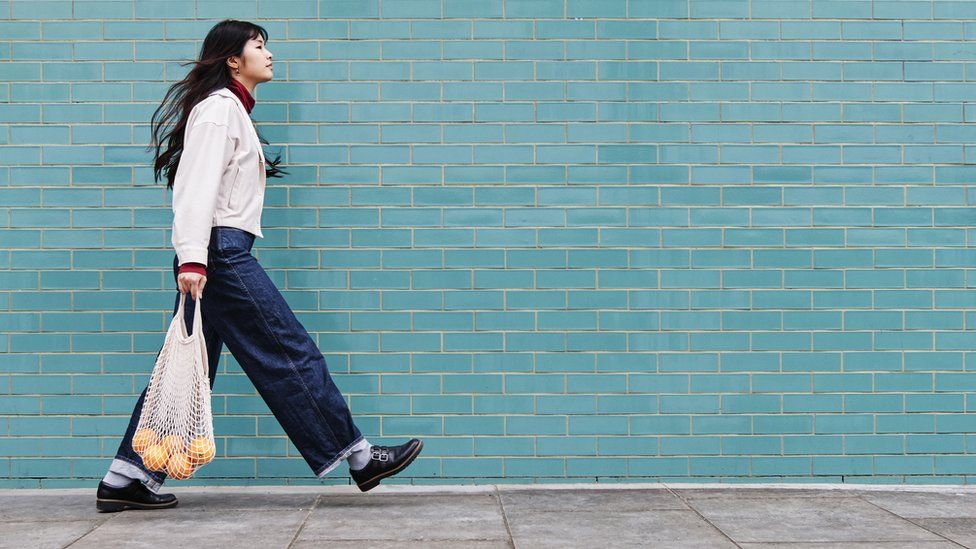
According to World Health Organization data, insufficient physical activity is responsible for 3.2 million deaths each year – the fourth most frequent cause worldwide.
Honey Fine, a personal trainer and instructor for global fitness company Barry’s, emphasises the problems that come from sitting down too much.
“It can slow your metabolism and affect muscle growth and strength, which can cause aches and pains,” she tells the BBC.
“Sitting down for too long can also cause all sorts of back problems, we find this a lot with people with office jobs, that their backs are constantly put in a stressed compressed position which causes a lot more problems later on in life.”
She explains the importance of non-exercise activity thermogenesis – also known as Neat, “which in simple terms is everything we do that uses energy and burns calories”.
“Tasks like standing, carrying shopping, washing the floors, hoovering, pacing whilst walking on the phone – it’s all the little things that make us more active that help us to burn calories more efficiently,” she said.
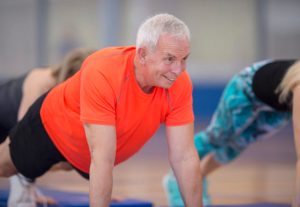
If you suffer from back pain, you’ve probably heard that strengthening your core can bring you some relief. But is this always true? And if so, how do you do it? We spoke with Cleveland Clinic physical therapist Patti Mariano, DPT, to find out.
When most people think about the core of the body they think of the abdominal or six-pack area just below the ribs. While the abdominal muscles are an important part of the core, we consider other areas important, too.
Your core includes:
Your core also includes the diaphragm and muscles of the pelvic floor. I also consider the gluteal muscles as core muscles.
Theoretically, if your muscles around the low back are weak, your body will rely more on passive structures, including ligaments — the tissue that connects bone to bone — as well as the spinal bones or discs, which lie between the spinal bones, for stability, which can cause pain.
But some studies have shown that specific core exercises are not any more beneficial than general exercise for low back pain. What we know is that exercise in general can help, and focusing on core muscles may provide some additional benefit.
Here are my top five:
For the plank exercises, start by holding them for 15 seconds to 30 seconds. For bird dog and scissors, try three sets of eight or 10 repetitions. For upward dog, do one set of 10 repetitions.
Any exercise performed incorrectly, whether it is core-strengthening or otherwise, has the potential to cause discomfort.
Twisting exercises or even incorrectly completing the exercises cited above can cause pain in the low back. But it’s highly unlikely that one repetition of an exercise will seriously harm your body, unless it’s an exercise using a very heavy weight.
The best way to keep your body safe is to listen to body cues such as pain during and immediately after an exercise, and the next day after exercising.
If any of the following is going on you should consult with your doctor:
Physical therapists train as musculoskeletal experts — they are the experts on muscles, bones and human movement. These professionals are the most qualified, aside from an orthopedic doctor, to assess back problems.
Since there are many factors that impact low back pain and many types of low back pain, it is a good idea to visit at least one time with a physical therapist for an evaluation and subsequent plan of care. This will give you an individually tailored plan with exercises that progress safely.
The idea of core strengthening, while beneficial, is just one piece of the low back pain puzzle.
https://health.clevelandclinic.org/2016/07/strong-core-best-guard-back-pain/

Harvard HealthVerified account @HarvardHealth 9 hours ago
Women who spend more time in green spaces live longer, according to recent analysis: http://bit.ly/2JLbqUa #HarvardHealth #outdoors
Walking is key to reducing the risk of death, according to a new study
By Annabel Rackham
BBC News
It has long been touted that 10,000 steps a day is the magic number you need to stay fit and healthy – but a new study shows fewer than 5,000 may be enough to see a benefit.
The analysis of more than 226,000 people around the world showed 4,000 was enough to start reducing the risk of dying prematurely of any cause.
Just over 2,300 is enough to benefit the heart and blood vessels.
The more you do, the more health benefits are seen, researchers said.
Every extra 1,000 steps beyond the 4,000 reduced the risk of dying early by 15% up to 20,000 steps.
The team from the Medical University of Lodz in Poland and Johns Hopkins University School of Medicine in the US found the walking benefits applied to all genders and ages, regardless of where they lived.
However, the biggest benefits were seen among the under-60s.
Prof Maciej Banach, from the Lodz university, said that while the number of advanced drugs for treatment was growing, they were not the only answer.
“I believe we should always emphasise that lifestyle changes, including diet and exercise, which was a main hero of our analysis, might be at least as, or even more, effective in reducing cardiovascular risk and prolonging lives,” he said.
According to World Health Organization data, insufficient physical activity is responsible for 3.2 million deaths each year – the fourth most frequent cause worldwide.
Honey Fine, a personal trainer and instructor for global fitness company Barry’s, emphasises the problems that come from sitting down too much.
“It can slow your metabolism and affect muscle growth and strength, which can cause aches and pains,” she tells the BBC.
“Sitting down for too long can also cause all sorts of back problems, we find this a lot with people with office jobs, that their backs are constantly put in a stressed compressed position which causes a lot more problems later on in life.”
She explains the importance of non-exercise activity thermogenesis – also known as Neat, “which in simple terms is everything we do that uses energy and burns calories”.
“Tasks like standing, carrying shopping, washing the floors, hoovering, pacing whilst walking on the phone – it’s all the little things that make us more active that help us to burn calories more efficiently,” she said.

Here’s a fact that may surprise you: By the year 2020, depression is projected to be a leading social and economic burden worldwide — second only to coronary artery disease! Psychotherapy and antidepressants are effective but aren’t for everyone.
But there’s another treatment for depression that’s free and available to everyone: exercise. It will also lower your blood pressure, improve your cholesterol profile, help control blood sugar, and reduce your risk of heart disease, diabetes and common cancers. And, of course, help you achieve or maintain a healthy weight.
https://health.clevelandclinic.org/2016/03/get-happy-exercise-can-lift-mood-infographic/?
 Healthaware