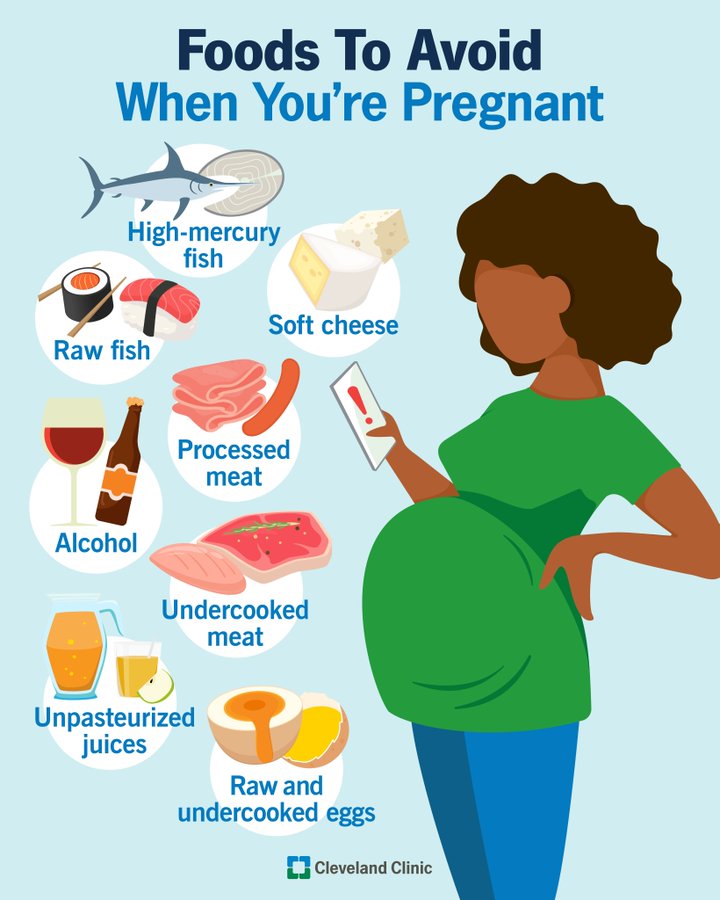
When you’re pregnant, it’s important to eat a healthy diet that provides the nutrients you need. That helps keep you feeling your best and promotes healthy fetal development. But pregnancy also puts you at higher risk for foodborne illness. Some foods and drinks can increase your risk for pregnancy complications. Avoid high-mercury fish and processed meat, and go easy on salt and caffeine.
An estimated 55 000 women are pregnant in #Gaza, with one third facing high-risk pregnancies. Around 130 babies are born each day, 27% by caesarean. Due to the aid blockade,
’s supplies for maternal and child health are critically low. Portable incubators, ventilators for neonatal intensive care, ultrasound machines, and oxygen pumps, along with 180 000 doses of routine childhood vaccines have not been permitted to enter, leaving ill newborns and young children without the life-saving care they urgently need. Lift the aid blockade. Protect health care. Ceasefire. Statementhttp://bit.ly/3XMLJul#WorldHealthDay
An estimated 55 000 women are pregnant in #Gaza, with one third facing high-risk pregnancies. Around 130 babies are born each day, 27% by caesarean. Due to the aid blockade,
’s supplies for maternal and child health are critically low. Portable incubators, ventilators for neonatal intensive care, ultrasound machines, and oxygen pumps, along with 180 000 doses of routine childhood vaccines have not been permitted to enter, leaving ill newborns and young children without the life-saving care they urgently need. Lift the aid blockade. Protect health care. Ceasefire. Statementhttp://bit.ly/3XMLJul#WorldHealthDay
The health of mothers and babies is the foundation of healthy families and communities, helping ensure hopeful futures for us all.
World Health Day, celebrated on 7 April 2025, will kick off a year-long campaign on maternal and newborn health. The campaign, titled Healthy beginnings, hopeful futures, will urge governments and the health community to ramp up efforts to end preventable maternal and newborn deaths, and to prioritize women’s longer-term health and well-being.
WHO and partners will also share useful information to support healthy pregnancies and births, and better postnatal health.
This task is critical. Tragically, based on currently published estimates, close to 300 000 women lose their life due to pregnancy or childbirth each year, while over 2 million babies die in their first month of life and around 2 million more are stillborn. That’s roughly 1 preventable death every 7 seconds.
Based on current trends, a staggering 4 out of 5 countries are off track to meet targets for improving maternal survival by 2030. 1 in 3 will fail to meet targets for reducing newborn deaths.
Listening to women and supporting families
Women and families everywhere need high quality care that supports them physically and emotionally, before, during and after birth.
Health systems must evolve to manage the many health issues that impact maternal and newborn health. These not only include direct obstetric complications but also mental health conditions, noncommunicable diseases and family planning.
Additionally, women and families should be supported by laws and policies that safeguard their health and rights.
Campaign goals
To raise awareness about gaps in maternal and newborn survival and the need to prioritize women’s longer-term well-being.
To advocate for effective investments that improve the health of women and babies.
To encourage collective action to support parents as well as health professionals who provide critical care.
To provide useful health information relating to pregnancy, childbirth, and the postnatal period.
Get involved
Here’s what you can do to support the campaign:
Spread awareness: share information about the campaign using #HopefulFutures and #HealthForAll.
Participate: attend our global events to learn more about what it will take to end maternal and newborn mortality.
Donate: contribute to the WHO Foundation which supports WHO’s work to protect mothers and babies in countries around the world.
The relationship between alcohol consumption and menstrual cycle: a review of the literature:
Abstract
Alcohol use affects men and women differently, with women being more affected by the health effects of alcohol use (NIAAA, 2011). Yet, a dearth of information investigating the alcohol use in women exists (SAMSHA, 2011). In particular, one dispositional factor hypothesized to contribute to alcohol consumption in women is the menstrual cycle. However, only 13 empirical papers have considered the menstrual cycle as related to alcohol consumption in women. These studies fall out with somewhat mixed findings suggesting that the premenstrual week is associated with increased, decreased, or no change in alcohol consumption, likely due to methodological differences in menstrual cycle determination and measures of alcohol consumption. These methodological differences and possible other contributing factors are discussed here with recommendations for future research in this area. Understanding the contribution of the menstrual cycle to alcohol consumption is one step in addressing an important women’s health concern.
Keywords: Alcohol consumption, Menstrual cycle, Women, Women’s health







 Healthaware