The potential dangers of kids using social media and — if you’re allowing them to use it — how to talk to them about how to stay safe, not overdo it and not take a lot of what they see on there too seriously:
Spending time on social media has become almost a way of life for most adults — scrolling through videos of cuddly cats and wacky dances for hours a day.
But is it healthy for your children to have the same habits? And how do you know if they’re being safe on social media?
Child psychologist Kate Eshleman, PsyD, discusses the potential dangers of kids using social media and — if you’re allowing them to use it — how to talk to them about how to stay safe, not overdo it and not take a lot of what they see on there too seriously.
How social media affects children
Most social media apps require users to be at least 13 years old. But in a recent poll, parents shared that 50% of children 10 to 12 years old and 33% of children 7 to 9 years old use social media apps.
If your child is currently on social media or if they’ve been asking to join, it’s important to talk to them about what social media is, what rules you have for it and how it doesn’t always show an accurate picture of someone’s life.
“Social media makes it easy to compare oneself to another,” says Dr. Eshleman. “Most people put on social media what they want you to see. And by using social media, all of us have the ability to access endless information anytime we want to and that can be very hard for kids.”
Impact on children
While experts are just beginning to understand social media’s impact on children, one study shows that children younger than 11 years old who use Instagram and Snapchat are more likely to have problematic digital behaviors like having online-only friends and visiting sites parents would disapprove of, as well as a greater chance of taking part in online harassment.
That same study says limiting how much time a child spends on social media may reduce some of the negative effects of using social media at such an early age.
Another study talks about how children who use TikTok are developing tics and having tic-like attacks. They’re experiencing a movement disorder brought on by stress and anxiety — presumably made worse by the pandemic and teens’ increased social media consumption.
In addition to problematic digital behaviors, there may be changes in children’s daily behavior at home like:
“If kids are being asked to get off social media and do their homework, then parents might see increased periods of irritability or frustration directed towards parents,” says Dr. Eshleman. “They’re being asked to do something they don’t want to do and stop doing something they enjoy.”
Dangers of social media
As a parent, it can be hard knowing what your child is doing online. There are dangers to be aware of, though, including:
“Kids don’t have the cognitive and executive functioning to think through harmful situations and why those might be a bad idea,” says Dr. Eshleman. “So sometimes they’re placing themselves in physical risk.”
What’s the solution?
Social media can have a positive effect on your child like helping them learn how to communicate with others, navigate relationships and how to manage somebody who isn’t being kind to them. So, no social media at all might not be the best (or realistic) solution for your kids.
But if you decide to let your children use social media, make sure to talk to them about expectations — both yours and theirs. Here are a few tips on how to navigate the social media world together:
Determine if your child is ready. Even if your child is old enough to join a social media platform, they might not be ready for it. As the parent, you have a good sense of their maturity level and how they interact with others like coaches and friends. If you’re unsure, Dr. Eshleman suggests doing a test period on social media. “Parents should identify their expectations and communicate those to their children,” she says. “Also, identify consequences of not following them.”
Talk to your kids. From the beginning, it’s important to have an open and honest conversation with your children on what social media is and what it can be used for. Ask why they’re interested in having an account on a particular platform and what they want to use it for. But as they start venturing into the world of social media, keep talking. “If you hear about a popular TikTok trend or that a newsworthy story is trending, talk to your children about what they think and what they’ve seen,” says Dr. Eshleman.
Limit screen time. The American Academy of Pediatrics recommends limiting screen time to two hours a day for children. Eshleman says that’s a good guideline but wants parents to also focus on the big picture — making sure your kid is still getting enough physical activity and face-to-face interactions. “It’s not always just the screen time that’s the problem,” she says. “It’s what the screen time is in place of.” You can always use a screen time app that automatically sets limits, too, to prevent arguing!
Monitor their usage. Dr. Eshleman suggests checking on what your child is consuming, whether that’s scrolling through their tablet or phone or using a social media monitoring tool. “See what apps are there and familiarize yourself with those,” she says. “Ask yourself if this tool is going to fit your goal.”
Model good behavior. Easier said than done, right? But Dr. Eshleman says practicing safe and healthy social media behaviors in front of your child can go a long way. “It’s much harder for kids to understand the potential dangers or risks of social media when parents engage in the same behaviors themselves,” she says.
The biggest takeaway? Go easy on yourself as a parent when it comes to social media and your kids. Don’t be afraid to talk to other parents about what they do or ask for help if you are struggling with how to navigate social media and keep your kids safe.
“For many parents, this is uncharted territory,” Dr. Eshleman says. “It takes time and energy, and it can be difficult for parents who are working, raising children and managing household tasks. It’s OK to ask for help.”
Moderate-to-vigorous exercise appears to boost cardiorespiratory fitness, which quantifies how well the heart & lungs supply oxygen to the muscles. Higher CRF during midlife is linked to a lower risk of heart disease later: https://bit.ly/3rEwvXe#HarvardHealth
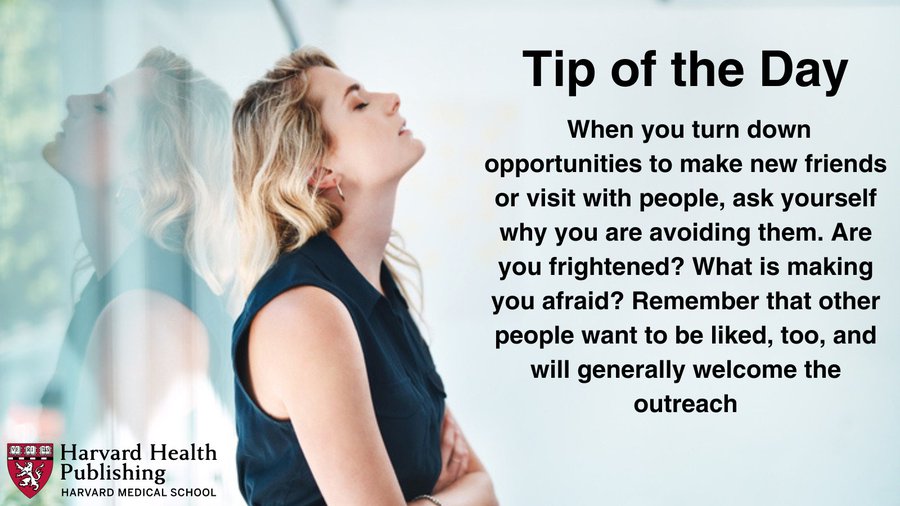
Overcome social apprehensions: When you turn down opportunities to make new friends or visit people, ask yourself why you are avoiding them. Remember that other people want to be liked, too, and will generally welcome the outreach. — #HarvardHealthTipoftheDay#HarvardHealth
Even when we have the best of intentions, we can tend to overindulge in … well, everything. Whether it’s a second helping of dinner, snacking on sweets or a venti-sized coffee, we often go a little too far. And that’s especially true — and risky — when it comes to alcohol.
Overdoing it with booze occasionally, like at a wedding or birthday party, might be fine (though your headache the next morning might make you think otherwise). But when does drinking frequently cross the line into being problematic? And what are the health risks of alcohol overconsumption? To gain some insight into these concerns, we spoke with hepatologist Jamile Wakim-Fleming, MD.
What are alcohol consumption guidelines?
It’s first best if we understand some of the dietary guidelines around alcohol. The U.S. Department of Agriculture and U.S. Department of Health and Human Services’ “Dietary Guidelines for Americans, 2020-2025” recommends adults of the legal drinking age should either not drink or limit their drinking to two drinks a day or fewer for men and one drink a day or fewer for women.
The guidelines say those who shouldn’t consume any alcohol under any circumstances include:
Anyone under the legal drinking age.
Anyone with liver disease.
Anyone who’s pregnant or might be pregnant.
Anyone with a medical condition or taking medication that has poor interactions with alcohol.
Anyone recovering from “an alcohol use disorder” or has trouble controlling their alcohol consumption.
As for how much alcohol is considered standard, the guidelines define a standard drink as:
12 ounces of 5% alcohol by volume (ABV) like beer.
8 ounces of 7% ABV like malt liquor.
5 ounces of 12% ABV like wine.
1.5 ounces of 40% ABV (or 80 proof) distilled spirits like gin, rum and whiskey.
There are nuances to consider with these guidelines, though. While major American brands of beer have a 5% ABV measurement, many popular craft beers have higher alcohol content. That IPA you love might have an ABV of 7% or higher, so keep an eye on it when you’re knocking them back at your next summer barbecue.
But, as Dr. Wakim-Fleming explains, we also have to be cautious when applying these guidelines to our own habits for several reasons that go beyond the alcohol content of your beverage.
Factors in alcohol consumption
According to Dr. Wakim-Flemings, there are a few factors to consider when it comes to alcohol affecting you because each person is different. She outlines the following as the main ones when weighing alcohol consumption.
Age. “A 50-year-old person will handle alcohol differently than someone who’s 70 years.”
Gender. “Women don’t tolerate the same amount of alcohol as men because they have less of a certain enzyme — alcohol dehydrogenase — that metabolizes the alcohol before it’s absorbed into the blood.”
Body size. If two people of different sizes intake the same amount of alcohol, the person with the smaller body carries less water and has a higher concentration of alcohol in their body, affecting the dilution.
Family history. Those who are raised in a household with parents who drink are more likely to have an adverse relationship with alcohol.
Comorbidities.Relatively healthy people will have an easier time processing alcohol than those with existing health issues.
Those factors are largely outside of our control. But other things we can control should also be considered, Dr. Wakim-Fleming advises. For instance, she says, “Drinking on an empty stomach is more toxic than if you’ve had something to eat. There’s no food to help absorb the alcohol so more goes into your blood system.”
And, again, there’s that percentage of alcohol to consider. “Remember that the percentages of alcohol vary among the types of alcohol,” she says. “Drinking 12 ounces of wine contains far more alcohol than 12 ounces of most common beers.”
How many drinks are too many?
Taking into account all of these factors, Dr. Wakim-Fleming says there are still ways to figure out where a person crosses the line into overindulging in alcohol, and separating what’s considered “binge” drinking, “heavy” drinking and “excessive” drinking.
What’s considered binge drinking?
Studies have shown that even if you only occasionally drink alcohol, drinking regularly over a long period can have negative outcomes on your health. “It’s a cumulating effect caused by drinking over time,” says Dr. Wakim-Fleming.
But a more present danger is binge drinking. According to the U.S. Centers for Disease and Prevention (CDC), binge drinking is classified for men as consuming five or more standard drinks within a few hours and four or more standard drinks within a few hours for women.
That kind of alcohol consumption can lead to severe reactions in your body, including:
Dehydration and headaches (a hangover, in other words).
Loss of motor skills that can lead to serious injuries.
The loss of judgment that comes from binge drinking can cause you to make poor choices, too, including driving under the influence, physical altercations and even further physical injury.
What’s considered excessive drinking?
Dr. Wakim-Fleming says excessive drinking is essentially the same as binge drinking. The CDC also includes underage drinking and drinking by women who are pregnant.
Most excessive drinking — more than 90%, according to the CDC — is binge drinking. Additional statistics on binge drinking from the CDC include:
More than 38 million adults in the U.S. are binge drinkers.
The average binge drinker does so around four times a month.
The average binge drinker consumes eight drinks per binge.
Most people who binge drink do not have an alcohol dependency.
Excessive drinking is something that’s thought of more in the short term, but can still be extremely damaging to your body, especially as it becomes a habit and potentially leads to more long-term, heavy drinking.
What’s considered heavy drinking?
While considered part of excessive drinking by the CDC, heavy drinking is applied to drinking over a longer period than binge drinking; while binge drinking is measured in an increment of two-to-three hours, heavy drinking is measured over a week.
“For women, heavy drinking is eight standard drinks a week or more,” says Dr. Wakim-Fleming, “While for men, it’s 15 drinks a week or more.” And, yes, multiple binges within a week do equal heavy drinking.
And no matter which category you fall into, there are consequences. “You subject your body to more health risks, to more toxicity and you begin a cycle of withdrawal problems,” she adds.
How does too much alcohol affect your body?
So, more about those consequences. “Alcohol affects the body in two ways,” says Dr. Wakim-Fleming. “The initial stage occurs right after drinking. Drinking causes inflammation of your swallowing tube [esophagus], stomach and gastrointestinal tract. Additionally, your liver is also inflamed which causes it to become enlarged and tender.”
If you stop drinking at this stage, she says, that inflammation is reversible. But if you continue to drink excessively over time or become a heavy drinker, that leads to serious complications.
Cancer
“If your drinking and inflammation continues daily, it leads to scarring and becomes irreversible, as in cirrhosis, which can lead to cancer,” notes Dr. Wakim-Fleming.
“The important thing to remember is that these organizations consider alcohol a modifiable risk factor for cancer, which means you can do something about it,” adds Dr. Wakim-Fleming. “That means following their guidelines and avoiding drinking.”
How alcohol affects your brain
You may not realize it, but the most common consequence of overconsumption of alcohol — the hangover — is the alcohol directly affecting your brain. In the immediate aftermath, your hangover can include poor concentration, lagging reflexes, headache, nausea and vomiting.
Over time, though, excessive amounts of alcohol do far more damage to your brain, resulting in consequences beyond just an unpleasant morning after. “You can end up with alcohol dementia and a type of nerve damage we call neuropathy,” cautions Dr. Wakim-Fleming.
Chronic alcoholism has also been linked to poor diets, which deprive your body of necessary vitamins and nutrients, which can compound issues with many parts of your body, including your brain and central nervous system.
How alcohol affects your heart
Alcohol can adversely affect muscles, and your heart is a muscle. Heavy drinking can lead to a poor diet, which means your muscles are using empty calories from alcohol rather than healthy foods.
The result can be a dilated heart muscle and, eventually, dilated cardiomyopathy. Your heart weakens and can’t pump blood as strongly, which can cause your kidneys to retain more fluid. That can lead to fluid build-up in your extremities and lungs, and even to congested heart failure.
How alcohol affects your liver
Excessive and heavy drinking can lead to cirrhosis and liver cancer. But, says Dr. Wakim-Fleming, the risks go beyond that.
Cirrhosis of the liver, which causes scar tissue that prevents your liver from functioning properly, is often caused by alcoholism. “Because that scarring affects the ability of the liver to function, it can lead to life-threatening conditions. And that’s why alcohol is one of the most common reasons for a liver transplant.”
Will one night of drinking impact your overall health?
Excessive drinking in one night can lead to acute damage and cause alcohol poisoning, which has severe consequences including, at its most extreme, death.
But if you drink only occasionally and in moderation — say, a glass of wine with dinner or a beer at a ballgame — it’s not going to create long-term damage. It’s all about moderation and avoiding chronic use, says Dr. Wakim-Fleming.
And while following recommended guidelines is important, it’s also about knowing yourself and your limits. “We don’t have personalized medicine when it comes to alcohol because everyone responds differently,” she says.
Even if you’re not overdoing it, consider taking a break or several breaks throughout the year. “Any break is good because your body needs time to reduce that inflammation. Taking a month or two off from consuming alcohol can help,” she suggests.
“Know your body, know your personal and family history and know your limits,” she continues. “Know what’s good for you because what works for others won’t necessarily work for you. Take charge of your health and if you need, seek help, whether from family, friends or other support groups and always discuss with your doctor.”
health.clevelandclinic.org
How Much Alcohol Is Too Much?
Learn how much alcohol is overdoing it in one sitting or over time.
Overcome social apprehensions: When you turn down opportunities to make new friends or visit people, ask yourself why you are avoiding them. Remember that other people want to be liked, too, and will generally welcome the outreach. — #HarvardHealthTipoftheDay#HarvardHealth
You go to the store to pick up some apples. Seems simple enough — until you’re faced with a dozen different varieties in the produce aisle. You want the healthiest apple, so which one will keep the doctor away? Dietitian Mira Ilic, RD, LD, reveals the juicy details about this popular fruit. Big difference in taste, not nutrition Apples have slightly different nutrients depending on their type and color. For instance, Red Delicious apples have polyphenols that are exclusively found in dark red fruits. Polyphenols are plant compounds that may help prevent cancer, heart disease and other conditions. But if the thought of biting into a Red Delicious isn’t appealing, don’t worry. Any apple you buy will deliver a punch of health-boosting nutrients. “The nutritional differences among apple varieties are small,” says Ilic. “But the taste differences are big. Don’t choose an apple based on a small nutrient difference if you don’t like the taste.” Choose fresh and local apples Whatever apple variety you pick, make sure it’s fresh. Old apples aren’t as nutritious, don’t taste as good and could be rotten. “Choose a firm apple with no bruises,” says Ilic. “Look for bright color, keeping in mind that some apple varieties are naturally more colorful. Fresh apples usually have a nice aroma, too.” Whenever possible, go with local apples. The less your apple had to travel, the more nutritious it is when it gets to you. July through October is prime apple season in the U.S. During these months, local apples are easy to find. When you choose apples in the off-season, check the sticker for its country of origin. If your apple traveled a long distance, it probably lost some of its nutrition in transport. Try to choose apples that come from a nearby country. “We don’t have the option to eat local apples year-round,” Ilic says. “In the off-season, we have to get apples from other parts of the world. No matter where they come from, wash them thoroughly.” You don’t need any chemicals or tools to wash your apples. Wash your hands first. Then wash your apple with running water. Gently scrub the skin with a cloth or brush. Are organic apples healthier? Some organic fruits may be slightly more nutritious than conventionally grown ones. But you don’t need to buy organic apples. They tend to cost more, which can be a downside if you’re sticking to a grocery budget. “Growers use different growing practices for organic apples and while pesticides are used on conventionally grown apples, some organic growers may actually use pesticides approved for organic farming,” explains Ilic. “The government has guidelines about what pesticides growers can use. Both types are safe and nutritious. Just wash them well if you’re still concerned about pesticide residue or you can peel your apples, but you’ll lose some nutrients and fiber found in the skin.” Have fun with apple sampling With so many apple varieties, you’re bound to find one you like. Hold an apple sampling by picking a few different types. Cut them into bite-sized pieces, put them on a plate and label them. Have your family members try the different apples and choose their favorite. An apple sampling can be a fun way to get kids to eat more apples, too. Kids often like having some control over the types of foods they eat. All apples are amazing Whether your favorite is a sour Granny Smith or a sweet Honeycrisp, you can’t go wrong with apples. “All apples are a good source of fiber, including pectin, which may help lower cholesterol,” Ilic says. “They also contain phytochemicals like polyphenols, which are antioxidants linked to multiple health benefits. Some studies have suggested that apples may also help reduce the risk of some cancers.” Bottom line: An apple a day is a healthy habit, so don’t stress about picking the right one. “Eat the apples you like because they’re all healthy,” Ilic says. FACEBOOK TWITTER LINKEDIN PINTEREST Email applesfiber
Taking short breaks throughout the day is beneficial for your mental health. Cleveland Clinic Yoga Program Manager, Judi Bar, shares stretches you can do wherever you are. #NationalYogaMonthpic.twitter.com/hIdb9GQkQO
Exercise is a vital part of a healthy lifestyle. But if you’ve gotten out of the habit of being active — or have never found an exercise routine that works — it might feel like an impossible task to get started. Luckily, it’s never too late to figure out a workout routine. Here’s how to start exercising — and tips to stay motivated when all you want to do is hang out on the couch instead. What should I include in my exercise program? Every exercise session should include a warm-up, a conditioning phase and a cool-down phase. The warm-up In a nutshell, a warm-up helps your body adjust slowly from rest to exercise. Making this part of your routine reduces the stress on your heart and muscles, and slowly increases your breathing, circulation (heart rate) and body temperature. A warm-up can also help improve your flexibility and reduce muscle soreness. The best warm-up includes stretching, range of motion activities and beginning the activity at a low-intensity level. Conditioning phase The conditioning phase follows the warm-up and is the time when you’re burning calories and moving and grooving. During the conditioning phase, you should monitor the intensity of your activity. The intensity is how hard you’re exercising, which can be measured by checking your heart rate. Over time, you can work on increasing the duration of the activity. The duration is how long you exercise during one session. Cool-down phase The cool-down phase is the last phase of your exercise session. It allows your body to gradually recover from the conditioning phase. Your heart rate and blood pressure will return to near-resting values. However, a cool down does not mean tosit down. In fact, for safety reasons, don’t sit, stand still or lie down right after exercise. This might cause you to feel dizzy, lightheaded or have heart palpitations (fluttering in your chest). The best cool down is to slowly decrease the intensity of your activity. You might also do some of the same stretching activities you did in the warm up. General exercise guidelines In general, experts recommend doing a five-minute warm up, including stretching exercises, before any aerobic activity, and include a five- to 10-minute cool down after the activity. Stretching can be done while standing or sitting. Here are some other things to keep in mind when starting a workout routine: Determine the best exercise routine for your lifestyle Not everybody likes to hop out of bed in the morning and go for a run. Figuring out a routine that fits your lifestyle can help you be more successful. Here are some questions you can think about before choosing a routine: What physical activities do I enjoy? Do I prefer group or individual activities? What programs best fit my schedule? Do I have physical conditions that limit my choice of exercise? What goals do I have in mind? (These might include losing weight, strengthening muscles or improving flexibility, for example.) Don’t try and exercise too much too fast Gradually increase your activity level, especially if you haven’t been exercising regularly. Guidelines around how often to exercise also differ depending on your age, any health conditions you have and your fitness history. Set big and small goals — and be specific If you’re looking to reach a particular goal, exercise specialist Ben Kuharik suggests setting mini goals to achieve along the way. This ensures your motivation stays strong over the long haul. Setting a specific goal is also important. “For example, if you want to lose some weight, it’s hard to be motivated or stick to a plan,” he says. “That’s because you don’t have the excitement in knowing you are getting closer to achieving it.” Having smaller goals or milestones to reach in between the big ones keeps you on track. “If you want to lose 8 pounds in two months — and you set a mini goal of losing 1 pound a week in the process — you get the sense of accomplishment that reaffirms your efforts,” Kuharik says. “And this can snowball into achieving even greater goals.” This also applies if you fall short of your goal. “If you only lose 7 pounds in two months, you’re still 7 pounds down than when you started,” Kuharik affirms. “You’ll feel great about the progress you’ve already made.” Schedule exercise into your daily routine Plan to exercise at the same time every day, such as in the mornings when you have more energy or right after work. Add a variety of exercises so you don’t get bored. Where exercise is concerned, something is also always better than nothing. “Not every day will go as planned,” Kuharik notes. “If you unexpectedly have a tight schedule or are even just having an off day, doing half of your planned workout that day is much more rewarding and beneficial than skipping it altogether.” Exercise at a steady pace Keep a pace that allows you to still talk during the activity. Be sure not to overdo it! You can measure the intensity of your exercise using the Rated Perceived Exertion (RPE) scale. The RPE scale runs from 0 to 10 and rates how easy or difficult you find an activity. For example, 0 (nothing at all) would be how you feel when sitting in a chair; 10 (very, very heavy) is how you feel at the end of an exercise stress test or after a very difficult activity. In most cases, you should exercise at a level that feels 3 (moderate) to 4 (somewhat heavy). Keep an exercise record Keep a record of how much and when you exercise. This can help you look at goal-setting, as well as get a sense of how much activity you’re doing in a given week. Time your eating and drinking properly Wait at least one and a half hours after eating a meal before exercising. When drinking liquids during exercise, remember to follow any fluid restriction guidelines you might have. Only buy what you need Exercise doesn’t have to put a strain on your wallet. Avoid buying expensive equipment or health club memberships unless you’re sure you’ll use them regularly. But you’ll want to dress for the weather (if working out outside) and wear protective footwear. Sneakers are the one thing you should prioritize, as you want to make sure your feet are protected. Stick with it If you exercise regularly, it’ll soon become part of your lifestyle. Make exercise a lifetime commitment. Finding an exercise “buddy” can also help you stay motivated. Don’t forget to have fun Exercising should be fun and not feel like a chore. “Consistency is key — but to do something consistently, it’s important to find a way to enjoy it,” Kuharik says. So, above all, choose an activity you enjoy! You’ll be more likely to stick with an exercise program if you don’t dread working out. “Try to look at exercise as an opportunity to get away from stress, clear your mind and leave nagging thoughts at the door,” Kuharik encourages. “With this in mind, over time, you will look forward to giving your mind a break and feeling good after a great workout session!” Exercise: Where To Start You should always talk to your doctor before starting an exercise routine. Together, you can figure out a plan to ease into regular physical activity. And walking and climbing stairs are two easy ways to start an exercise program. Walking guidelines Start with a short walk. See how far you can go before you become breathless. Stop and rest whenever you’re short of breath. Count the number of steps you take while you inhale. Then exhale for twice as many steps. For example, if you inhale while taking two steps, exhale through pursed lips while taking the next four steps. Learn to walk so breathing in and exhaling out become a habit once you find a comfortable breathing rate. Try to increase your walking distance. When setting specific goals, you might find you can go farther every day. Many people find that an increase of 10 feet a day is a good goal. Set reasonable goals. Don’t walk so far that you can’t get back to your starting point without difficulty breathing. Remember, if you’re short of breath after limited walking, stop and rest. Never overdo it. Always stop and rest for two or three minutes when you start to become short of breath. Stair climbing Hold the handrail lightly to keep your balance and help yourself climb. Take your time. Step up while exhaling or breathing out with pursed lips. Place your whole foot flat on each step. Go up two steps with each exhalation. Inhale or breathe in while taking a rest before the next step. Going downstairs is much easier. Hold the handrail and place each foot flat on the step. Count the number of steps you take while inhaling, and take twice as many steps while exhaling. Whichever activity you choose, remember, even a little exercise is better than none! FACEBOOK TWITTER LINKEDIN PINTEREST Email aerobic exerciseexerciseexercise and heart healthexercise planmoderate exercise









 Healthaware