

·
Remember to use #WorldPTDay so people can follow and share your activities for World PT Day http://ow.ly/583M50KyRRp #GlobalPT

No pain, no gain? Not true for people suffering from chronic back pain. Instead, it’s the opposite: Back pain is one of the main causes of missed work (and missed paychecks).
But could the key to coping with chronic back pain be in your mind? “We actually know that pain is not just a sensory, or physical, experience,” says psychologist Sara Davin, PsyD, MPH. “It is also an emotional experience.”
Dr. Davin explains how you can harness your pain management super-powers by understanding the very real connection between pain and your thoughts.
To understand how it all works, think of pain’s purpose. Pain is your brain’s way of alerting you that something is wrong, whether it’s a stubbed toe or a slipped disk.
How your brain processes an injury, then shares that information, has a direct connection to the level of pain you feel. You’re aware of pain because your brain tells you it’s there. (Psst — your brain also controls your thoughts and emotions.)
“Pain is processed in the brain and the central nervous system. Both have areas connected to the sensory experience, but both also have areas connected to the emotional experience,” Dr. Davin explains. “The sensory and emotional go together to create the output of one’s experience of pain. So to comprehensively treat chronic back pain, we have to look at both sides.”
And while traditional treatments like medications and physical therapy can take the edge off, they often ignore the elephant in the room: your thoughts.
“Managing back pain with behavioral medicine strategies might even prevent the pain from becoming chronic,” Dr. Davin states.
CBT for pain is talk therapy’s more specialized cousin. It’s a behavioral medicine strategy that teaches people how to:
Still not sold? Dr. Davin gives this example: Someone who feels that their pain is unbearable may cope by lying in bed and isolating themselves from activities they value. “This cycle can go on and on,” she explains. “The person becomes more helpless and then, from a physical standpoint, becomes weaker. Naturally, they now have even more pain.”
With CBT, that helpless feeling (and associated pain) is kicked to the curb because pain psychologists teach people how to:
The proof is in the pudding. Dr. Davin runs an interdisciplinary program that uses physical therapy and CBT to treat chronic back pain. Patients participate in this program for 4 to 10 weeks, depending upon their progress.
“Folks in the program were better when compared to physical therapy alone,” she reports. “We have consistently seen significant improvements across all quality of life measures, including how much pain interferes with someone’s life, levels of fatigue, anxiety and depression, plus improvements in pain-related disability.”
Interestingly, one of the metrics that improves the most in the program is how satisfied participants are in their social roles. “In our program we teach people how to start having fun again and connected with others,” Dr. Davin notes. “I suspect this is why we see people wanting to be more socially active after the program.”
Here’s how you can incorporate behavioral medicine strategies into your back pain management:
https://health.clevelandclinic.org/chronic-back-pain-you-may-find-relief-with-behavioral-medicine/

Take a ‘Paws’ With Downward Dog
This transitional and restorative yoga pose provides a full-body stretch
Physical therapist Dawn Lorring, PT, MPT, walks through the steps of how to do downward dog correctly and shares its many benefits.
From beginner’s yoga to more advanced practices, downward dog is one of the most popular poses…with a few common misconceptions.
Rounding your back, placing your feet too far apart or putting too much weight into your wrists can all create a deeper stretch than intended — which increases your risk of injury.
Physical therapist Dawn Lorring, PT, MPT, walks through the steps of how to do downward dog correctly and shares its many benefits.
Downward dog (also known as downward facing dog, facing dog pose or Adho Mukha Svanasana in Sanskrit) is a foundational yoga pose. It’s often used as a transition between movements, like sun salutations. It’s also a form of active resting, active stretching and strengthening. This allows you to check in with yourself and re-evaluate your intentions during your practice.
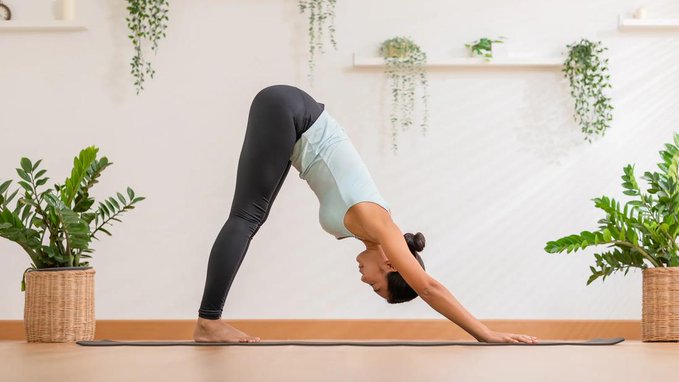
You do downward facing dog by putting your body into an inverted V-shape (or pyramid), as if there were a straight line that runs through the top of your head up your spine and out of your butt toward the ceiling.
Facing dog pose won’t usually be your first movement when doing yoga. Before trying it, it’s best to loosen up your muscles and joints and find ways to work it into your overall yoga practice.
Once you’re warmed up and ready to go, follow these steps:
“Downward facing dog isn’t about keeping your heels on the ground or holding it for long periods of time,” clarifies Lorring. “It’s really about making sure you’re going to a place that’s comfortable for you, so you can adjust your body as often as you need in this pose.”
If you have a hard time getting down on your hands and knees, try this wall variation:
For a more challenging stretch that deeply engages your hips and hamstrings:
Downward facing dog provides a full body stretch, while also strengthening and working your:
Adho Mukha Svanasana helps improve your flexibility and control, and provides you a moment of active rest. It also increases blood flow to your head and upper body when you’re in the inverted V position. But because of this, you should talk to your yoga instructor, athletic trainer or healthcare provider before starting this position if you have:
“Facing dog pose tries to improve flexibility but also builds the strength to control that flexibility,” says Lorring. “If you’re feeling excessive stress to a certain part of your body, then you’re probably holding the pose for too long or you’re trying to go into a range that you’re not ready for. We can help you get there.”

Take a ‘Paws’ With Downward Dog
This transitional and restorative yoga pose provides a full-body stretch
Physical therapist Dawn Lorring, PT, MPT, walks through the steps of how to do downward dog correctly and shares its many benefits.
From beginner’s yoga to more advanced practices, downward dog is one of the most popular poses…with a few common misconceptions.
Rounding your back, placing your feet too far apart or putting too much weight into your wrists can all create a deeper stretch than intended — which increases your risk of injury.
Physical therapist Dawn Lorring, PT, MPT, walks through the steps of how to do downward dog correctly and shares its many benefits.
Downward dog (also known as downward facing dog, facing dog pose or Adho Mukha Svanasana in Sanskrit) is a foundational yoga pose. It’s often used as a transition between movements, like sun salutations. It’s also a form of active resting, active stretching and strengthening. This allows you to check in with yourself and re-evaluate your intentions during your practice.
You do downward facing dog by putting your body into an inverted V-shape (or pyramid), as if there were a straight line that runs through the top of your head up your spine and out of your butt toward the ceiling.
Facing dog pose won’t usually be your first movement when doing yoga. Before trying it, it’s best to loosen up your muscles and joints and find ways to work it into your overall yoga practice.
Once you’re warmed up and ready to go, follow these steps:
“Downward facing dog isn’t about keeping your heels on the ground or holding it for long periods of time,” clarifies Lorring. “It’s really about making sure you’re going to a place that’s comfortable for you, so you can adjust your body as often as you need in this pose.”
If you have a hard time getting down on your hands and knees, try this wall variation:
For a more challenging stretch that deeply engages your hips and hamstrings:
Downward facing dog provides a full body stretch, while also strengthening and working your:
Adho Mukha Svanasana helps improve your flexibility and control, and provides you a moment of active rest. It also increases blood flow to your head and upper body when you’re in the inverted V position. But because of this, you should talk to your yoga instructor, athletic trainer or healthcare provider before starting this position if you have:
“Facing dog pose tries to improve flexibility but also builds the strength to control that flexibility,” says Lorring. “If you’re feeling excessive stress to a certain part of your body, then you’re probably holding the pose for too long or you’re trying to go into a range that you’re not ready for. We can help you get there.”


Dr Nina Byrnes and Angela O’Donoghue likedOne of my favourite things is to do some exercises with patients. Basic stuff for knee or shoulder pain but it is so rewarding to have something to offer other than tablets. Someday there will be a gym in my practice with physical therapists and I will be prescribing exercise.