Skip to content
Healthaware

Healthaware

Health is Wealth

  • Home

Tag: back pain

Posted on December 28, 2022

A Strong Core is Your Best Guard Against Back Pain @ClevelandClinic

A group of adults are taking a fitness class together at the gym. They are working out on exercise mats and are holding a high plank.

A physical therapist answers your questions

If you suffer from back pain, you’ve probably heard that strengthening your core can bring you some relief. But is this always true? And if so, how do you do it? We spoke with Cleveland Clinic physical therapist Patti Mariano, DPT, to find out.

Q: What is your core?

When most people think about the core of the body they think of the abdominal or six-pack area just below the ribs. While the abdominal muscles are an important part of the core, we consider other areas important, too.

Your core includes:

  • Front abdominal muscles — the rectus abdominis
  • Muscles along the side of your body — the internal and external obliques
  • A deep muscle that wraps around the front — the transverse abdominis
  • Muscles in your back that are located between your spine bones and run along your spine — the erector spinae and multifidi

Your core also includes the diaphragm and muscles of the pelvic floor. I also consider the gluteal muscles as core muscles.

Q: What is the relationship between core strength and back pain?

Theoretically, if your muscles around the low back are weak, your body will rely more on passive structures, including ligaments — the tissue that connects bone to bone — as well as the spinal bones or discs, which lie between the spinal bones, for stability, which can cause pain.

But some studies have shown that specific core exercises are not any more beneficial than general exercise for low back pain. What we know is that exercise in general can help, and focusing on core muscles may provide some additional benefit.

Q: What are some exercises for the core that can help with back pain?

Here are my top five:

  • Side plank — Sit on the floor with your right hand below your right shoulder and feet stacked. Lift your body, keeping your legs long, abdominals engaged and feet stacked. Hold. Repeat on the other side. You can modify this pose by dropping your bottom knee to the floor for extra support.
  • Plank — Kneel on all fours. Pull in your abdomen and step your feet behind you until your legs are straight. Keep your hands directly under your shoulders and your neck straight. Hold your abdomen and legs tight and avoid letting your lower back sag. Hold and breathe for 30 seconds. You can modify this pose by lowering your knees.
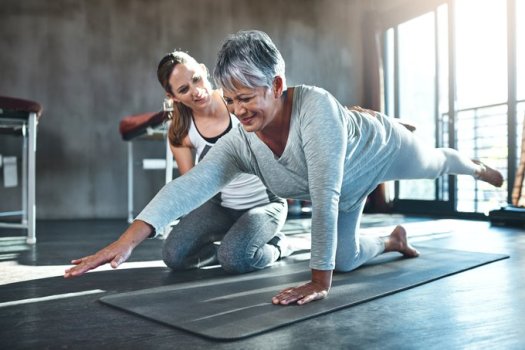
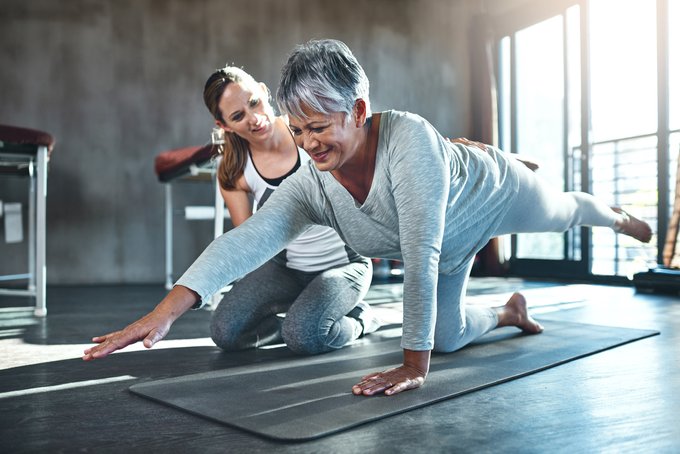
  • Bird dog — Kneel  on all fours. Reach one arm out in front of you, draw in your abdomen, and extend the opposite leg long behind you. Repeat on the other side.
  • Scissors — Lie on your back with your arms at your sides and legs pointed straight into the air above your hips. Press your lower back into the mat and tighten your abdomen. Lower your right leg until it’s a few inches from the floor. Raise your right leg up and begin lowering your left leg the same way. Continue switching right and left.
  • Upward dog — Lie face down with head slightly lifted and hands palm-down under your shoulders. Point your toes. Exhale, then press through your hands and the tops of your feet and raise your body and legs up until your arms are straight and your body and legs are off the ground. Keep your neck relaxed and long and thigh muscles tight as you hold and breathe.

For the plank exercises, start by holding them for 15 seconds to 30 seconds. For bird dog and scissors, try three sets of eight or 10 repetitions. For upward dog, do one set of 10 repetitions.

Q: Can you injure your back by trying to strengthen your core?

Any exercise performed incorrectly, whether it is core-strengthening or otherwise, has the potential to cause discomfort.

Twisting exercises or even incorrectly completing the exercises cited above can cause pain in the low back. But it’s highly unlikely that one repetition of an exercise will seriously harm your body, unless it’s an exercise using a very heavy weight.

The best way to keep your body safe is to listen to body cues such as pain during and immediately after an exercise, and the next day after exercising.

Q: When should you talk to a doctor about your back pain?

If any of the following is going on you should consult with your doctor:

  • Your pain has been going on for longer than a month, despite resting from activities that make it worse.
  • Your pain is getting worse.
  • Your pain wakes you from sleep.
  • Your pain is in your low back but also is going down one or both of your legs.
  • You notice that one leg is becoming weaker than the other.

Q: Where should you turn if you want help in creating a plan to address back pain?

Physical therapists train as musculoskeletal experts — they are the experts on muscles, bones and human movement. These professionals are the most qualified, aside from an orthopedic doctor, to assess back problems.

Since there are many factors that impact low back pain and many types of low back pain, it is a good idea to visit at least one time with a physical therapist for an evaluation and subsequent plan of care. This will give you an individually tailored plan with exercises that progress safely.

The idea of core strengthening, while beneficial, is just one piece of the low back pain puzzle.

https://health.clevelandclinic.org/2016/07/strong-core-best-guard-back-pain/

 

Posted on October 24, 2022October 24, 2022

Standing can help you lose weight, increase productivity, and lower risk of heart disease. @mayoclinicsport

Mayo Clinic Sports‏ @mayoclinicsport 14h14 hours ago

Sitting vs. Standing DYK that more standing and less sitting can help you lose weight, increase productivity, and lower risk of heart disease. Take a stand for health and success today! Learn more ➡️ https://mayocl.in/2Mbvqnm 

Posted on October 20, 2022

Yoga is a gentle practice that helps to reduce low back pain. @HarvardHealth


Harvard Health

@HarvardHealth
·
3h


Yoga is a gentle practice that is ideal for maintaining back strength and flexibility. It’s also one of the more effective tools for helping reduce low back pain, the most common source of pain and disability among older adults. https://bit.ly/3nRzFEP #HarvardHealth #Yoga
Posted on October 19, 2022October 19, 2022

Physical Therapy to ease back pain @ClevelandClinic


  •  
  •  

    Cleveland Clinic‏Verified account @ClevelandClinic Jun 3


The 3 most common reasons people develop back pain after age 50 are: http://cle.clinic/2qjWiUk 

Posted on September 24, 2022

A Gentle Yoga Sequence to Target Your Nerves

yoga journal therapeutic tool

A Gentle Yoga Sequence to Target Your Nerves
Your yoga practice can be a therapeutic tool for pain management and prevention. Try this gentle sequence to target your nerves and protect their signaling powers.
yogajournal.com

Join Tiffany Cruikshank at Yoga Journal’s upcoming event in January at 1440 Multiversity. Learn more at yogajournal.com/thepractice.

Jenny Jimenez

With all of the new and emerging information on pain science, yoga students and teachers have the opportunity to apply modern research to their practices and help alleviate and prevent pain.

Preliminary research suggests that gentle movement of your nerves is vital to both managing pain and supporting the general health of your nervous system. The idea is that healthy nerves should be able to gently slide, elongate, and angulate within neural tissues (some nerves can move as much as ¾ inch) in order to adapt to different loads and minimize pressure that can worsen existing pain, alter sensation, or lead to new pain patterns. Sometimes, tone and tension around neural tissues can be a problem. These tissues are bloodthirsty and rely on an important pressure gradient around them to maintain adequate blood flow. So even small changes in tissue tension around a nerve can be enough to block nerve mobility and lead to compression that disrupts blood flow and nerve signaling back to the brain, contributing to pain.

See also Low Back Pain 101: 3 Sequences to Ease Your Pain

To help you keep your nerves adaptable and protected, try the asana technique on the following pages based on an understanding of neurodynamics (the study of nerve movement through its surrounding tissues) and nerve pathways. We have the ability to alternately put tension on different ends of the nerve to create a movement of the nerve through the tissues, often referred to as nerve gliding. As you floss the nerve, you potentially allow it to move more freely so that it can communicate more efficiently with your brain. For example, the sciatic nerve runs through the back of your leg, so in Supta Padangusthasana (Reclining Hand-to-Big-Toe Pose) if you bend your knee (raised leg) and flex your foot, you’ll put tension on one end of the nerve (by your foot) and slack the other end (by your knee). This action draws the sciatic nerve and its branches toward your foot. Then, as you extend your knee and point your toes, you’ll reverse the areas of tension and slack. This action draws the branches of the sciatic nerve toward your knee. When you put these movements together you can encourage the sciatic nerve to move back and forth through its tissues more effortlessly. You also may down-regulate local inflammatory responses, restore healthy blood flow to the hard-working nerve, and encourage more efficient communication between your brain and body. Optimal signaling is crucial if you want your immune and nervous systems to function at their best, which is another reason to add nerve gliding to your repertoire.

The key to nerve gliding is to move gently within an easy range of motion. Since your target is the pain-free movement of your nerves, not of your muscles and fascia, you want very little sensation or stretch. It’s a great reminder that even in the physical body there’s clearly more to what we do than just sensations or the feel-good endorphins associated with them. Another thing I love about this approach is that, in addition to being a safe way to work with pain, it’s very accessible since it’s about simple, gentle movements.

See also Reduce Pain and Discomfort with These Poses for the Pelvis

Sequence – Neurodynamic Movement

To begin, pick a nerve you want to focus on and find a range of motion that’s accessible, pain-free, and with very little (if any) stretching sensation. Do 5–10 repetitions of the pose or this sequence once or twice a day. If you’re using these moves more preventatively, try rotating a few of them into your regular practice a couple times a week, and remember that in group classes there’s more than just stretch and sensation affecting the tissues. Happy flossing!

Supta Padangusthasana (Reclining Hand-to-Big-Toe Pose)

What Science Tells Us About Preventing Nerve Pain With Stretching

Posted on September 10, 2022

Physical Therapy to ease back pain @ClevelandClinic


  •  
  •  

    Cleveland Clinic‏Verified account @ClevelandClinic Jun 3


The 3 most common reasons people develop back pain after age 50 are: http://cle.clinic/2qjWiUk 

Posted on August 24, 2022

Oneday there will be a gym in my practice with physical therapists and I will be prescribing exercise.@DrBrianHiggins

harvard strength trainingDr Nina Byrnes and Angela O’Donoghue liked

Brian Higgins‏ @DrBrianHiggins 18h18 hours ago

One of my favourite things is to do some exercises with patients. Basic stuff for knee or shoulder pain but it is so rewarding to have something to offer other than tablets. Someday there will be a gym in my practice with physical therapists and I will be prescribing exercise.

Posted on August 23, 2022

Physical Therapy to ease back pain @ClevelandClinic


  • Cleveland Clinic‏Verified account @ClevelandClinic Jun 3


The 3 most common reasons people develop back pain after age 50 are: http://cle.clinic/2qjWiUk 

Posted on August 22, 2022August 22, 2022

Physical Therapy to ease back pain @ClevelandClinic


  • Cleveland Clinic‏Verified account @ClevelandClinic Jun 3


The 3 most common reasons people develop back pain after age 50 are: http://cle.clinic/2qjWiUk 

Posted on August 2, 2022August 2, 2022

Stiff back? Try loosening up with these gentle stretches @ClevelandClinic

Cleveland Clinic
@ClevelandClinic

·
3m


Stretches to loosen up those tight back muscles:

Try These Yoga Poses to Improve Your Lower Back Flexibility
Stiff back? Try loosening up with these gentle stretches
health.clevelandclinic.org

https://health.clevelandclinic.org/try-these-yoga-poses-to-improve-your-lower-back-flexibility/?utm_medium=social&utm_s

Posts pagination

Previous page Page 1 … Page 5 Page 6 Page 7 … Page 21 Next page

Tags

  • Alcohol
  • Cleveland Clinic
  • Depression
  • diet
  • exercise
  • Female health
  • fitness
  • Harvard Health
  • Healthaware
  • heartaware
  • heart health
  • nutrition
  • physical activity
  • physiotherapy
  • yoga

Recent Posts

  • Milk really does do a body good. It’s high in calcium, vitamin D and potassium. And it’s also rich in a beneficial protein called casein! @ClevelandClinic
  • Milk really does do a body good. It’s high in calcium, vitamin D and potassium. And it’s also rich in a beneficial protein called casein! @ClevelandClinic
  • “Piglet?” said Pooh. “Yes Pooh?” said Piglet. “Do you ever have days when everything feels… Not Very Okay At All?
  • Running is great exercise. A dietitian talks about what runners should eat ― and when ― for optimal nutrition and performance. @HopkinsMedicine
  • Running is good for you  👍🙏  #BlackrockHealth
  • Physiotherapists allowed to refer patients for medical radiological procedures for the first time @RCSI_Irl
  • “Avoid Alcoholic Drinks” in the new European Code Against Cancer (5th edition) #alcohol Trauma
  • Our best balance boosters #physiotherapy😉 @HarvardHealth
  • 3 ways alcohol may be contributing to your back pain @ClevelandClinic
  • Take a fresh look at oatmeal – it’s not as simple as you think @American_Heart
  • Be Kind and Patient with New Mums 🩷@motherandbaby
  • Vitamin D is one of the most powerful nutrients for supporting the immune system @ClevelandClinic  🌞
  • Yes alcohol affects hormones in women by increasing estrogen and cortisol, and decreasing progesterone, Source: AI
  • Bananas nature’s perfect snack @ClevelandClinic #therapeutic
  • This fresh English Pea Pasta recipe is loaded with healthful pea protein and flavored with garlic, mint and grated Parmigiano Reggiano.@ClevelandClinic
  • Try our lighter carrot cake recipe.@clevelandclinic #homebaking
  • The best medicine for back pain may be good old-fashioned movement and exercise. @HarvardHealth
  • ‘Life is like riding a bicycle. To keep your balance, you must keep moving..@thecsp
  • Recipe: Perfect Chocolate Chia Pudding Sweet mix of coconut, cherries and chocolate @ClevelandClinic #foodaware #womenshealth
  • Cherry blossoms are the national flower of Japan, representing a time of renewal and optimism. @StPatricks #mentalhealth
Blog at WordPress.com.
  • Subscribe Subscribed
    • Healthaware
    • Join 1,722 other subscribers
    • Already have a WordPress.com account? Log in now.
    • Healthaware
    • Subscribe Subscribed
    • Sign up
    • Log in
    • Report this content
    • View site in Reader
    • Manage subscriptions
    • Collapse this bar
 

Loading Comments...