Harvard Health
@HarvardHealth
·
Exercise is an all-natural treatment to help fight #depression: https://bit.ly/3cjxyV4 #HarvardHealth

Health is Wealth

Wearing no clothes could lead to cooler skin temperatures that put ZZZs within reach
Many people believe they were born with the only pajamas needed for a good night’s sleep, but here’s the naked truth: No research directly confirms that sleeping in the buff leads to better slumber.
There is, however, some validity behind the idea of sleeping naked — namely regarding how a cooler skin temperature improves sleep quality.
So, should you consider stripping down at bedtime before sliding under the sheets? Let’s look at the potential benefits (and risks) with behavioral sleep disorders specialist Michelle Drerup, PsyD, DBSM.
There are some possible perks to nude sleeping … so, maybe? Here are a few reasons why you might want to slip off your clothes before slipping off to sleep.
Your body naturally works to lower its thermostat to doze off at night through its circadian rhythm, which regulates your sleep/wake cycle. The faster you cool off, the faster you typically catch some ZZZs, says Dr. Drerup.
That’s also one of the reasons why sleep experts recommended that you keep your bedroom temperature between 60 degrees Fahrenheit and 67 degrees Fahrenheit (15.5 degrees Celsius to 19.44 degrees Celsius) for optimal snoozing.
Ever toss and turn in bed because you’re too hot? Sleeping naked certainly removes any possibility of pajama-induced overheating interfering with a good night’s rest. It’s the absolute final move in shedding layers to stay cool.
“There’s no question that cooler is better than warmer for overall sleeping,” says Dr. Drerup.
And getting enough rest is key to … well, just about everything in day-to-day life. Waking up refreshed can help you manage stress more effectively, improve focus, boost performance and make you a more pleasant person.
Tight-fitting underwear can trap heat and moisture between your legs. What makes a yeast infection thrive? Yep — heat and moisture.
Sleeping naked (or even in loose-fitting cotton bottoms) allows for some air circulation around your vagina. Keeping the area cooler and drier may help reduce your chances of getting a yeast infection, too.
Heat isn’t a friend of male fertility. Regular exposure to higher temperatures for your testicles can cause sperm counts to drop. Wearing underwear that keeps things packed tight doesn’t exactly offer a cooling effect.
Studies show that men who wear boxers have a higher sperm count than their buddies in briefs. So if loose-fitting boxes help that much, imagine what 8 hours of no clothing might do.
Sleepwalkers may want to give the idea some extra thought to going au natural to avoid any potential awkward encounters, notes Dr. Drerup.
And if you’re not a fan of doing laundry, consider this: Your washing schedule for bedding may need to increase with more skin-to-sheet contact. (Gross fact: The skin cells you shed in a day can feed 1 million dust mites. You don’t want to turn your bed into their buffet.)
Going to bed “nearly” naked while wearing lightweight and loose-fitting garments can bring you similar quality sleep results as taking everything off. “Tank tops and boxer-style briefs don’t possess a ton of warming qualities,” says Dr. Drerup.
And while being cool is desirable for sleep, you also don’t want to be cold. There’s even evidence that wearing socks to bed to warm your tootsies can help you drift off to sleep.
Ultimately, what you wear to sleep is a personal choice. “There’s no proven benefit or harm to sleeping naked,” says Dr. Drerup. “Just do what feels right and then rest easy with your decision.”



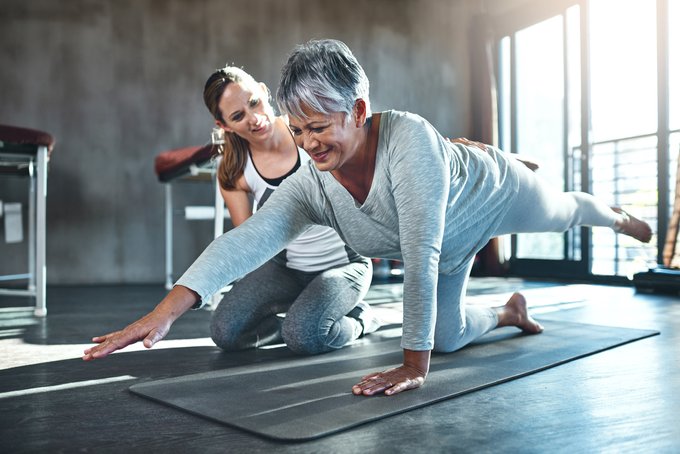

Join Tiffany Cruikshank at Yoga Journal’s upcoming event in January at 1440 Multiversity. Learn more at yogajournal.com/thepractice.
With all of the new and emerging information on pain science, yoga students and teachers have the opportunity to apply modern research to their practices and help alleviate and prevent pain.
Preliminary research suggests that gentle movement of your nerves is vital to both managing pain and supporting the general health of your nervous system. The idea is that healthy nerves should be able to gently slide, elongate, and angulate within neural tissues (some nerves can move as much as ¾ inch) in order to adapt to different loads and minimize pressure that can worsen existing pain, alter sensation, or lead to new pain patterns. Sometimes, tone and tension around neural tissues can be a problem. These tissues are bloodthirsty and rely on an important pressure gradient around them to maintain adequate blood flow. So even small changes in tissue tension around a nerve can be enough to block nerve mobility and lead to compression that disrupts blood flow and nerve signaling back to the brain, contributing to pain.
See also Low Back Pain 101: 3 Sequences to Ease Your Pain
To help you keep your nerves adaptable and protected, try the asana technique on the following pages based on an understanding of neurodynamics (the study of nerve movement through its surrounding tissues) and nerve pathways. We have the ability to alternately put tension on different ends of the nerve to create a movement of the nerve through the tissues, often referred to as nerve gliding. As you floss the nerve, you potentially allow it to move more freely so that it can communicate more efficiently with your brain. For example, the sciatic nerve runs through the back of your leg, so in Supta Padangusthasana (Reclining Hand-to-Big-Toe Pose) if you bend your knee (raised leg) and flex your foot, you’ll put tension on one end of the nerve (by your foot) and slack the other end (by your knee). This action draws the sciatic nerve and its branches toward your foot. Then, as you extend your knee and point your toes, you’ll reverse the areas of tension and slack. This action draws the branches of the sciatic nerve toward your knee. When you put these movements together you can encourage the sciatic nerve to move back and forth through its tissues more effortlessly. You also may down-regulate local inflammatory responses, restore healthy blood flow to the hard-working nerve, and encourage more efficient communication between your brain and body. Optimal signaling is crucial if you want your immune and nervous systems to function at their best, which is another reason to add nerve gliding to your repertoire.
The key to nerve gliding is to move gently within an easy range of motion. Since your target is the pain-free movement of your nerves, not of your muscles and fascia, you want very little sensation or stretch. It’s a great reminder that even in the physical body there’s clearly more to what we do than just sensations or the feel-good endorphins associated with them. Another thing I love about this approach is that, in addition to being a safe way to work with pain, it’s very accessible since it’s about simple, gentle movements.
See also Reduce Pain and Discomfort with These Poses for the Pelvis
To begin, pick a nerve you want to focus on and find a range of motion that’s accessible, pain-free, and with very little (if any) stretching sensation. Do 5–10 repetitions of the pose or this sequence once or twice a day. If you’re using these moves more preventatively, try rotating a few of them into your regular practice a couple times a week, and remember that in group classes there’s more than just stretch and sensation affecting the tissues. Happy flossing!

https://www.yogajournal.com/practice/gentle-yoga-sequence-to-target-your-nerves