If you’re planning to start an exercise program and wondering where to begin, start with your core first, says physical therapist Brittany Smith, DPT. People often think of the core muscles as being the abdominal muscles, but the core includes the muscles in the abdomen, back and hips, all working together as a group.
“The core muscles provide stability for the entire body as it moves,” says Smith. “These muscles are activated when you stand up, turn, bend, reach, twist, stoop and move in most other ways. Everything starts with your core.”
Strong core muscles help you maintain good posture, while weak ones can lead to slouching and slumping. Poor posture can be a cause of aches and pain, especially in the back.
Getting started with your core
To get your core muscles in shape, you need to exercise.
“Our bodies were made to move, so any physical activity is really important,” says Smith.
She recommends these specific core-strengthening exercises below.
The first one engages the deep muscles in the abdomen, called the transverse abdominis. “These muscles help hold us in a better position to stabilize our core, thereby stabilizing our arms and legs,” says Smith.
“The more you work on these muscles, the more it will become second nature to hold these muscles tight when you’re lifting grocery bags, doing yard work or any other kind of physical activity,” says Smith. This will help support your body.
Other muscles that tend to be weak are the gluteus maximus in the buttocks, and the gluteus medius and gluteus minimus on the side of the hip. The bridge and clamshell exercises can help strengthen these muscles.
Smith emphasizes that getting the proper position of these exercises correct is more important than the number of repetitions you do. “It’s better to take your time, maybe do fewer reps, but with better quality,” she says. For that reason, it can be helpful to have the guidance of a physical therapist to get started.
Move on from the core
Core exercises are the starting point of overall fitness because you need to hold those muscles engaged while you strengthen other muscles, such as the biceps in the arms or the quadriceps in the legs.
Smith suggests setting short-term goals (for about a month) and then more long-term goals. Once you have achieved short-term goals, such as getting around more easily, add other types of weight-training or resistance exercises to build muscle elsewhere.
With any exercise you do, always listen to your body, warns Smith. If you have pain other than muscle burn, take it easy. Reduce the number of repetitions, the weight or the duration of the exercises. Then build up gradually. “You don’t have to be in pain to make gains,” she says.
Beginner exercises for core strength
For each of the following, work up to one to two sets of 10 to 15 repetitions once a day.
Abdominal bracing
Lie on your back with your knees bent and feet flat on the floor. Contract your abdominal muscles, and press the arch of your back down toward the floor, pulling your belly button toward your spine. Hold for 5 to 10 seconds. Make sure your lower back stays flat on the floor. Relax and repeat.
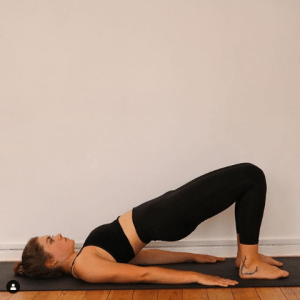
Bridge
Lie on your back with your knees bent and feet flat on the floor with your arms at your sides. Squeeze your abdominal and buttocks muscles, push your heels into the floor and slowly lift your buttocks and hips off the floor. Keep your back straight. Hold for 5 to 10 seconds.
Clamshell
Lie on your side with knees bent in line with your hips and back, draw up the top knee while keeping contact of your feet together as shown. Don’t let your pelvis roll back during the lifting movement. Hold for 5 seconds.
This transitional and restorative yoga pose provides a full-body stretch
Physical therapist Dawn Lorring, PT, MPT, walks through the steps of how to do downward dog correctly and shares its many benefits.
From beginner’s yoga to more advanced practices, downward dog is one of the most popular poses…with a few common misconceptions.
Rounding your back, placing your feet too far apart or putting too much weight into your wrists can all create a deeper stretch than intended — which increases your risk of injury.
Physical therapist Dawn Lorring, PT, MPT, walks through the steps of how to do downward dog correctly and shares its many benefits.
What is downward dog?
Downward dog (also known as downward facing dog, facing dog pose or Adho Mukha Svanasana in Sanskrit) is a foundational yoga pose. It’s often used as a transition between movements, like sun salutations. It’s also a form of active resting, active stretching and strengthening. This allows you to check in with yourself and re-evaluate your intentions during your practice.
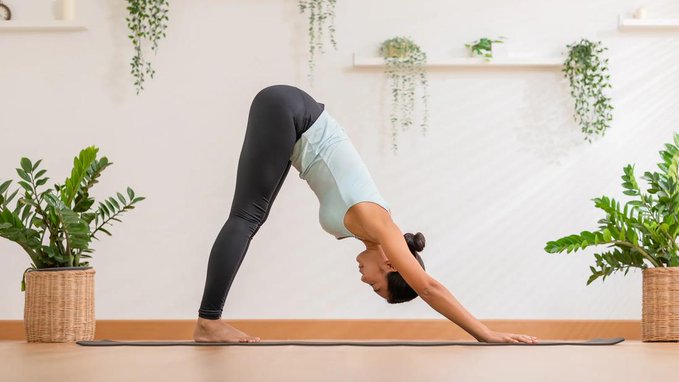
You do downward facing dog by putting your body into an inverted V-shape (or pyramid), as if there were a straight line that runs through the top of your head up your spine and out of your butt toward the ceiling.
How to properly do downward facing dog
Facing dog pose won’t usually be your first movement when doing yoga. Before trying it, it’s best to loosen up your muscles and joints and find ways to work it into your overall yoga practice.
Once you’re warmed up and ready to go, follow these steps:
Start on all fours with your hands shoulder-width apart and your knees in line directly behind your hips.
Spreading your fingers wide, press down into your hands and tuck your toes (almost like you’re using them to grip the floor beneath you).
As you exhale, bring your hips up and back, as if there’s a string pulling your butt toward the ceiling, so your body creates an inverted V-shape (or pyramid).
Focus on straightening your back, not rounding it, so your head and neck are relaxed between your upper arms. It helps to focus on pressing through your arms to “push” the ground away from you and keep your arms active.
Keep your legs straight and, if it’s comfortable for you to do so, try to drop your heels down to the floor.
Adjust your posture by shifting your weight between your hands and feet until you sink comfortably into the position.
Hold this pose for 10 to 15 seconds at a time, making sure to breathe throughout.
For a more relaxed stretch, bend your knees a little and readjust your posture as needed.
When you’re done, exhale and move into your next pose or slowly lower yourself to the floor to enter child’s pose.
“Downward facing dog isn’t about keeping your heels on the ground or holding it for long periods of time,” clarifies Lorring. “It’s really about making sure you’re going to a place that’s comfortable for you, so you can adjust your body as often as you need in this pose.”
Facing dog pose variations
If you have a hard time getting down on your hands and knees, try this wall variation:
Face the wall and place both your hands out in front of you so your palms are flat and your fingers are stretched out.
Keeping your head and back straight and your hands on the wall in front of you, slowly walk your legs backward.
As you move, walk your hands down the wall so you hinge at your hips and look directly at the floor.
Keeping your head and neck relaxed, hold this pose for 10 to 15 seconds before slowly returning to stand.
If you feel stress or discomfort in your wrists, you can modify by rolling up a towel or the edge of your yoga mat and placing the roll under the heels of your hands. This will decrease some of that pressure.
For a more challenging stretch that deeply engages your hips and hamstrings:
While in the downward facing dog position, lift one leg up and stretch it toward the ceiling.
For a deeper stretch, bend your outstretched leg back and over your body, so your knee is facing away from you.
Repeat this process with the other leg, holding the pose for as long as you feel comfortable on either side.
Downward dog benefits
Downward facing dog provides a full body stretch, while also strengthening and working your:
Adho Mukha Svanasana helps improve your flexibility and control, and provides you a moment of active rest. It also increases blood flow to your head and upper body when you’re in the inverted V position. But because of this, you should talk to your yoga instructor, athletic trainer or healthcare provider before starting this position if you have:
“Facing dog pose tries to improve flexibility but also builds the strength to control that flexibility,” says Lorring. “If you’re feeling excessive stress to a certain part of your body, then you’re probably holding the pose for too long or you’re trying to go into a range that you’re not ready for. We can help you get there.”
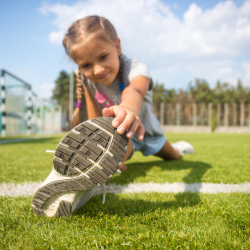
BRIDGING
This is the one of a physiotherapist’s staple exercises, if in doubt…bridge 😂
Often when children are growing, they come up against muscle imbalances, which can lead to aches and pains. A great way to protect the body from these is by keeping a good strong core!
A tip my top #pilates friend showed me was rolling the spine up and down, like a Mexican wave 👋🏽! Go follow @excellencepilates@excellence_physio for much more specialist knowledge than I can offer 😁
HOW TO INCORPORATE INTO PLAY
Get some lovely little cars or animals on one side of your child, and help them create a BRIDGE (!) so you can drive those little toys under their bottom!
….a traffic jam can always help you keep their bottom up for little longer 😏
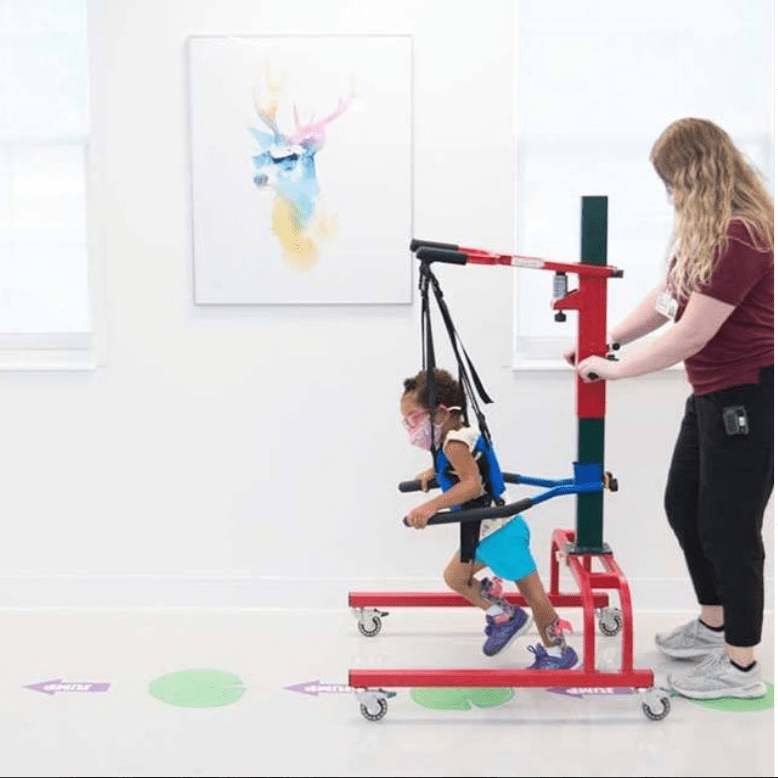
clevelandclinic Verified Way to go, Hannah! 🎉🎉 3-year old Hannah, born with cerebral palsy, has fun while learning to walk with our pediatric physical therapists at #ClevelandClinicChildrens!
We couldn’t think of a better way to celebrate National Physical Therapy Month than a walk around campus. Our therapists use play to work with children and their families on developmental skills, strength, flexibility, mobility and more!
RCSI welcomes progress in physiotherapist referral for medical radiological procedures
RCSI University of Medicine and Health Sciences has welcomed the policy decision to permit physiotherapists to refer patients for medical radiological procedures, and the progress made in implementing this important new measure which will make it quicker for patients to access a diagnosis and begin their treatment.
Physiotherapist referral for medical radiological procedures results in fewer health professionals being involved in the patient pathway. At present, physiotherapists with advanced training can refer their patients for radiological investigations, such as X-ray, in several jurisdictions including England, Sweden, Canada and New Zealand.
Physiotherapists in Ireland will soon be invited to undertake advanced training which will allow them to refer their patients for radiological procedures. Initially, clinical specialist physiotherapists working in roles in specific clinical areas in the HSE are being invited to train for the authority to refer. In early 2025, application to the training programmes will then be opened more widely.
Professor Suzanne McDonough, Head of the RCSI School of Physiotherapy, said: “This is an important development which will lead to efficiencies in the patient pathway and reduce barriers to effective treatment for a range of musco-skeletal conditions.
“The evidence from the countries which already permit physiotherapist referral for radiological procedures is positive, with no serious adverse events reported and with many advantages for the patient and the health system,” added Professor McDonough.
An Expert Working Group was established in March 2024 to support the development and implementation of this policy. The group includes representation from Department of Health, Health Service Executive, CORU, UCD and the Irish Society of Chartered Physiotherapists.
Established in 1999, the RCSI School of Physiotherapy aims to educate professionally safe, competent, reflective and analytical physiotherapists.
Many older adults focus on exercise and diet to stay healthy. But one of the worst offenders to health—poor balance—is often an afterthought. “I see a lot of older adults who are nonchalant about balance,” says Liz Moritz, a physical therapist at Harvard-affiliated Brigham and Women’s Hospital.
Unfortunately, imbalance is a common cause of falls, which send millions of people in the United States to emergency departments each year with broken hips and head injuries. But there are many things you can do to improve your balance. The strategies below are some of the most effective.
Physical therapy
Physical therapy for balance focuses on the ability of the joints and brain to communicate, the balance system in the ear (the vestibular system), and vision. “We coordinate all three with exercises such as standing on one foot, first with the eyes open, and then with the eyes closed. We also work on joint flexibility, walking, and lower-extremity exercises on one or two legs,” says Moritz. Other exercises that boost balance include chair stands (see “Move of the month”) and squats. Make sure you get training before attempting these exercises at home.
Muscle strengthening
“Core strength is very important for balance. If the abdominal muscles in your core are weak, they cannot support your limbs, especially when you’re walking. If the gluteal muscles in your buttocks and hips aren’t strong, they won’t be able to propel you forward,” says Moritz. Muscle strengthening can help. Moritz suggests starting with gentle core exercises like a pelvic tilt (lie on the floor with your knees bent up, then roll your pelvis up) and then moving to more intense exercises such as wall planks (stand six inches from a wall, keeping your body rigid, then lean forward with your forearms flat against the wall, and hold the position for 20 seconds). Leg lifts will strengthen the gluteal muscles, and adding resistance bands to leg lifts makes the exercise even more effective.
Tai chi and yoga
“Tai chi and yoga are exercises that make you pay attention to the control and quality of movement, rather than the quantity, which improves your balance,” says Moritz. In tai chi, you practice slow, flowing motions and shift your weight from one limb to another. Yoga incorporates a series of focused postures and breathing. Both exercises increase flexibility, range of motion, leg and core strength, and reflexes. The result: you become better at balancing in a number of different positions, which helps you avoid falling if you encounter uneven pavement or obstacles in your path.
Vision correction
“If you can’t see where you’re going, your fall risk goes up,” says Moritz. “A lot of people I treat for balance are here be-cause they tripped when they didn’t see something on the floor.” The fix may be as simple as a new eyeglasses prescription. Get a comprehensive, dilated eye exam every one or two years if you’re 65 or older, every one to three years if you’re age 55 to 64, and every two to four years if you’re 40 to 54. If you have an increased risk for other eye conditions, you may need an eye exam more often.
Assistive walking devices
A cane or a walker can complement your balance and give you more stability and confidence walking. But don’t buy a device on your own. “If it’s too high or too low, that can cause a fall. You need to get it measured, and you need training to learn how to use it,” says Moritz. Training takes just a few physical therapy sessions. Walkers are available with wheels intended for different terrain, lockable brakes, seats, baskets, and other features such as headlights. Canes are available with various handgrips and bases.