On Friday’s #BBCMorningLive Dr Punam’s looking at the latest health news including how music could help people with dementia and that scientists may have found the cause of Multiple Sclerosis. If you have any health questions, email us morninglive@bbc.co.uk or reply below
This transitional and restorative yoga pose provides a full-body stretch
Physical therapist Dawn Lorring, PT, MPT, walks through the steps of how to do downward dog correctly and shares its many benefits.
From beginner’s yoga to more advanced practices, downward dog is one of the most popular poses…with a few common misconceptions.
Rounding your back, placing your feet too far apart or putting too much weight into your wrists can all create a deeper stretch than intended — which increases your risk of injury.
Physical therapist Dawn Lorring, PT, MPT, walks through the steps of how to do downward dog correctly and shares its many benefits.
What is downward dog?
Downward dog (also known as downward facing dog, facing dog pose or Adho Mukha Svanasana in Sanskrit) is a foundational yoga pose. It’s often used as a transition between movements, like sun salutations. It’s also a form of active resting, active stretching and strengthening. This allows you to check in with yourself and re-evaluate your intentions during your practice.
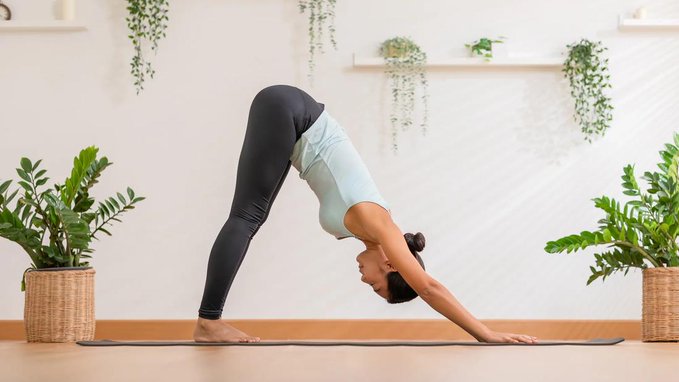
You do downward facing dog by putting your body into an inverted V-shape (or pyramid), as if there were a straight line that runs through the top of your head up your spine and out of your butt toward the ceiling.
How to properly do downward facing dog
Facing dog pose won’t usually be your first movement when doing yoga. Before trying it, it’s best to loosen up your muscles and joints and find ways to work it into your overall yoga practice.
Once you’re warmed up and ready to go, follow these steps:
Start on all fours with your hands shoulder-width apart and your knees in line directly behind your hips.
Spreading your fingers wide, press down into your hands and tuck your toes (almost like you’re using them to grip the floor beneath you).
As you exhale, bring your hips up and back, as if there’s a string pulling your butt toward the ceiling, so your body creates an inverted V-shape (or pyramid).
Focus on straightening your back, not rounding it, so your head and neck are relaxed between your upper arms. It helps to focus on pressing through your arms to “push” the ground away from you and keep your arms active.
Keep your legs straight and, if it’s comfortable for you to do so, try to drop your heels down to the floor.
Adjust your posture by shifting your weight between your hands and feet until you sink comfortably into the position.
Hold this pose for 10 to 15 seconds at a time, making sure to breathe throughout.
For a more relaxed stretch, bend your knees a little and readjust your posture as needed.
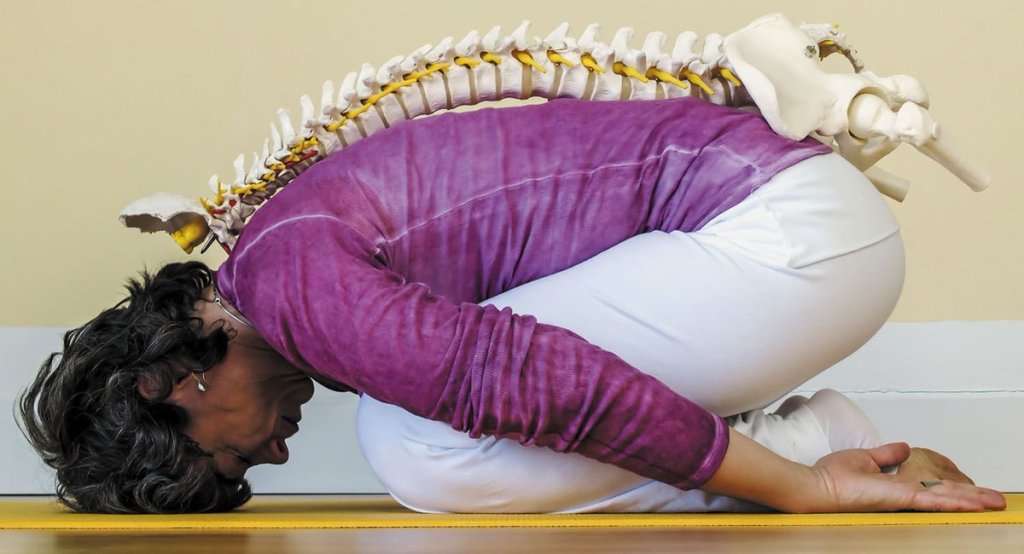
When you’re done, exhale and move into your next pose or slowly lower yourself to the floor to enter child’s pose.
“Downward facing dog isn’t about keeping your heels on the ground or holding it for long periods of time,” clarifies Lorring. “It’s really about making sure you’re going to a place that’s comfortable for you, so you can adjust your body as often as you need in this pose.”
Facing dog pose variations
If you have a hard time getting down on your hands and knees, try this wall variation:
Face the wall and place both your hands out in front of you so your palms are flat and your fingers are stretched out.
Keeping your head and back straight and your hands on the wall in front of you, slowly walk your legs backward.
As you move, walk your hands down the wall so you hinge at your hips and look directly at the floor.
Keeping your head and neck relaxed, hold this pose for 10 to 15 seconds before slowly returning to stand.
If you feel stress or discomfort in your wrists, you can modify by rolling up a towel or the edge of your yoga mat and placing the roll under the heels of your hands. This will decrease some of that pressure.
For a more challenging stretch that deeply engages your hips and hamstrings:
While in the downward facing dog position, lift one leg up and stretch it toward the ceiling.
For a deeper stretch, bend your outstretched leg back and over your body, so your knee is facing away from you.
Repeat this process with the other leg, holding the pose for as long as you feel comfortable on either side.
Downward dog benefits
Downward facing dog provides a full body stretch, while also strengthening and working your:
Adho Mukha Svanasana helps improve your flexibility and control, and provides you a moment of active rest. It also increases blood flow to your head and upper body when you’re in the inverted V position. But because of this, you should talk to your yoga instructor, athletic trainer or healthcare provider before starting this position if you have:
“Facing dog pose tries to improve flexibility but also builds the strength to control that flexibility,” says Lorring. “If you’re feeling excessive stress to a certain part of your body, then you’re probably holding the pose for too long or you’re trying to go into a range that you’re not ready for. We can help you get there.”
You’re taking cough syrup and lozenges in an attempt to get some relief. But what about using honey for sore throat symptoms? Does this natural home remedy actually work to soothe a sore throat and cough?
In addition to having other symptoms like nasal congestion, fatigue and fever, you may develop a cough.
Honey has a long history of being used as a natural remedy. And one remedy is to soothe sore throats and help alleviate a cough.
“Research shows that honey has some antimicrobial and anti-inflammation properties. Honey can help by decreasing inflammation and irritation in your throat,” explains Dr. Rainbolt. “Another study shows that honey may reduce mucus secretion. So, you can use honey for cough symptoms as well, whether it’s a wet or dry cough.”
Is it safe for children?
Giving honey to a child under 1-year-old isn’t recommended, warns Dr. Rainbolt.
“There’s concern for an infant botulism, a serious illness that’s caused by Clostridium botulinum,” she continues. “While it’s a rare occurrence, honey can contain spores that cause botulism. It attacks the body’s nervous system and children under one are more vulnerable.”
How to use for a sore throat
Most sore throats tend to get better within a week, but during that time, adults can take a spoonful (about 1 teaspoon) of honey for a cough and sore throat.
You can also dilute half a teaspoon to 1 teaspoon of honey in warm water or tea. This method is also recommended for children older than 1.
“You can use it with any kind of herbal tea or warm water with lemon juice, which can be soothing as well,” says Dr. Rainbolt.
So, how often can you use this home remedy? Dr. Rainbolt recommends using honey no more than four or five times a day.
And part of that reasoning is that honey does contain sugar.
“If you’re concerned about your sugar intake, then I recommend using honey more sparingly,” she says. “I would just use it at night to give you some relief before you go to bed.”
And can you use both honey and traditional cold medicine?
Yes, says Dr. Rainbolt.
“If it seems like the honey isn’t helping on its own, then you can certainly do both honey and medication, if medicine is something that you are able to take,” she notes.
Is honey safe to use?
Honey can be a helpful tool for those who can’t take traditional cold medications — for example, children under 6 years old or individuals with health conditions like high blood pressure or cardiovascular disease.
Overall, honey can be a good way to help soothe your sore throat and cough. It doesn’t come with some of the side effects that over-the-counter medications have like drowsiness.
So, can you just buy any honey you see on the grocery store shelf?
Yes, but you might want to make sure it’s been pasteurized. The pasteurization process removes any crystallization and unwanted yeast. It also improves honey’s texture and color, while extending its shelf life.
Dr. Rainbolt also mentions that some people think using local honey, which tends to be unpasteurized or raw, can come with extra benefits.
“There’s a thought that if you use local honey, you are exposed to some of the area’s natural allergens in a positive way,” she explains. “The idea is that it will help with allergies you have.”
The next time your throat starts to tickle, reach for honey and see if it helps.
“Think of honey as a first line of defense for those over 1 year old,” says Dr. Rainbolt. “Honey is something that pretty much everyone can try. And it’s been shown to work as well as some cough suppressant medications. It’s a nice alternative.”
Daily stressors can increase BP in the moment, as well as contribute to habits that can feed long-term hypertension
Feeling stressed? If so, you’re hardly alone, given that stress has been called the health epidemic of the 21st century. But have you ever wondered what all this stress means for your blood pressure?
The answer, it turns out, is more complex than you might think. Let’s take a closer look with preventive cardiologist Luke Laffin, MD.
Does stress raise blood pressure?
Stressful moments can totally send your blood pressure (BP) skyrocketing. You feel it deep in your core, too, as your heart thumps harder and your nerves jangle with a fight-or-flight response.
“If we’re in a stressful situation, the normal physiologic response is to increase blood pressure,” explains Dr. Laffin. “But your body can handle these sorts of acute changes in blood pressure pretty well.”
And once the immediate stressor is gone, your BP should return to its typical level.
Of course, not all stress clocks out like it’s a shift worker. Chronic stress tends to linger — and that can contribute to a long list of physical symptoms, including high blood pressure (hypertension).
The connection between stress and hypertension
Researchers don’t know as much about the direct effects of long-term stress on blood pressure. But they do know that stress can impact lifestyle habits and increase your risk of heart disease and other chronic health issues.
“Stress itself doesn’t necessarily cause sustained elevations in blood pressure,” says Dr. Laffin. “But it often has an impact on lifestyle factors, which can absolutely contribute to long-term elevations in blood pressure.”
When you’re chronically stressed, you can fall into habits that can lead to higher blood pressure and increase your risk of heart disease. These include:
It can be difficult to see when acute stress transitions to chronic stress. But seemingly “temporary” stressors that last for weeks can turn into chronic stressors that need to be addressed for the sake of your heart health.
“What we’re really worried about is chronically elevated blood pressure,” states Dr. Laffin.
Can lowering stress lower your BP?
Finding ways to better manage your stress can help keep your blood pressure from rising and staying at elevated levels, suggests Dr. Laffin. He suggests:
Focusing on fitness: “Working out regularly is a great way to feel better, decrease stress levels and better adapt to difficult situations,” says Dr. Laffin. The positive effects of exercise on heart health are also important for your blood pressure.
Catching ZZZs: The quantity and quality of your sleep matter for your BP. “For stable blood pressure, you need to get about six to eight hours of uninterrupted sleep at night,” he advises.
Minimizing stressors: To reduce stress, you need to address its causes. Of course, that can be easier said than done when stressors involve your job or family. In these cases, additional steps, like therapy, may help you find coping strategies.
Adopting a heart-healthy diet: Foods high in sodium and saturated fats can increase blood pressure even before you add stress to the mix. Embracing a Mediterranean-style diet and eating more antioxidant-rich foods can help keep your BP down.
Calming techniques: Various forms of meditation can help you calm your mind and tamp down stress. There’s evidence that mindfulness-based stress reduction can lower BP within a few months.
Medications like beta-blockers may also be an option if stress seems to be driving blood pressure into danger zones. Antihypertensives can help bring down high blood pressure, too.
“But managing stress-related hypertension usually comes down to lifestyle,” clarifies Dr. Laffin. “Diet, exercise, sleep — those are all factors that play a big role in keeping your heart healthy.”
This savory Greek appetizer is usually made with a lot of butter and a lot of feta cheese, which is delicious, but not really heart-healthy. Our just-as-delicious recipe offers a lighter, heart-healthier alternative!
Ingredients
Olive oil cooking spray
1 small onion, minced
One 10-ounce package frozen, chopped spinach
1/3 cup crumbled reduced-fat feta cheese
1/4 cup 1% cottage cheese
1/8 teaspoon ground nutmeg
1 1/2 tablespoons chopped fresh dill
Freshly ground pepper
1 tablespoon egg substitute
5 sheets frozen phyllo dough, thawed
Refrigerated butter-flavored cooking spray
Directions
Preheat the oven to 350 F. Coat a baking sheet with olive oil cooking spray.
Coat a large nonstick skillet with olive oil cooking spray. Add the onion and spinach; saute over medium-high heat until the spinach is thawed and the onion begins to wilt, 8 to 10 minutes. Stir frequently to break up clumps of spinach. Add the feta and cottage cheese along with the nutmeg, dill, pepper and egg substitute; mix well. Remove from heat and cool for 5 minutes.
Cut the phyllo dough into four lengthwise strips, covering the dough you’re not using with a damp tea towel so it doesn’t dry out. Coat each strip with the butter-flavored spray. Place a tablespoon of spinach mix on top of a strip of dough and fold over to make a triangle; continue folding over as if folding a flag. Place on the prepared baking sheet. Repeat, using all the remaining phyllo and filling. Coat each triangle with the butter-flavored spray. Bake for about 20 minutes, until browned. Serve warm.
Nutrition information (per serving)
Makes 20 pieces (10 servings/2 pieces serving)
Calories: 50 Total fat: 1.5 g Protein: 3 g Carbohydrate: 7 g Dietary fiber: 0 g Cholesterol: 0 mg Sodium: 180 mg Potassium: 60 mg
When you’re pregnant, it’s important to eat a healthy diet that provides the nutrients you need. That helps keep you feeling your best and promotes healthy fetal development. But pregnancy also puts you at higher risk for foodborne illness. Some foods and drinks can increase your risk for pregnancy complications. Avoid high-mercury fish and processed meat, and go easy on salt and caffeine.