
How and Why To Do Pelvic Floor Exercises
Strengthening your pelvic floor can help you avoid incontinence issues and sexual dysfunction
You do bicep curls to keep your arms strong. Crunches to keep your core in shape. Squats to build lower-body stability.
But there’s another muscle group that you may not be giving the attention you need. It’s your pelvic floor, a network of muscles in your pelvis that’s critical to your quality of life.
How do you do pelvic floor exercises? And do you really need to?
Gynecologist Amy Gee, MD, shares advice about how to strengthen your pelvic floor and why it matters.
Benefits of pelvic floor exercises
Your pelvic floor sits in the lower part of your torso between your abdomen and legs. It forms a kind of bowl that supports your bladder, bowels, rectum, urethra and other pelvic organs. Exercising your pelvic floor helps maintain strength and integrity so those vital organs can work their best.
Exercises that target your pelvic floor can help you avoid troubles like:
- Bladder problems, including leaking urine and an overactive bladder.
- Stool incontinence.
- Sexual issues, like decreased sensitivity, pain and erectile dysfunction.
- Prolapse, which happens when your vagina, urethra, uterus or rectum sags or slips out of position. That can feel like a fullness or pressure sensation in your vagina or bottom.
Because of the nature of the female anatomy, pelvic floor exercises are more commonly recommended for women.
“The vaginal canal is an open space. And that void can lend itself to issues for females if your pelvic floor becomes weakened,” Dr. Gee explains.
But people of any sex can benefit from a strong pelvic floor.
How do you know if your pelvic floor is weak?
The muscles in your pelvic floor tend to weaken as you age. Pregnancy and vaginal births can speed that along. And if you’re carrying extra weight (particularly around your midsection), it can put added pressure on your pelvic floor muscles.
Urinary incontinence is one of the most common signs of a weak pelvic floor. That can look like:
- Peeing when you cough, laugh, sneeze or exercise
- Difficulty starting to pee
- Leaking urine
- Having an urgent need to pee
- Waking up several times a night to pee
Dr. Gee recommends pelvic floor strengthening for most people starting in their 20s. But it’s worth pointing out that, while many of us can benefit from exercising our pelvic floor, it may not be for everyone.
Some people have particularly tight muscles in their pelvic floor. It’s called pelvic floor dysfunction and can cause issues like trouble releasing pee or poop. And it can cause pain during intercourse if the muscles in your vagina can’t relax.
In that case, exercises to strengthen your pelvic floor muscles can exacerbate your troubles. Talk with a healthcare provider about options for pelvic floor relaxation exercises.
Finding and engaging your pelvic floor muscles
It’s not especially difficult to engage your pelvic floor muscles, but it can take some practice to identify the right muscles to squeeze.
To start, pretend you have to pee. Now, squeeze the muscles you’d use to hold it. Those muscles are your pelvic floor.
Still not sure you’re getting the right spot?
“Sometimes, it can help to place a finger in your vagina and squeeze until you feel those muscles activate,” Dr. Gee advises.
Still not finding it? A pelvic floor physical therapist may help.
Physical therapists sometimes use extra tools to help you target the right muscles.
That can include things like biofeedback techniques, which use sensors to monitor your muscle activity as you engage your pelvic floor. That feedback can help you target the right muscles to perform the exercises correctly.
Some people also try vaginal weights, which are special weights shaped like cones or teardrops that can be inserted in the vagina and used to train your pelvic floor. It’s not about adding weight in the same way you would if you’re bench-pressing. Think of these tools as less about pumping up the resistance and more as a way to help you identify the correct muscles so you can make sure you’re engaging your pelvic floor properly.
Best exercises for the pelvic floor
Before we jump into the exercises, let’s set some expectations.
For starters, there are no quick fixes to strengthen your pelvic floor. Like any other muscle, it takes some time to build up.
“I always tell patients to equate it to trying to increase your cardio; it takes time and dedication,” Dr. Gee shares. “And like with any other exercise program, you want to start slowly and build up.”
She recommends these exercises.
Kegels
Kegel exercises are the most widely recommended pelvic floor exercises. And for good reason — they’re the only exercises that specifically target your pelvic floor.
“There is a lot of different advice about how to best do Kegels,” Dr. Gee notes. “But there’s no data that shows any specific regimen that’s best for everyone.”
That said, here’s one way to get started:
- Sit or lie down.
- Squeeze your pelvic floor muscles (remember, like you’re trying to stop a stream of urine) for a second.
- Relax for a second.
- Repeat four more times.
- Repeat for two cycles a day.
Easy? Try a set of four one-second Kegels and then hold the fifth for five seconds.
“Holding a Kegel for several seconds can be pretty challenging,” she recognizes. “But the more you try, the more stamina you’ll build. I try to tell patients to work toward a five-second hold. If you can get there, you’re doing really well.”
Here’s a pro tip for people dealing with stress incontinence — a tendency to leak urine when you sneeze, cough, laugh or lift things: Do a quick, strong Kegel right before the activity that causes you to leak. (It’s called “the knack.”)
And another tip: Tickle in your nose? Squeeze before you sneeze.
Cat-cow pose
Learn how to do a cat-cow yoga pose from exercise physiologist, Katie Lawton, MEd.
If you’re up for a bigger challenge, you can incorporate Kegels into other stretches and exercises, like cat-cow pose.
Here’s how:
- Start in a tabletop position on the floor. That means kneeling on the floor with your hands down in front of you, about shoulder-width apart. Your back should be in a straight line from your tailbone to your head.
- Inhale as you drop your tummy toward the ground, allowing your back to dip as you lift your bottom and your head toward the ceiling. That’s the “cow” part of cat-cow pose.
- As you exhale, release your pelvic floor muscles, as you arch your back and drop your head to look at the ground. Engage your pelvic floor muscles, as you do with a Kegel. This is the “cat” pose.
- Repeat for several rounds alternating between cat and cow as you engage and relax your pelvic floor.
It’s important to remember that, while cat-cow and other exercises are good for things like building flexibility and strength in your body, holding the Kegel is the part that targets your pelvic floor. If you’re not squeezing your pelvic floor muscles, you’re not targeting that muscle group.
“You have to be cognizant about purposefully engaging your pelvic floor if you want to get the benefit. Think to yourself, Am I just clenching my butt? Or am I actually contracting my pelvic floor?” Dr. Gee advises.
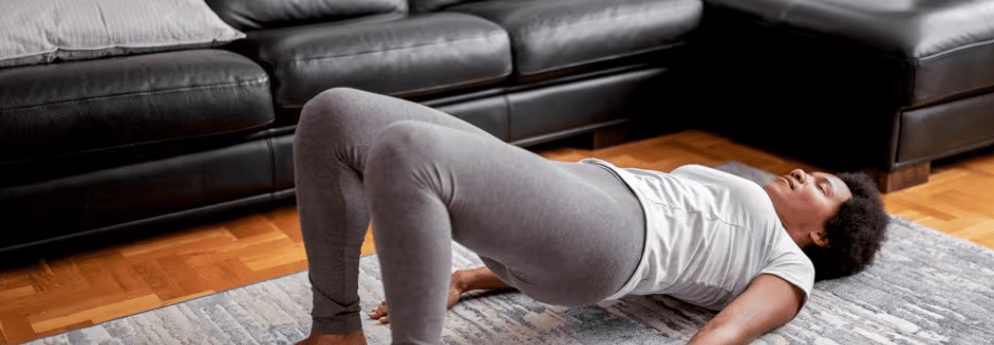
Bridge
Bridge pose can help strengthen the muscles in your back and legs. And with some extra effort, your pelvic floor, too.
Here’s how to do it:
- Lie on your back with your knees bent, feet on the floor and arms at your sides.
- Lift your hips to raise your pelvis toward the ceiling. Engage your pelvic floor muscles.
- Hold for a few seconds.
- Slowly lower your hips to the ground and relax your pelvic floor.
- Repeat for several rounds.
Squats
You can also exercise your pelvic floor while doing squats. Squeeze as you lower and release as you stand. Up the ante even more with squat variations, like jump squats, sumo squats and using barbells.
Seeking support
Kegels and other pelvic floor exercises are typically safe to do at home. But many people benefit from working with a physical therapist trained in pelvic floor dysfunction.
“Learning the appropriate technique is important, and it’s helpful to have a trained professional guide you through it,” Dr. Gee states.
Seeing a physical therapist who specializes in pelvic floor problems is especially important if you experience pelvic pain or signs of prolapse.
“Underlying back and hip pain can contribute to pelvic pain. A specialist can make sure you’re addressing all of the issues,” she adds. “For pelvic pain, physical therapy is really a mainstay of treatment.”
Talk with a healthcare provider about your concerns and whether pelvic floor therapy could be right for you.