Recipe: Garden Omelet @ClevelandClinic

Full of superfoods to power your day

This superfood omelet is full of nutrient-rich veggies. Brussels sprouts and kale provide folate and glucosinolates. Seaweeds are full of minerals and avocados are loaded with healthy monounsaturated and saturated fats.
Ingredients
2 large kale leaves, stemmed and halved lengthwise
4 Brussels sprouts, trimmed and halved
3 large pasture-raised eggs
5 large pasture-raised egg whites
freshly ground black pepper and sea salt, to taste
2 tablespoons extra-virgin olive oil
6 crimini mushrooms, sliced
1/4 cup chopped fresh cilantro
1/4 cup chopped fresh dill
2 (1/2-ounce) packages roasted seaweed snacks (see note*)
2 cups baby spinach
1 avocado, peeled, pitted and sliced, for garnish
1 teaspoon white truffle oil (optional, for garnish)
Note: If you can’t find roasted seaweed snacks, you can substitute 1 ounce plain nori. Before using nori, brush it with a tiny bit of oil and toast it in a lightly oiled skillet over medium-heat for 10 to 15 seconds on each side. Cut into 3-inch squares before using in the omelet.
Directions
Bring a large pot of water to a boil over high-heat. When it boils, add a large pinch of sea salt. Drop in the kale leaves and Brussels sprouts and blanch just until they turn a brighter shade of green, 2 to 3 minutes. Drain well.
Crack the 3 eggs into a medium mixing bowl, and then add the 5 egg whites. Whisk the eggs together and season with salt and black pepper, to taste.
Heat the oil in a large nonstick pan over medium-heat. Add the eggs and immediately turn the heat down to low. Stir to scramble the eggs, tilting the pan to distribute them in an even layer.
As soon as the eggs are no longer runny, arrange the Brussels sprouts on one side of the omelet and scatter the mushrooms over them. Add the kale and sprinkle the cilantro and dill on top. Cover the herbs all with the seaweed snacks and top with the spinach.
Cover the pan and cook over the lowest possible heat for 5 minutes.
Fold the omelet in half and then cut it into 4 sections. Garnish each portion with a few slices of avocado and a drizzle of truffle oil, if using. Serve immediately.
Nutritional information
Each slice of omelet contains:
Calories 248
Fat 18g
Saturated fat 3g
Cholesterol 123mg
Fiber 6g
Protein 14g
Carbohydrate 12g
Sodium 120mg


Facebook

Twitter

Recipe: Spaghetti With Fresh Tomato Sauce and Roasted Vegetables @ClevelandClinic #nutrition

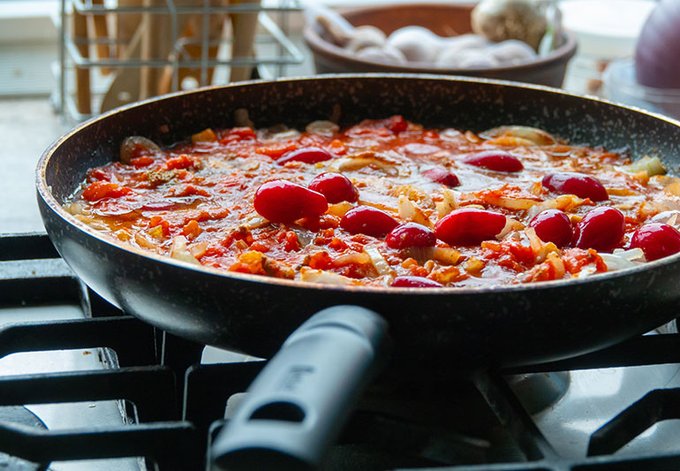
Why not try your hand at making homemade tomato sauce? The freshness of the tomatoes and the smokiness of the roasted vegetables make this a great topping for spaghetti. If you don’t have your own garden, use canned Roma tomatoes for a tasty dish that includes roasted mushrooms, broccoli and peppers.

Ingredients

Tomato sauce

Olive oil cooking spray
2 garlic cloves, minced
1 small carrot, minced
1 shallot, minced
4 cups peeled, seeded, and diced ripe tomatoes or one 28-ounce can no-salt-added diced tomatoes, drained
1/4 cup dry red wine
1 1/2 tablespoons balsamic vinegar
1/4 teaspoon crushed red pepper flakes, optional
1/4 cup chopped fresh basil

Pasta

1/2 pound whole wheat spaghetti
3/4 pound broccoli florets and stalks, peeled and cut into bite-size pieces
2 portobello mushrooms, halved and thinly sliced
1 red, yellow or orange bell pepper, seeded and coarsely chopped
1 1/2 tablespoons extra-virgin olive oil
1 1/2 tablespoons balsamic vinegar
Freshly grated pepper
2 tablespoons freshly grated Parmesan cheese

Directions

  1. Preheat oven to 400° F. Line a rimmed baking sheet with aluminum foil.
  2. To make the sauce, coat a large pot with cooking spray and saute the garlic, carrot and shallot over low heat until they begin to wilt, about 5 minutes. Stir in the tomatoes, wine, vinegar and red pepper flakes (if using). Cover and simmer slowly for 30 minutes.
  3. Stir in the basil and simmer for 10 minutes more. (To make a smoother sauce, cool and process in batches in either a blender or food processor.) Set aside.
  4. Place the broccoli, mushrooms and bell pepper on the prepared pan. Toss with oil and vinegar. Roast about 10 minutes until crisp or done to your taste. Sprinkle with pepper.
  5. Cook the pasta according to package directions. Drain.
  6. In a large serving bowl, toss the pasta with 2 cups tomato sauce. Top with the roasted vegetables and sprinkle with Parmesan cheese.

Nutrition information (per serving)

Makes 4 servings

Calories: 363
Total fat: 4 g
Protein: 15 g
Carbohydrate: 71 g
Dietary fiber: 4 g
Cholesterol: 0 mg
Sodium: 100 mg
Potassium: 93 mg

Cleveland Clinic Healthy Heart Lifestyle Guide and Cookbook (© 2007 Broadway Books).

Recipe: Asparagus Salad With Lemon and Parmesan @ClevelandClinic

This bright, lemony salad is best made with farm-fresh asparagus, which is dressed and eaten raw here. Look for stalks that are bright green with firm, tight tips. Buy it in season from your local farmer’s market.

Ingredients

1 pound fresh asparagus
1 tablespoon fresh lemon juice
1 tablespoon extra virgin olive oil
1/8 teaspoon kosher salt
1/8 teaspoon freshly ground black pepper
1 tablespoon shaved Parmesan
8 fresh chives

Directions

  1. Break off the tough ends of the asparagus and discard.
  2. Use a vegetable peeler to make long thin ribbons of asparagus. Add to a large bowl.
  3. In a small bowl, whisk together the lemon juice, oil, salt and pepper. Drizzle over the asparagus ribbons and toss well.
  4. Use the vegetable peeler to shave thin strips from a piece of fresh Parmesan (about 1 tablespoon) and scatter over the salad.
  5. Use kitchen shears to cut the chives into small pieces directly over the salad.

Nutritional information (per serving)

Makes 4 servings

Calories: 70
Total fat: 4 g
Saturated fat: 1 g
Trans fat: 0 g
Protein: 4 g
Total carbohydrate: 7 g
Fiber: 3 g
Sugar: 2 g
Cholesterol: 0 mg
Sodium: 95 mg

Developed by Sara Quessenberry for Cleveland Clinic Wellness.

Recipe: Asparagus Salad With Lemon and Parmesan @ClevelandClinic

This bright, lemony salad is best made with farm-fresh asparagus, which is dressed and eaten raw here. Look for stalks that are bright green with firm, tight tips. Buy it in season from your local farmer’s market.

Ingredients

1 pound fresh asparagus
1 tablespoon fresh lemon juice
1 tablespoon extra virgin olive oil
1/8 teaspoon kosher salt
1/8 teaspoon freshly ground black pepper
1 tablespoon shaved Parmesan
8 fresh chives

Directions

  1. Break off the tough ends of the asparagus and discard.
  2. Use a vegetable peeler to make long thin ribbons of asparagus. Add to a large bowl.
  3. In a small bowl, whisk together the lemon juice, oil, salt and pepper. Drizzle over the asparagus ribbons and toss well.
  4. Use the vegetable peeler to shave thin strips from a piece of fresh Parmesan (about 1 tablespoon) and scatter over the salad.
  5. Use kitchen shears to cut the chives into small pieces directly over the salad.

Nutritional information (per serving)

Makes 4 servings

Calories: 70
Total fat: 4 g
Saturated fat: 1 g
Trans fat: 0 g
Protein: 4 g
Total carbohydrate: 7 g
Fiber: 3 g
Sugar: 2 g
Cholesterol: 0 mg
Sodium: 95 mg

Developed by Sara Quessenberry for Cleveland Clinic Wellness.

This fresh English Pea Pasta recipe is loaded with healthful pea protein and flavored with garlic, mint and grated Parmigiano Reggiano.@ClevelandClinic

There is something special about using fresh peas straight out of the pod. This recipe was inspired by our root-to-stem philosophy of cooking: It always seems like such a waste to throw away the pea pods, but they are relatively inedible. To make use of the pods, we’ve pureed them into a spring-fresh pasta sauce. Remember: Pasta for breakfast is a great choice, especially when it’s loaded with healthful pea protein.

Ingredients

Kosher salt
1 pound fresh English peas in pods (yields about 1 cup shelled peas and about 3 ½ cups pods)
½ cup water
¼ cup extra-virgin olive oil
2 small spring onions or 2 large shallots, chopped
2 small spring garlic (whites) or 3 garlic cloves, minced
2 tablespoons Greek yogurt (optional)
12 ounces whole grain pasta, such as linguine, rigatoni or small shells
Freshly ground black pepper
¼ cup fresh mint (peppermint preferred), thinly sliced
Espelette pepper to taste (optional)
Grated Parmigiano Reggiano cheese (optional)

Directions

  1. Bring a large pot of water to boil and add enough salt to make it salty like the sea.
  2. Meanwhile, wash the peas. Pull off the stem ends: remove the peas and place in a small bowl. Reserve the pods.
  3. Fill a bowl with cold water. Set aside. Add the empty pea pods to the pot of boiling water and cook for 5 minutes. Using a slotted spoon or spider, remove the pods from the boiling water and transfer to the bowl of cold water to cool quickly. Drain the pea pods and add to a Vitamix or high-speed blender. Add ½ cup water. Puree for 2 to 3 minutes.
  4. Place a fine strainer over a bowl and add the pea pod puree to the strainer, pressing on the solids to release as much puree as possible into the bowl. Discard the solids in the strainer. Reserve the puree in the bowl; season to taste with salt and pepper.
  5. Cook the pasta in the pot of boiling water until al dente, stirring occasionally.
  6. Meanwhile, in a large skillet, heat the olive oil over medium heat. Add the onions and garlic and sauté until softened, 3 to 4 minutes. Add the peas and cook 2 minutes. Stir in the reserved pea pod puree and Greek yogurt, if using, and cook just until heated through. (Don’t overcook the peas or puree as the sauce will turn brown).
  7. Using tongs or a spider, transfer the pasta to the sauce in the skillet. Toss until combined. Season to taste with salt and pepper. Transfer the pasta to the serving bowl. Add the basil and mint. Serve with Espelette pepper and grated Parmigiano Reggiano cheese, if using.

Nutritional info (per serving)

Makes 4 servings.

Calories: 554 kcal
Total fiber: 12 g
Soluble fiber: 0.1 g
Protein: 15.5 g
Total fat: 16.7 g
Saturated fat: 2.0 g
Healthy fats: 12.1 g
Carbohydrates: 84 g
Sugars: 7.7 g
Added sugars: 0 g
Sodium: 178 mg
Potassium: 433 mg
Magnesium: 14 mg
Calcium: 134 mg

Source: The What to Eat When Cookbook by Michael F. Roizen, MD, Michael Crupain, MD, MPH and Jim Perko, Sr, CEC, AAC.

Recipe: Asparagus Salad With Lemon and Parmesan @ClevelandClinic

This bright, lemony salad is best made with farm-fresh asparagus, which is dressed and eaten raw here. Look for stalks that are bright green with firm, tight tips. Buy it in season from your local farmer’s market.

Ingredients

1 pound fresh asparagus
1 tablespoon fresh lemon juice
1 tablespoon extra virgin olive oil
1/8 teaspoon kosher salt
1/8 teaspoon freshly ground black pepper
1 tablespoon shaved Parmesan
8 fresh chives

Directions

  1. Break off the tough ends of the asparagus and discard.
  2. Use a vegetable peeler to make long thin ribbons of asparagus. Add to a large bowl.
  3. In a small bowl, whisk together the lemon juice, oil, salt and pepper. Drizzle over the asparagus ribbons and toss well.
  4. Use the vegetable peeler to shave thin strips from a piece of fresh Parmesan (about 1 tablespoon) and scatter over the salad.
  5. Use kitchen shears to cut the chives into small pieces directly over the salad.

Nutritional information (per serving)

Makes 4 servings

Calories: 70
Total fat: 4 g
Saturated fat: 1 g
Trans fat: 0 g
Protein: 4 g
Total carbohydrate: 7 g
Fiber: 3 g
Sugar: 2 g
Cholesterol: 0 mg
Sodium: 95 mg

Developed by Sara Quessenberry for Cleveland Clinic Wellness.