
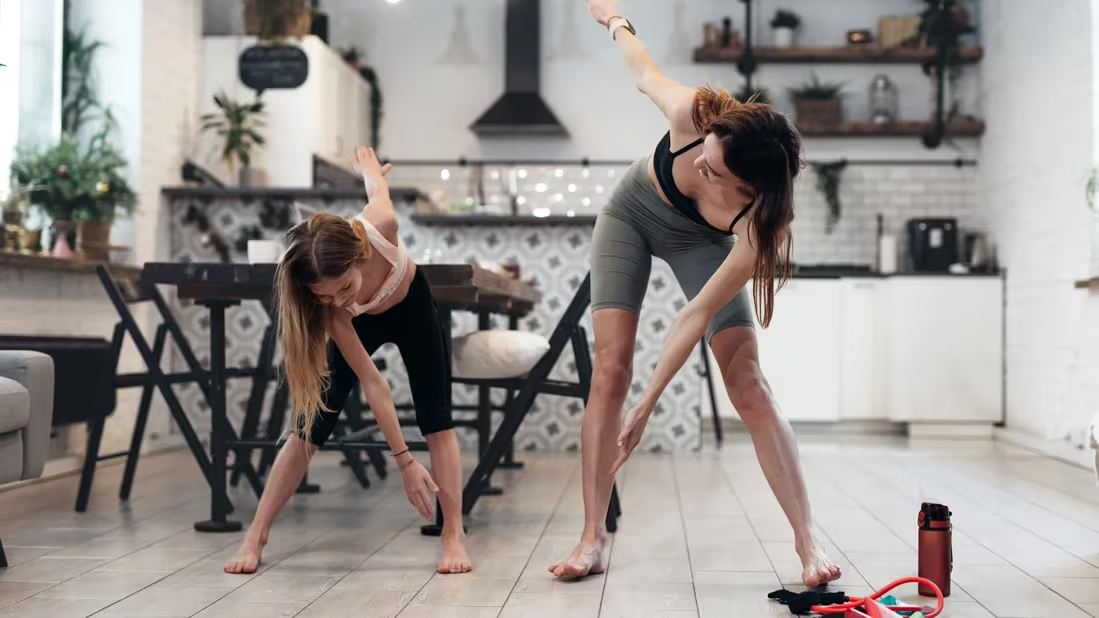
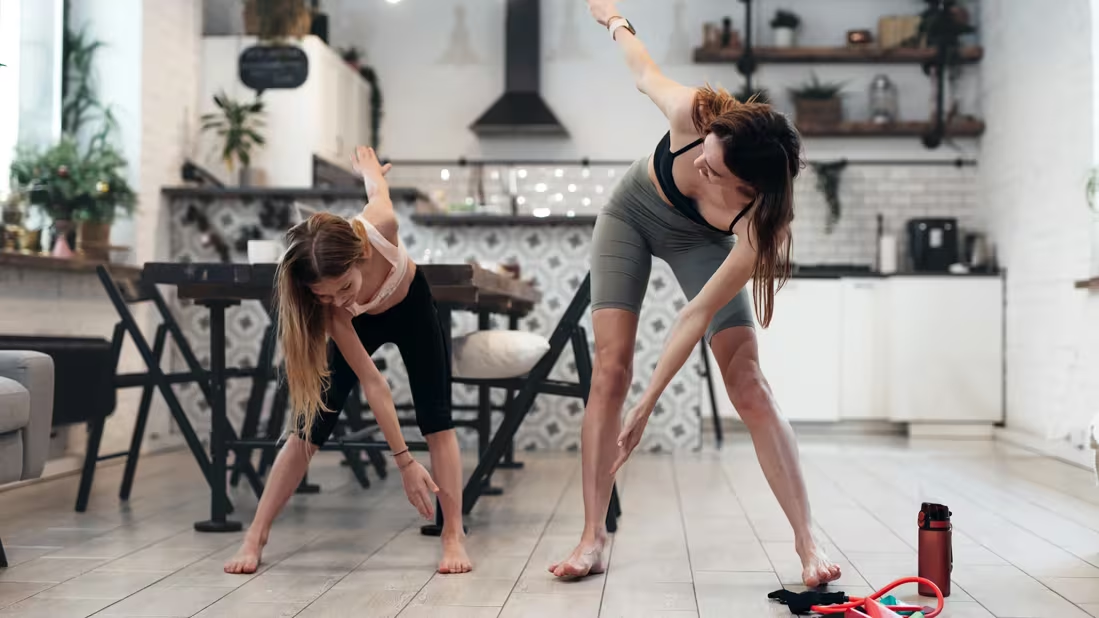
Want to tone your midsection? You can start by standing up to do ab exercises. @ClevelandClinic

Want to tone your midsection? You can start by standing up to do ab exercises.

Surprised? That’s understandable. After all, most of us think of a few classic on-the-floor exercises when it comes to strengthening our abdominals. Crunches and sit-ups, for instance. Planks, too.

But it turns out, you can get a deeper and more thorough core workout while on your feet, says exercise physiologist Katie Lawton, MEd. Here’s how.

Standing ab exercises

The pursuit of “six-pack abs” explains the devotion to crunches and similar floor exercises. “You completely isolate the rectus abdominis muscles when you lie down and do that motion,” says Lawton. “It’s very targeted.”

That’s great for creating washboard abs. But it doesn’t do much to enhance other muscles in your middle that play an important role in day-to-day movements.

Standing ab exercises, on the other hand, engage a network of muscles within your core that you use all the time, whether it’s picking laundry up off the floor or putting cans on the top shelf in the pantry.

“Think of your core as a chain of muscles that needs to work together to get the job done,” illustrates Lawton. “When you do an ab workout from a standing position, you’re working more of the muscles in that system.”

Strengthening your core can help you:

  • Improve your balance
  • Maintain good posture
  • Protect your back from aches and pains
  • Better handle day-to-day movements that require bending, lifting and twisting

Incorporate these exercises in a standing abs workout to see those benefits.
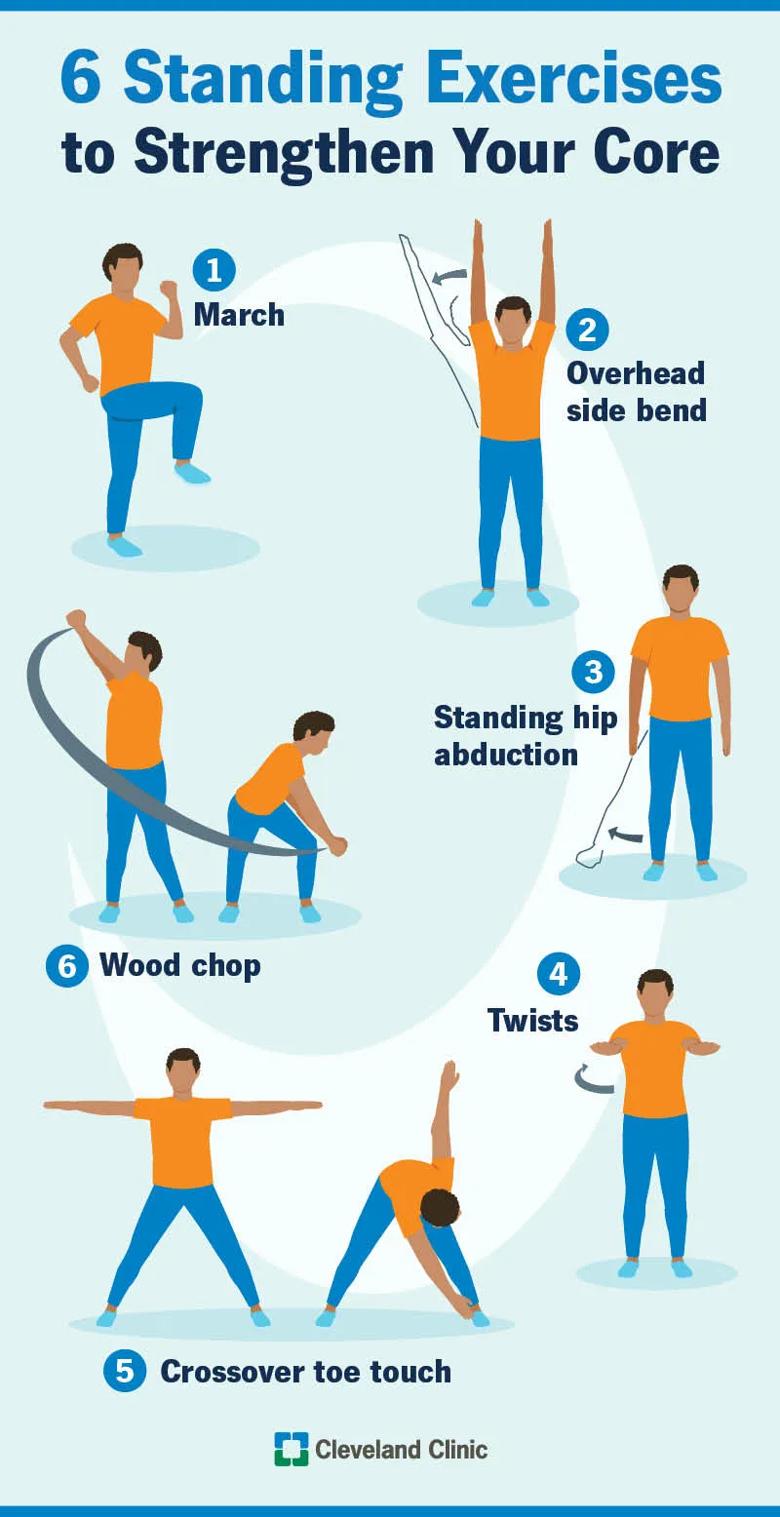
Six standing exercises to strengthen your core

1. March

Muscles targeted: Rectus abdominis, transverse abdominis, erector spinae and hip flexors

  1. Start in a standing position with your feet about hip-width apart.
  2. In an exaggerated marching motion, bring your right knee straight up and move it toward your chest until your thigh is parallel to the floor.
  3. Return to a standing position and repeat the motion with your left leg for one set.
  4. Continue for 10 to 15 sets.

Pro tip: Want to make the march more challenging? Then add a “twist” to your motion by moving your right knee toward your left side when you raise it. (Your left knee would go toward your right side.)

2. Overhead side bend

Muscles targeted: External and internal obliques, quadratus lumborum, deltoids and erector spinae

  1. Stand tall with your feet hip-width apart.
  2. Extend your arms up, palms facing each other (as if you’re signaling a touchdown).
  3. Tilt to the right while keeping your torso and arms straight. You’ll feel a stretch on the left side of your body as your waist bends to the right.
  4. Return to the center position and repeat the motion to the left for one set.
  5. Continue for 10 to 15 sets.

Pro tip: “As you bend to each side, focus on engaging your core muscles to work them properly,” advises Lawton. “You’re just going to the side, too. Your torso shouldn’t lean forward at all.”

3. Standing hip abduction

Muscles targeted: Rectus abdominis, transverse abdominis, erector spinae, glutes and hamstrings

  1. Begin in an upright position with your feet about hip-width apart.
  2. Kick your right leg out to the side, keeping it straight. Your toes should point forward during the motion as your leg scissors out and back. “Keep the movement smooth and consistent both ways,” instructs Lawton.
  3. Repeat 10 to 15 times and then do the same with your left leg.

Pro tip: Use a chair to steady yourself if balance is an issue. “You always want to make sure these exercises are done in the safest way possible,” emphasizes Lawton.

4. Twists

Muscles targeted: Internal and external obliques, rectus abdominis, transverse abdominis and erector spinae

  1. Stand and plant your feet about shoulder-width apart.
  2. Extend your arms straight out in front of you, parallel to the floor.
  3. Rotate your upper body to the right from your midsection while trying to keep your hips facing forward.
  4. Return to the center. Then, rotate to the left to complete one set.
  5. Repeat 10 times.

Pro tip: Twists should be done in a slow and controlled manner. “You don’t want to be whipping back and forth,” cautions Lawton.

5. Crossover toe touch

Muscles targeted: Internal and external obliques, rectus abdominis, transverse abdominis, erector spinae, hamstrings and glutes

  1. Begin in a standing position with your feet slightly wider than shoulder-width apart.
  2. Extend your arms out to your side, as if forming the letter T.
  3. Rotate your torso to the right while reaching your left hand down to tap your right foot. Most of the movement should be in your core, not your legs.
  4. Return to the T position and repeat the motion in the opposite direction (with your right hand touching your left foot) to complete a full set.
  5. Repeat 10 to 15 times.

Pro tip: Skip this exercise if you sometimes get lightheaded when raising your head and up and down.

6. Wood chop

Muscles targeted: Internal and external obliques, rectus abdominis, transverse abdominis, erector spinae, deltoids and latissimus dorsi

  1. Stand with your feet positioned shoulder-width apart.
  2. Clasp your hands together (as if holding an ax) and bring them up over your head to the right. Your torso will rotate slightly to the right as you twist.
  3. Bring your hands down and to the left in a “chopping” motion that swings across your chest toward your left leg. Rotate your torso to the left as you take the swing. Bend your knees slightly and pivot your feet, too.
  4. Return to the raised position. Take 10 chops.
  5. Repeat with your hands, starting to the left and swinging to the right.

Pro tip: Tailor these exercises to your range of motion. “Move the best you can within the parameters you have,” advises Lawton. “When you start to feel that tension in your muscles, stop there. If it hurts, you’ve gone too far.”

Final thoughts

The simplicity of standing ab exercises just … well, stands out. That’s because the exercises build on natural movements that we do all the time. “That’s a big reason why they’re so effective,” says Lawton.

It’s important to safely progress these exercises as they become easier. Resistance bands, cable machines, medicine balls or free weights are all tools that can help you increase the intensity of the movements.

Dedicating a few minutes a day to these exercises can help you build core strength that supports everything you do, from walking the dog to lifting groceries.

“Standing ab exercises really don’t take a lot of time,” emphasizes Lawton.

Plus, you won’t need to find your floor mat to do them.

Learn more about our editorial process.

Want to tone your midsection? You can start by standing up to do ab exercises. @ClevelandClinic

Want to tone your midsection? You can start by standing up to do ab exercises.

Surprised? That’s understandable. After all, most of us think of a few classic on-the-floor exercises when it comes to strengthening our abdominals. Crunches and sit-ups, for instance. Planks, too.

But it turns out, you can get a deeper and more thorough core workout while on your feet, says exercise physiologist Katie Lawton, MEd. Here’s how.

Standing ab exercises

The pursuit of “six-pack abs” explains the devotion to crunches and similar floor exercises. “You completely isolate the rectus abdominis muscles when you lie down and do that motion,” says Lawton. “It’s very targeted.”

That’s great for creating washboard abs. But it doesn’t do much to enhance other muscles in your middle that play an important role in day-to-day movements.

Standing ab exercises, on the other hand, engage a network of muscles within your core that you use all the time, whether it’s picking laundry up off the floor or putting cans on the top shelf in the pantry.

“Think of your core as a chain of muscles that needs to work together to get the job done,” illustrates Lawton. “When you do an ab workout from a standing position, you’re working more of the muscles in that system.”

Strengthening your core can help you:

  • Improve your balance
  • Maintain good posture
  • Protect your back from aches and pains
  • Better handle day-to-day movements that require bending, lifting and twisting

Incorporate these exercises in a standing abs workout to see those benefits.

Six standing exercises to strengthen your core

1. March

Muscles targeted: Rectus abdominis, transverse abdominis, erector spinae and hip flexors

  1. Start in a standing position with your feet about hip-width apart.
  2. In an exaggerated marching motion, bring your right knee straight up and move it toward your chest until your thigh is parallel to the floor.
  3. Return to a standing position and repeat the motion with your left leg for one set.
  4. Continue for 10 to 15 sets.

Pro tip: Want to make the march more challenging? Then add a “twist” to your motion by moving your right knee toward your left side when you raise it. (Your left knee would go toward your right side.)

2. Overhead side bend

Muscles targeted: External and internal obliques, quadratus lumborum, deltoids and erector spinae

  1. Stand tall with your feet hip-width apart.
  2. Extend your arms up, palms facing each other (as if you’re signaling a touchdown).
  3. Tilt to the right while keeping your torso and arms straight. You’ll feel a stretch on the left side of your body as your waist bends to the right.
  4. Return to the center position and repeat the motion to the left for one set.
  5. Continue for 10 to 15 sets.

Pro tip: “As you bend to each side, focus on engaging your core muscles to work them properly,” advises Lawton. “You’re just going to the side, too. Your torso shouldn’t lean forward at all.”

3. Standing hip abduction

Muscles targeted: Rectus abdominis, transverse abdominis, erector spinae, glutes and hamstrings

  1. Begin in an upright position with your feet about hip-width apart.
  2. Kick your right leg out to the side, keeping it straight. Your toes should point forward during the motion as your leg scissors out and back. “Keep the movement smooth and consistent both ways,” instructs Lawton.
  3. Repeat 10 to 15 times and then do the same with your left leg.

Pro tip: Use a chair to steady yourself if balance is an issue. “You always want to make sure these exercises are done in the safest way possible,” emphasizes Lawton.

4. Twists

Muscles targeted: Internal and external obliques, rectus abdominis, transverse abdominis and erector spinae

  1. Stand and plant your feet about shoulder-width apart.
  2. Extend your arms straight out in front of you, parallel to the floor.
  3. Rotate your upper body to the right from your midsection while trying to keep your hips facing forward.
  4. Return to the center. Then, rotate to the left to complete one set.
  5. Repeat 10 times.

Pro tip: Twists should be done in a slow and controlled manner. “You don’t want to be whipping back and forth,” cautions Lawton.

5. Crossover toe touch

Muscles targeted: Internal and external obliques, rectus abdominis, transverse abdominis, erector spinae, hamstrings and glutes

  1. Begin in a standing position with your feet slightly wider than shoulder-width apart.
  2. Extend your arms out to your side, as if forming the letter T.
  3. Rotate your torso to the right while reaching your left hand down to tap your right foot. Most of the movement should be in your core, not your legs.
  4. Return to the T position and repeat the motion in the opposite direction (with your right hand touching your left foot) to complete a full set.
  5. Repeat 10 to 15 times.

Pro tip: Skip this exercise if you sometimes get lightheaded when raising your head and up and down.

6. Wood chop

Muscles targeted: Internal and external obliques, rectus abdominis, transverse abdominis, erector spinae, deltoids and latissimus dorsi

  1. Stand with your feet positioned shoulder-width apart.
  2. Clasp your hands together (as if holding an ax) and bring them up over your head to the right. Your torso will rotate slightly to the right as you twist.
  3. Bring your hands down and to the left in a “chopping” motion that swings across your chest toward your left leg. Rotate your torso to the left as you take the swing. Bend your knees slightly and pivot your feet, too.
  4. Return to the raised position. Take 10 chops.
  5. Repeat with your hands, starting to the left and swinging to the right.

Pro tip: Tailor these exercises to your range of motion. “Move the best you can within the parameters you have,” advises Lawton. “When you start to feel that tension in your muscles, stop there. If it hurts, you’ve gone too far.”

Final thoughts

The simplicity of standing ab exercises just … well, stands out. That’s because the exercises build on natural movements that we do all the time. “That’s a big reason why they’re so effective,” says Lawton.

It’s important to safely progress these exercises as they become easier. Resistance bands, cable machines, medicine balls or free weights are all tools that can help you increase the intensity of the movements.

Dedicating a few minutes a day to these exercises can help you build core strength that supports everything you do, from walking the dog to lifting groceries.

“Standing ab exercises really don’t take a lot of time,” emphasizes Lawton.

Plus, you won’t need to find your floor mat to do them.

Learn more about our editorial process.

Want to tone your midsection? You can start by standing up to do ab exercises. @ClevelandClinic

Want to tone your midsection? You can start by standing up to do ab exercises.

Surprised? That’s understandable. After all, most of us think of a few classic on-the-floor exercises when it comes to strengthening our abdominals. Crunches and sit-ups, for instance. Planks, too.

But it turns out, you can get a deeper and more thorough core workout while on your feet, says exercise physiologist Katie Lawton, MEd. Here’s how.

Standing ab exercises

The pursuit of “six-pack abs” explains the devotion to crunches and similar floor exercises. “You completely isolate the rectus abdominis muscles when you lie down and do that motion,” says Lawton. “It’s very targeted.”

That’s great for creating washboard abs. But it doesn’t do much to enhance other muscles in your middle that play an important role in day-to-day movements.

Standing ab exercises, on the other hand, engage a network of muscles within your core that you use all the time, whether it’s picking laundry up off the floor or putting cans on the top shelf in the pantry.

“Think of your core as a chain of muscles that needs to work together to get the job done,” illustrates Lawton. “When you do an ab workout from a standing position, you’re working more of the muscles in that system.”

Strengthening your core can help you:

  • Improve your balance
  • Maintain good posture
  • Protect your back from aches and pains
  • Better handle day-to-day movements that require bending, lifting and twisting

Incorporate these exercises in a standing abs workout to see those benefits.

Six standing exercises to strengthen your core

1. March

Muscles targeted: Rectus abdominis, transverse abdominis, erector spinae and hip flexors

  1. Start in a standing position with your feet about hip-width apart.
  2. In an exaggerated marching motion, bring your right knee straight up and move it toward your chest until your thigh is parallel to the floor.
  3. Return to a standing position and repeat the motion with your left leg for one set.
  4. Continue for 10 to 15 sets.

Pro tip: Want to make the march more challenging? Then add a “twist” to your motion by moving your right knee toward your left side when you raise it. (Your left knee would go toward your right side.)

2. Overhead side bend

Muscles targeted: External and internal obliques, quadratus lumborum, deltoids and erector spinae

  1. Stand tall with your feet hip-width apart.
  2. Extend your arms up, palms facing each other (as if you’re signaling a touchdown).
  3. Tilt to the right while keeping your torso and arms straight. You’ll feel a stretch on the left side of your body as your waist bends to the right.
  4. Return to the center position and repeat the motion to the left for one set.
  5. Continue for 10 to 15 sets.

Pro tip: “As you bend to each side, focus on engaging your core muscles to work them properly,” advises Lawton. “You’re just going to the side, too. Your torso shouldn’t lean forward at all.”

3. Standing hip abduction

Muscles targeted: Rectus abdominis, transverse abdominis, erector spinae, glutes and hamstrings

  1. Begin in an upright position with your feet about hip-width apart.
  2. Kick your right leg out to the side, keeping it straight. Your toes should point forward during the motion as your leg scissors out and back. “Keep the movement smooth and consistent both ways,” instructs Lawton.
  3. Repeat 10 to 15 times and then do the same with your left leg.

Pro tip: Use a chair to steady yourself if balance is an issue. “You always want to make sure these exercises are done in the safest way possible,” emphasizes Lawton.

4. Twists

Muscles targeted: Internal and external obliques, rectus abdominis, transverse abdominis and erector spinae

  1. Stand and plant your feet about shoulder-width apart.
  2. Extend your arms straight out in front of you, parallel to the floor.
  3. Rotate your upper body to the right from your midsection while trying to keep your hips facing forward.
  4. Return to the center. Then, rotate to the left to complete one set.
  5. Repeat 10 times.

Pro tip: Twists should be done in a slow and controlled manner. “You don’t want to be whipping back and forth,” cautions Lawton.

5. Crossover toe touch

Muscles targeted: Internal and external obliques, rectus abdominis, transverse abdominis, erector spinae, hamstrings and glutes

  1. Begin in a standing position with your feet slightly wider than shoulder-width apart.
  2. Extend your arms out to your side, as if forming the letter T.
  3. Rotate your torso to the right while reaching your left hand down to tap your right foot. Most of the movement should be in your core, not your legs.
  4. Return to the T position and repeat the motion in the opposite direction (with your right hand touching your left foot) to complete a full set.
  5. Repeat 10 to 15 times.

Pro tip: Skip this exercise if you sometimes get lightheaded when raising your head and up and down.

6. Wood chop

Muscles targeted: Internal and external obliques, rectus abdominis, transverse abdominis, erector spinae, deltoids and latissimus dorsi

  1. Stand with your feet positioned shoulder-width apart.
  2. Clasp your hands together (as if holding an ax) and bring them up over your head to the right. Your torso will rotate slightly to the right as you twist.
  3. Bring your hands down and to the left in a “chopping” motion that swings across your chest toward your left leg. Rotate your torso to the left as you take the swing. Bend your knees slightly and pivot your feet, too.
  4. Return to the raised position. Take 10 chops.
  5. Repeat with your hands, starting to the left and swinging to the right.

Pro tip: Tailor these exercises to your range of motion. “Move the best you can within the parameters you have,” advises Lawton. “When you start to feel that tension in your muscles, stop there. If it hurts, you’ve gone too far.”

Final thoughts

The simplicity of standing ab exercises just … well, stands out. That’s because the exercises build on natural movements that we do all the time. “That’s a big reason why they’re so effective,” says Lawton.

It’s important to safely progress these exercises as they become easier. Resistance bands, cable machines, medicine balls or free weights are all tools that can help you increase the intensity of the movements.

Dedicating a few minutes a day to these exercises can help you build core strength that supports everything you do, from walking the dog to lifting groceries.

“Standing ab exercises really don’t take a lot of time,” emphasizes Lawton.

Plus, you won’t need to find your floor mat to do them.

Learn more about our editorial process.

Go inside the operating room for open-heart surgery. Dr. Eric Roselli gives us a behind-the-scenes look at a complex procedure. @ClevelandClinic #nickfaldo

Square profile picture

Cleveland Clinic

@ClevelandClinic

·

Go inside the operating room for open-heart surgery. Dr. Eric Roselli gives us a behind-the-scenes look at a complex procedure.

5 surprising benefits of walking: @HarvardHealth #healthaware #physicalactivity


Harvard Health

@HarvardHealth
·


5 surprising benefits of #walking: Any physical activity is a boon to your overall health. But walking in particular comes with a host of benefits. https://bit.ly/3uyNvhI #HarvardHealth

The next time you have a check-up, don’t be surprised if your doctor hands you a prescription to walk. Yes, this simple activity that you’ve been doing since you were about a year old is now being touted as “the closest thing we have to a wonder drug,” in the words of Dr. Thomas Frieden, former director of the Centers for Disease Control and Prevention.

Of course, you probably know that any physical activity, including walking, is a boon to your overall health. But walking in particular comes with a host of benefits. Here’s a list of five that may surprise you.

1. It counteracts the effects of weight-promoting genes. Harvard researchers looked at 32 obesity-promoting genes in over 12,000 people to determine how much these genes actually contribute to body weight. They then discovered that, among the study participants who walked briskly for about an hour a day, the effects of those genes were cut in half.

2. It helps tame a sweet tooth. A pair of studies from the University of Exeter found that a 15-minute walk can curb cravings for chocolate and even reduce the amount of chocolate you eat in stressful situations. And the latest research confirms that walking can reduce cravings and intake of a variety of sugary snacks.

3. It reduces the risk of developing breast cancer. Researchers already know that any kind of physical activity blunts the risk of breast cancer. But an American Cancer Society study that zeroed in on walking found that women who walked seven or more hours a week had a 14% lower risk of breast cancer than those who walked three hours or fewer per week. And walking provided this protection even for the women with breast cancer risk factors, such as being overweight or using supplemental hormones.

4. It eases joint pain. Several studies have found that walking reduces arthritis-related pain, and that walking five to six miles a week can even prevent arthritis from forming in the first place. Walking protects the joints — especially the knees and hips, which are most susceptible to osteoarthritis — by lubricating them and strengthening the muscles that support them.

5. It boosts immune function. Walking can help protect you during cold and flu season. A study of over 1,000 men and women found that those who walked at least 20 minutes a day, at least 5 days a week, had 43% fewer sick days than those who exercised once a week or less. And if they did get sick, it was for a shorter duration, and their symptoms were milder.

Image: gradyreese/Getty images

5 surprising benefits of walking: @HarvardHealth #healthaware #physicalactivity


Harvard Health

@HarvardHealth
·


5 surprising benefits of #walking: Any physical activity is a boon to your overall health. But walking in particular comes with a host of benefits. https://bit.ly/3uyNvhI #HarvardHealth

The next time you have a check-up, don’t be surprised if your doctor hands you a prescription to walk. Yes, this simple activity that you’ve been doing since you were about a year old is now being touted as “the closest thing we have to a wonder drug,” in the words of Dr. Thomas Frieden, former director of the Centers for Disease Control and Prevention.

Of course, you probably know that any physical activity, including walking, is a boon to your overall health. But walking in particular comes with a host of benefits. Here’s a list of five that may surprise you.

1. It counteracts the effects of weight-promoting genes. Harvard researchers looked at 32 obesity-promoting genes in over 12,000 people to determine how much these genes actually contribute to body weight. They then discovered that, among the study participants who walked briskly for about an hour a day, the effects of those genes were cut in half.

2. It helps tame a sweet tooth. A pair of studies from the University of Exeter found that a 15-minute walk can curb cravings for chocolate and even reduce the amount of chocolate you eat in stressful situations. And the latest research confirms that walking can reduce cravings and intake of a variety of sugary snacks.

3. It reduces the risk of developing breast cancer. Researchers already know that any kind of physical activity blunts the risk of breast cancer. But an American Cancer Society study that zeroed in on walking found that women who walked seven or more hours a week had a 14% lower risk of breast cancer than those who walked three hours or fewer per week. And walking provided this protection even for the women with breast cancer risk factors, such as being overweight or using supplemental hormones.

4. It eases joint pain. Several studies have found that walking reduces arthritis-related pain, and that walking five to six miles a week can even prevent arthritis from forming in the first place. Walking protects the joints — especially the knees and hips, which are most susceptible to osteoarthritis — by lubricating them and strengthening the muscles that support them.

5. It boosts immune function. Walking can help protect you during cold and flu season. A study of over 1,000 men and women found that those who walked at least 20 minutes a day, at least 5 days a week, had 43% fewer sick days than those who exercised once a week or less. And if they did get sick, it was for a shorter duration, and their symptoms were milder.

Image: gradyreese/Getty images