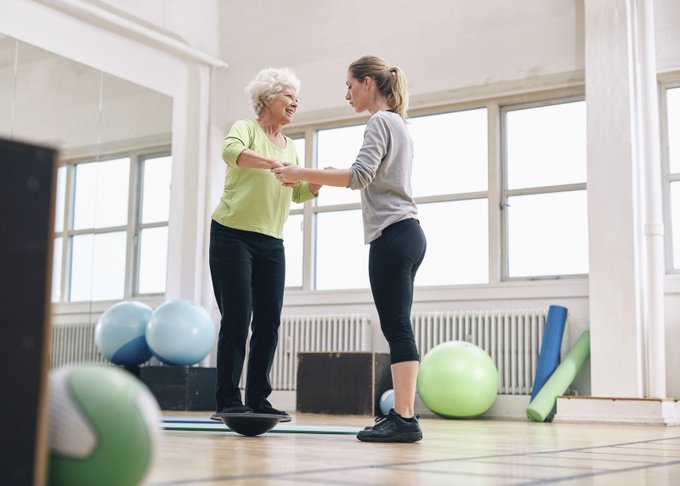
Our best balance boosters #physiotherapy😉 @HarvardHealth

harvard balance boosters

Harvard Health
@HarvardHealth

Our best balance boosters. bit.ly/2rkMG0N #HarvardHealth

Image: Jacob Ammentorp Lund/iStock

Many older adults focus on exercise and diet to stay healthy. But one of the worst offenders to health—poor balance—is often an afterthought. “I see a lot of older adults who are nonchalant about balance,” says Liz Moritz, a physical therapist at Harvard-affiliated Brigham and Women’s Hospital.

Unfortunately, imbalance is a common cause of falls, which send millions of people in the United States to emergency departments each year with broken hips and head injuries. But there are many things you can do to improve your balance. The strategies below are some of the most effective.

Physical therapy

Physical therapy for balance focuses on the ability of the joints and brain to communicate, the balance system in the ear (the vestibular system), and vision. “We coordinate all three with exercises such as standing on one foot, first with the eyes open, and then with the eyes closed. We also work on joint flexibility, walking, and lower-extremity exercises on one or two legs,” says Moritz. Other exercises that boost balance include chair stands (see “Move of the month”) and squats. Make sure you get training before attempting these exercises at home.

Muscle strengthening

“Core strength is very important for balance. If the abdominal muscles in your core are weak, they cannot support your limbs, especially when you’re walking. If the gluteal muscles in your buttocks and hips aren’t strong, they won’t be able to propel you forward,” says Moritz. Muscle strengthening can help. Moritz suggests starting with gentle core exercises like a pelvic tilt (lie on the floor with your knees bent up, then roll your pelvis up) and then moving to more intense exercises such as wall planks (stand six inches from a wall, keeping your body rigid, then lean forward with your forearms flat against the wall, and hold the position for 20 seconds). Leg lifts will strengthen the gluteal muscles, and adding resistance bands to leg lifts makes the exercise even more effective.

Tai chi and yoga

“Tai chi and yoga are exercises that make you pay attention to the control and quality of movement, rather than the quantity, which improves your balance,” says Moritz. In tai chi, you practice slow, flowing motions and shift your weight from one limb to another. Yoga incorporates a series of focused postures and breathing. Both exercises increase flexibility, range of motion, leg and core strength, and reflexes. The result: you become better at balancing in a number of different positions, which helps you avoid falling if you encounter uneven pavement or obstacles in your path.

Vision correction

“If you can’t see where you’re going, your fall risk goes up,” says Moritz. “A lot of people I treat for balance are here be-cause they tripped when they didn’t see something on the floor.” The fix may be as simple as a new eyeglasses prescription. Get a comprehensive, dilated eye exam every one or two years if you’re 65 or older, every one to three years if you’re age 55 to 64, and every two to four years if you’re 40 to 54. If you have an increased risk for other eye conditions, you may need an eye exam more often.

Assistive walking devices

A cane or a walker can complement your balance and give you more stability and confidence walking. But don’t buy a device on your own. “If it’s too high or too low, that can cause a fall. You need to get it measured, and you need training to learn how to use it,” says Moritz. Training takes just a few physical therapy sessions. Walkers are available with wheels intended for different terrain, lockable brakes, seats, baskets, and other features such as headlights. Canes are available with various handgrips and bases.

https://www.health.harvard.edu/staying-healthy/our-best-balance-boosters?utm_content=bufferbc3b8&utm_medium=social&utm_source=facebook&utm_campaign=buffer

Our best balance boosters #physiotherapy😉 @HarvardHealth

harvard balance boosters

Harvard Health
@HarvardHealth

Our best balance boosters. bit.ly/2rkMG0N #HarvardHealth

Image: Jacob Ammentorp Lund/iStock

Many older adults focus on exercise and diet to stay healthy. But one of the worst offenders to health—poor balance—is often an afterthought. “I see a lot of older adults who are nonchalant about balance,” says Liz Moritz, a physical therapist at Harvard-affiliated Brigham and Women’s Hospital.

Unfortunately, imbalance is a common cause of falls, which send millions of people in the United States to emergency departments each year with broken hips and head injuries. But there are many things you can do to improve your balance. The strategies below are some of the most effective.

Physical therapy

Physical therapy for balance focuses on the ability of the joints and brain to communicate, the balance system in the ear (the vestibular system), and vision. “We coordinate all three with exercises such as standing on one foot, first with the eyes open, and then with the eyes closed. We also work on joint flexibility, walking, and lower-extremity exercises on one or two legs,” says Moritz. Other exercises that boost balance include chair stands (see “Move of the month”) and squats. Make sure you get training before attempting these exercises at home.

Muscle strengthening

“Core strength is very important for balance. If the abdominal muscles in your core are weak, they cannot support your limbs, especially when you’re walking. If the gluteal muscles in your buttocks and hips aren’t strong, they won’t be able to propel you forward,” says Moritz. Muscle strengthening can help. Moritz suggests starting with gentle core exercises like a pelvic tilt (lie on the floor with your knees bent up, then roll your pelvis up) and then moving to more intense exercises such as wall planks (stand six inches from a wall, keeping your body rigid, then lean forward with your forearms flat against the wall, and hold the position for 20 seconds). Leg lifts will strengthen the gluteal muscles, and adding resistance bands to leg lifts makes the exercise even more effective.

Tai chi and yoga

“Tai chi and yoga are exercises that make you pay attention to the control and quality of movement, rather than the quantity, which improves your balance,” says Moritz. In tai chi, you practice slow, flowing motions and shift your weight from one limb to another. Yoga incorporates a series of focused postures and breathing. Both exercises increase flexibility, range of motion, leg and core strength, and reflexes. The result: you become better at balancing in a number of different positions, which helps you avoid falling if you encounter uneven pavement or obstacles in your path.

Vision correction

“If you can’t see where you’re going, your fall risk goes up,” says Moritz. “A lot of people I treat for balance are here be-cause they tripped when they didn’t see something on the floor.” The fix may be as simple as a new eyeglasses prescription. Get a comprehensive, dilated eye exam every one or two years if you’re 65 or older, every one to three years if you’re age 55 to 64, and every two to four years if you’re 40 to 54. If you have an increased risk for other eye conditions, you may need an eye exam more often.

Assistive walking devices

A cane or a walker can complement your balance and give you more stability and confidence walking. But don’t buy a device on your own. “If it’s too high or too low, that can cause a fall. You need to get it measured, and you need training to learn how to use it,” says Moritz. Training takes just a few physical therapy sessions. Walkers are available with wheels intended for different terrain, lockable brakes, seats, baskets, and other features such as headlights. Canes are available with various handgrips and bases.

https://www.health.harvard.edu/staying-healthy/our-best-balance-boosters?utm_content=bufferbc3b8&utm_medium=social&utm_source=facebook&utm_campaign=buffer

Injuries from falls can have a big impact on elderly adults’ ability to remain independent. A few simple PT exercises can improve strength and balance to reduce the risk.@HopkinsMedicine

Lora Durkin, Physical Therapist

Lora Stutzman, PT

Falls can have very serious consequences as we age. Each year, more than 25 percent of adults 65 or older have a fall, and 3 million are treated in emergency departments for fall injuries, according to the Centers for Disease Control and Prevention.

Fall Risks

The risk of falling in older adults is usually related to combination of factors, including:

  • Balance and/or walking problems. Balance can be affected by vision changes, vestibular problems and altered sensation in the feet.
  • The use of multiple medications. Studies indicate that when individuals take five or more medicines, the risk of falls increases.
  • Home hazards (including dim lighting and trip hazards)
  • Positional low blood pressure (such as orthostatic hypotension, when blood pressure drops upon standing.
  • Feet and footwear issues

Falls often occur in the bathroom when sitting or standing from the toilet or shower, or at night in a dark bedroom when getting up quickly and tripping on the way to the bathroom.

Exercises to Prevent Falls

While it’s not possible to completely prevent a fall, exercises that focus on balance and strength training can reduce the risk of falling. “We treat elderly adults for injuries sustained from falls, and other patients who feel unsteady while walking or standing and are fearful of falling,” says Lora Stutzman, a physical therapist with the Johns Hopkins Rehabilitation Network. “These exercises can help improve balance and build strength to help prevent future falls.”

For older adults, activities such as squatting, standing up from a chair and walking may be difficult or cause them to feel unsteady, which increases their risk of falling. The following exercises are intended for those who have a low risk of fall and are able to stand on their own without support from others. Always talk to your doctor or physical therapist first before starting new exercises, especially if you have weak balance.

Stutzman demonstrates two exercises below.

Sit-to-Stand Exercise

The sit-to-stand exercise builds leg strength and improves body mechanics and balance, which are all important in reducing falls.

1. Start by sitting on a sturdy chair of standard height, and make sure that it won’t slide or roll. You should be able to sit comfortably with your feet flat on the ground. Have a sturdy support surface in front of you, such as a countertop, so that you can reach to it for support if you start to feel unsteady when standing. Scoot forward so your buttocks is positioned at the front of the seat.

2. Lean your chest forward over your toes, shifting your body weight forward. Squeeze your gluteal muscles and slowly rise to a stable standing position.

Physical therapist showing exercises for fall prevention

3. Slowly sit back down to the starting position and repeat 10 times.

4. If necessary, place your hands on the arms or seat of the chair and push through your hands to help stand and sit. The goal is to not use your hands at all.

Physical therapist showing exercises for fall prevention

Perform 10 repetitions, twice a day. For an advanced version, hold hand weights to add resistance.

If you have pain in your knees, back or hips, discontinue and talk to your doctor or physical therapist.

Balance Exercise

This series of exercises helps if your balance is unsteady. Make sure you have someone with you in case you lose balance.

To begin, stand in a corner or have a kitchen counter in front of you to reach out to in case you start losing balance.

1. Feet apart: Stand with feet about shoulder-width apart, eyes open, and hold steady for 10 seconds, working your way up to 30 seconds.

If you find yourself swaying or reaching for the wall or counter frequently, just keep working on this exercise until you can do it with minimal swaying or support. Once you can hold this position firmly for 30 seconds, move on to the next exercise.

2. Feet together: Stand with feet together, eyes open, and hold steady 10 seconds, working your way up to 30 seconds.

Physical therapist showing exercises for fall prevention

Once you can do this exercise for 30 seconds with minimal swaying or support, move on to the next one.

3. One foot: Stand on one foot, eyes open, and hold steady 10 seconds, working up to 30 seconds. Switch to the other foot.

4. Eyes closed: If you can perform the first three exercises safely and with little support, try to do each one with your eyes closed. Hold for 10 seconds, working up to 30 seconds.

Physical therapist showing exercises for fall prevention

The goal for each exercise is to hold the position for 10 seconds and progress to 30 seconds, five repetitions (including five per leg on the one-foot exercise), two times a day.

Additional Steps to Prevent Falls

Remember, it’s important to talk to your doctor or physical therapist about fall prevention.

  • Discuss medications and changes in your exercise routine.
  • Tell your doctor if you fall.
  • Ask a friend or family member to help check your home for trip hazards.

“Keep in mind,” adds Stutzman, “it is always best to have company at home with you while exercising for safety and supervision and in case you need help.”

Injuries from falls can have a big impact on elderly adults’ ability to remain independent. A few simple PT exercises can improve strength and balance to reduce the risk.@HopkinsMedicine

Lora Durkin, Physical Therapist

Lora Stutzman, PT

Falls can have very serious consequences as we age. Each year, more than 25 percent of adults 65 or older have a fall, and 3 million are treated in emergency departments for fall injuries, according to the Centers for Disease Control and Prevention.

Fall Risks

The risk of falling in older adults is usually related to combination of factors, including:

  • Balance and/or walking problems. Balance can be affected by vision changes, vestibular problems and altered sensation in the feet.
  • The use of multiple medications. Studies indicate that when individuals take five or more medicines, the risk of falls increases.
  • Home hazards (including dim lighting and trip hazards)
  • Positional low blood pressure (such as orthostatic hypotension, when blood pressure drops upon standing.
  • Feet and footwear issues

Falls often occur in the bathroom when sitting or standing from the toilet or shower, or at night in a dark bedroom when getting up quickly and tripping on the way to the bathroom.

Exercises to Prevent Falls

While it’s not possible to completely prevent a fall, exercises that focus on balance and strength training can reduce the risk of falling. “We treat elderly adults for injuries sustained from falls, and other patients who feel unsteady while walking or standing and are fearful of falling,” says Lora Stutzman, a physical therapist with the Johns Hopkins Rehabilitation Network. “These exercises can help improve balance and build strength to help prevent future falls.”

For older adults, activities such as squatting, standing up from a chair and walking may be difficult or cause them to feel unsteady, which increases their risk of falling. The following exercises are intended for those who have a low risk of fall and are able to stand on their own without support from others. Always talk to your doctor or physical therapist first before starting new exercises, especially if you have weak balance.

Stutzman demonstrates two exercises below.

Sit-to-Stand Exercise

The sit-to-stand exercise builds leg strength and improves body mechanics and balance, which are all important in reducing falls.

1. Start by sitting on a sturdy chair of standard height, and make sure that it won’t slide or roll. You should be able to sit comfortably with your feet flat on the ground. Have a sturdy support surface in front of you, such as a countertop, so that you can reach to it for support if you start to feel unsteady when standing. Scoot forward so your buttocks is positioned at the front of the seat.

2. Lean your chest forward over your toes, shifting your body weight forward. Squeeze your gluteal muscles and slowly rise to a stable standing position.

Physical therapist showing exercises for fall prevention

3. Slowly sit back down to the starting position and repeat 10 times.

4. If necessary, place your hands on the arms or seat of the chair and push through your hands to help stand and sit. The goal is to not use your hands at all.

Physical therapist showing exercises for fall prevention

Perform 10 repetitions, twice a day. For an advanced version, hold hand weights to add resistance.

If you have pain in your knees, back or hips, discontinue and talk to your doctor or physical therapist.

Balance Exercise

This series of exercises helps if your balance is unsteady. Make sure you have someone with you in case you lose balance.

To begin, stand in a corner or have a kitchen counter in front of you to reach out to in case you start losing balance.

1. Feet apart: Stand with feet about shoulder-width apart, eyes open, and hold steady for 10 seconds, working your way up to 30 seconds.

If you find yourself swaying or reaching for the wall or counter frequently, just keep working on this exercise until you can do it with minimal swaying or support. Once you can hold this position firmly for 30 seconds, move on to the next exercise.

2. Feet together: Stand with feet together, eyes open, and hold steady 10 seconds, working your way up to 30 seconds.

Physical therapist showing exercises for fall prevention

Once you can do this exercise for 30 seconds with minimal swaying or support, move on to the next one.

3. One foot: Stand on one foot, eyes open, and hold steady 10 seconds, working up to 30 seconds. Switch to the other foot.

4. Eyes closed: If you can perform the first three exercises safely and with little support, try to do each one with your eyes closed. Hold for 10 seconds, working up to 30 seconds.

Physical therapist showing exercises for fall prevention

The goal for each exercise is to hold the position for 10 seconds and progress to 30 seconds, five repetitions (including five per leg on the one-foot exercise), two times a day.

Additional Steps to Prevent Falls

Remember, it’s important to talk to your doctor or physical therapist about fall prevention.

  • Discuss medications and changes in your exercise routine.
  • Tell your doctor if you fall.
  • Ask a friend or family member to help check your home for trip hazards.

“Keep in mind,” adds Stutzman, “it is always best to have company at home with you while exercising for safety and supervision and in case you need help.”