

Add more exercise into your day: While you watch a show, use the commercial breaks to do a plank, march in place, or stretch. #HarvardHealth #TipoftheDay https://bit.ly/41Xbvis

Health is Wealth
Add more exercise into your day: While you watch a show, use the commercial breaks to do a plank, march in place, or stretch. #HarvardHealth #TipoftheDay https://bit.ly/41Xbvis



WebMDVerified account @WebMD 22 hours ago
Dark chocolate has been shown to improve mood and brain function. Antioxidants in the cocoa can help protect cells, lower blood pressure, and improve blood flow. https://wb.md/2FaMSUX
·
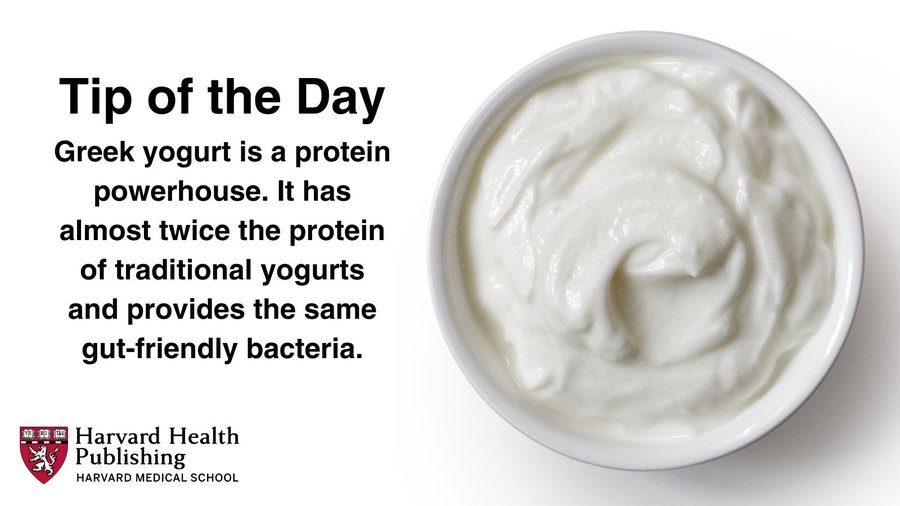
Protein in Greek yogurt: Greek yogurt is a protein powerhouse. It has almost twice the protein of traditional yogurts and provides the same gut-friendly bacteria. #HarvardHealth

We all want to protect our kids whether it be from falls, bumps and bruises — or avoidable infections and diseases. To help your child avoid illness, it’s important to encourage good habits and take steps to boost their immune system from an early age.
“Most of what makes a child’s immune system strong is common sense,” says pediatrician Adriane Lioudis, MD. If you keep these five tips in mind, you’ll stack the deck in your child’s favor for a healthier life.
While it’s a very personal decision (that isn’t always possible), if you are able to exclusively breastfeed your child for at least six months, it may have benefits. Some research shows that breastfeeding your child might possibly reduce allergies, Dr. Lioudis says.
Eighty percent of infections are spread by touch. Teach your little one to take the time to wash their hands after sneezing, coughing and going to the bathroom. Washing hands with warm water and soap for at least 20 seconds can remove bacteria and viruses and can reduce the chance of lung infections by up to 45%.
Follow your pediatrician’s advice when it comes to the childhood vaccination schedule. Immunizations start in infancy and continue to adulthood and prevent measles, mumps, chickenpox, rotavirus and other infections.
“Get the flu shot for your child yearly, as well,” Dr. Lioudis says. This is particularly important for children with asthma and other chronic health conditions.
Also, if your family will be traveling internationally, it’s important to seek advice from your child’s healthcare provider about any needed vaccinations.
To maximize immunity, children must get enough sleep.
Sleep requirements for each night vary by age:
Not getting enough sleep limits the body’s ability to produce proteins called cytokines that help fight infection and reduce inflammation.
A healthy diet is also important for your child’s immune system.
Dr. Lioudis recommends encouraging your child to “eat the rainbow” when it comes to fruits and vegetables. A good selection of whole grains should be part of their diet as well. Keep processed foods to a minimum. Proper food choices can help ensure that your child gets enough vitamins — such as vitamin A and E. These vitamins are needed to maintain good health and a strong immune system.
“Even if you follow these tips, your child might still get between seven and 11 colds each year,” says Dr. Lioudis. She adds that you can expect each one to last up to two weeks.
Also, keep in mind that some things billed as common “remedies” aren’t effective in boosting immunity. For example, there’s no definitive proof that large amounts of vitamin C or echinacea help prevent colds or shorten them, she says.
However, if your child has a compromised immune system, work closely with your pediatrician to find ways to improve his or her immunity. Each child needs a personalized approach because their individual immune system varies, Dr. Lioudis says.
“There’s generally a different protocol with immunocompromised children. There are some vaccines we have to add in on top of what most children have, but it’s something that we must determine on a case-by-case basis.

May 28, 2024/Pregnancy & Childbirth
Recommendations encourage breast milk exclusively for baby’s first six months and continuing to provide human milk until age 2 and beyond
How and what you feed your baby is probably one of the most basic — and yet deeply personal — decisions you’ll face when you become a parent.
You’ll hear things like “breast is best.” As in, breastfeeding (chestfeeding) is the absolute best way to nourish your baby.
And then you’ll hear the retort, “fed is best.” Meaning breast milk (human milk) and formula are both fine. As long as your baby is getting nutrients in their belly, all is well.
Then come the opinions on how long you should breastfeed. (You’re still breastfeeding? You gave up on nursing already? You fed your baby formula?)
It can feel like there’s no right way to do it. And there’s some truth to that.
Because what works for one family may not be feasible for another. But that’s OK.
Breast milk can provide certain benefits that formula can’t mimic. But breastfeeding, especially for long periods of time, might not work for everyone. Or you may have been given the impression that you’ve continued providing human milk long after others think you “should.”
No one should feel guilt, shame or otherwise crummy about how they feed their baby. Let’s face it, mom guilt is tough enough as it is.
So, we talked with board-certified breastfeeding medicine physician Heidi Szugye, DO, about breastfeeding recommendations.
Science shows that if you can give your baby human milk (either your own or a donor’s), it has its benefits. And the longer, the better, experts recommend.
The American Academy of Pediatrics (AAP) and the World Health Organization (WHO) share these recommendations for breastfeeding duration:
Previous recommendations called for providing breast milk until age 1. But these newer guidelines (implemented in 2022) are based on the understanding that human milk has benefits that continue long after baby’s first birthday. And they help to remove stigmas associated with people who choose to extend breastfeeding into toddlerhood.
“These recommendations are a call to action for everyone, and that includes hospitals, pediatricians and all physicians that are taking care of families,” Dr. Szugye states. “We want to make sure our practices and policies are set up to support people who choose to breastfeed beyond the first year of their child’s life.”
Think of the guidelines as the best-case scenario. If it works for you, your family, your child, your body and your life to breastfeed for two years or longer, you’re doing a great thing. And there’s no reason to stop until you and your child are ready.
If it doesn’t work for you, that’s OK, too. Your worth as a parent and your love for your child can’t be measured in ounces of milk.
The recommendations are based on research showing that human milk has some big benefits. And those perks continue for as long as you continue to supply it.
“Breastfeeding offers tremendous benefits — from custom-made nutrition and increased immunity to protecting you against some forms of cancer. And those benefits don’t go away as your baby ages,” Dr. Szugye shares. “We have more and more data supporting that there are benefits to breastfeeding for more than one year when possible.”
Breastfeeding can offer both you and your baby some big benefits:
| Benefits for lactating parents | Benefits for baby |
|---|---|
| Lower risk of developing conditions like Type 2 diabetes, high blood pressure, cardiovascular disease, breast cancer and ovarian cancer. | Decreased risk for ear infections, respiratory infections, gastrointestinal illnesses, SIDS, leukemia, diabetes, obesity, asthma and eczema. |
“There are a lot of immunologic factors and components to human milk,” Dr. Szugye says. “One big advantage to human milk is that you pass antibodies to the baby. So, if you’re exposed to a respiratory illness or GI illness, those antibodies are passed on to the baby and then that makes them less likely to get sick. And if they do get sick, it’s less severe. It’s almost like a built-in immunity.”
Some people can make enough milk to breastfeed for as long as they and their babies choose. But some don’t. At least not without taking some steps to keep it up.
If you suspect your supply is dwindling as your child gets older, there are ways to help promote more milk production if you want.
“Many people notice their supply drop and mistakenly assume it won’t return,” Dr. Szugye notes. “But if you want to continue to breastfeed, there are options that could help.”
If a supply boost is in order, you can try:
If two or more years of breastfeeding seems daunting, remember that you have options.
For starters, giving your child human milk doesn’t always mean latching them to your breast and nursing. That’s just one way to do it. Pumping milk and putting it in a bottle, cup or spoon are also options.
And you may find that a donor bank could be a route to explore if you don’t lactate or if you have concerns about a low milk supply. Donor milk is pasteurized, screened for drugs, medications and infections, and tested for bacterial contamination before it’s stored and made available for purchase.
“Reach out to your pediatrician or women’s healthcare provider if you’re interested in obtaining donor milk. You may need a prescription from a healthcare provider,” Dr. Szugye suggests.
Remember, too, that any amount of human milk can be a benefit. If keeping up with your baby’s breastfeeding demands becomes too high a burden, there are alternatives.
Some parents may find that supplementing with formula (or other foods and milk after baby turns 1) can help give your child some human milk, while keeping up with their nutritional needs — and not burning yourself out in the process.
“It’s not an all-or-nothing thing,” Dr. Szugye reassures. “Any amount of human milk you can give is a benefit. If it doesn’t work for you to constantly supply human milk, that’s OK. We’re all just doing our best.”
If breastfeeding is going well for both you and your child, there’s no reason to give it up until you’re both ready to.
Feeding a baby is tough work, no matter how you do it. And chances are, you’re doing a fantastic job.


·
Tip of the day: Include the right food categories in your breakfast. A healthy, balanced breakfast includes lean protein, whole grains, and fruit. — #HarvardHealthTipoftheDay #HarvardHealth #HealthyBreakfast #Breakfast



If you’re stressed and sore, you may think there’s nothing you can do but take some over-the-counter pain relievers and plow through your day. But licensed massage therapist, Victoria Bodner, LMT, says you don’t have to grin and bear it.
Massage is a great tool for relaxation, pain relief, easing muscle tension and more, says Bodner. Learn more about the common types of massage and their benefits.
Performed by a licensed massage therapist, massage therapy involves using different pressures, movements and techniques to manipulate muscles and other soft tissues in the body. With a goal of slowing down your nervous system, massage therapy can be used to release stress and tension, provide relief from symptoms, heal injuries and support wellness.
Massages come in all shapes and sizes. Here are some of the offerings you might find on a massage therapy menu.
Feeling stressed? A Swedish massage is the classic go-to for major relaxation. Swedish massage is typically a full-body massage that uses a gentle touch. It’s a good pick for people new to massages. “It can help calm your nervous system. Swedish massage is also a good avenue for encouraging a relaxed emotional state of mind which can directly impact your muscles,” says Bodner.
Your muscles can get tight from repeated use — even from something less active like sitting, driving or hunching over your laptop. “Deep tissue massage gets into your muscles and tendons to release that tightness,” Bodner says. It’s good for people with injuries, general muscle tightness and chronic muscle pain.
Sports massages are similar to deep-tissue massages, but they zero in on the muscles that take a beating when you play sports or do another repetitive physical activity. “Athletes and dancers use their bodies differently than the average person,” Bodner says. “A massage therapist with experience in sports massage can get in there to break up muscle tightness and address sports injuries.”
A knot in your neck or a tight spot in your back is known as a trigger point. “A trigger point is a tiny muscle spasm or tight spot in the tissue,” Bodner explains. In a trigger-point massage, the massage therapist uses focused and direct pressure to target those spots. This increases blood flow to the areas, helping them release. This type of massage can also be helpful for people with chronic pain.
The fascia is a web of connective tissue under the skin. “It supports the muscles and allows us to move freely,” Bodner explains. When you get a myofascial release, your massage therapist will knead and stretch the muscles and fascia to work out tension and tightness. “It’s a form of deep stretching often used together with other therapeutic massage techniques,” she says. “It’s great for opening up tightness in your neck, shoulders and your upper and lower back.”
Lymphatic fluid has several important functions, including maintaining fluid levels and removing waste products from the body. Lymphatic massage uses a gentle touch to help lymphatic fluid flow more freely through the body. “Lymphatic massage is great for people with inflammation — including people with illnesses like arthritis, as well as people who have had mastectomies, which often involve removing the lymph nodes,” Bodner says.
Prenatal massages are great for helping moms-to-be relax and can help address the aches and pains of growing a baby. “Prenatal massages are wonderful for taking pressure off the hips and can help with swelling in the feet and legs,” Bodner says. “And when mom is relaxed and feeling well, the baby benefits, too.”
Massage therapy may be beneficial for anyone but has been noted to help those who various conditions like cancer, heart disease, stomach problems and fibromyalgia. You should make sure you talk to your therapist about any medical issues prior to your first session. Here are some of the benefits of massage therapy.
That feeling of calm after a massage can aid in reducing stress and anxiety, a study found. Your body has two nervous systems: a sympathetic nervous system that drives your “fight or flight” response in stressful situations and a parasympathetic nervous system that focuses on routine and day-to-day operations that lead to relaxation and rest. A massage is thought to increase your parasympathetic response, which can decrease feelings of anxiety.
Getting a massage can decrease cortisol (a stress hormone) and increase levels of serotonin and dopamine, neurotransmitters known to stabilize your mood. Studies have shown that massage therapy is beneficial for those who have insomnia related to menopause and congestive heart failure.
A variety of studies have looked into how massage may help lessen pain like acute back pain, neck pain, headaches and knee pain. The results show that relief may be short-term, rather than long-term and in some cases receiving a 60-minute massage multiple times per week had better results than fewer or shorter massages.
Can a massage boost your immune system? A study suggests that regular massages increase your body’s level of white blood cells, which work to combat viruses.
A study shows that for those dealing with constipation after surgery, an abdominal massage may help with bowel movements.
From sleep, memory and mood, studies have shown that using massage over the course of five weeks may improve symptoms of fibromyalgia, a chronic illness that causes muscle and joint pain and fatigue.
For people undergoing cancer treatments, the physical and emotional toll is great. Many have turned to massage to help lessen cancer pain, increase relaxation and improve quality of life. There have been a variety of studies, some that say massage therapy doesn’t improve cancer pain and others that show a positive impact.
Many of us can benefit from a massage — it’s a great way to improve wellness, help with pain and more. If you have a medical condition, you should check with your doctor and have a conversation with your massage therapist. For those who are pregnant, a prenatal massage can help alleviate pain and swelling.
“There are so many good reasons to see a massage therapist,” Bodner says.
Not sure what type of massage is right for you? You don’t have to zero in on the perfect massage before booking an appointment. In fact, massage therapists often mix and match techniques to address your unique concerns.
“The different types of massage aren’t exclusive from one another,” Bodner says. “A massage therapist uses a combination of techniques to help you relax, get rid of tight muscles and address other concerns.”

